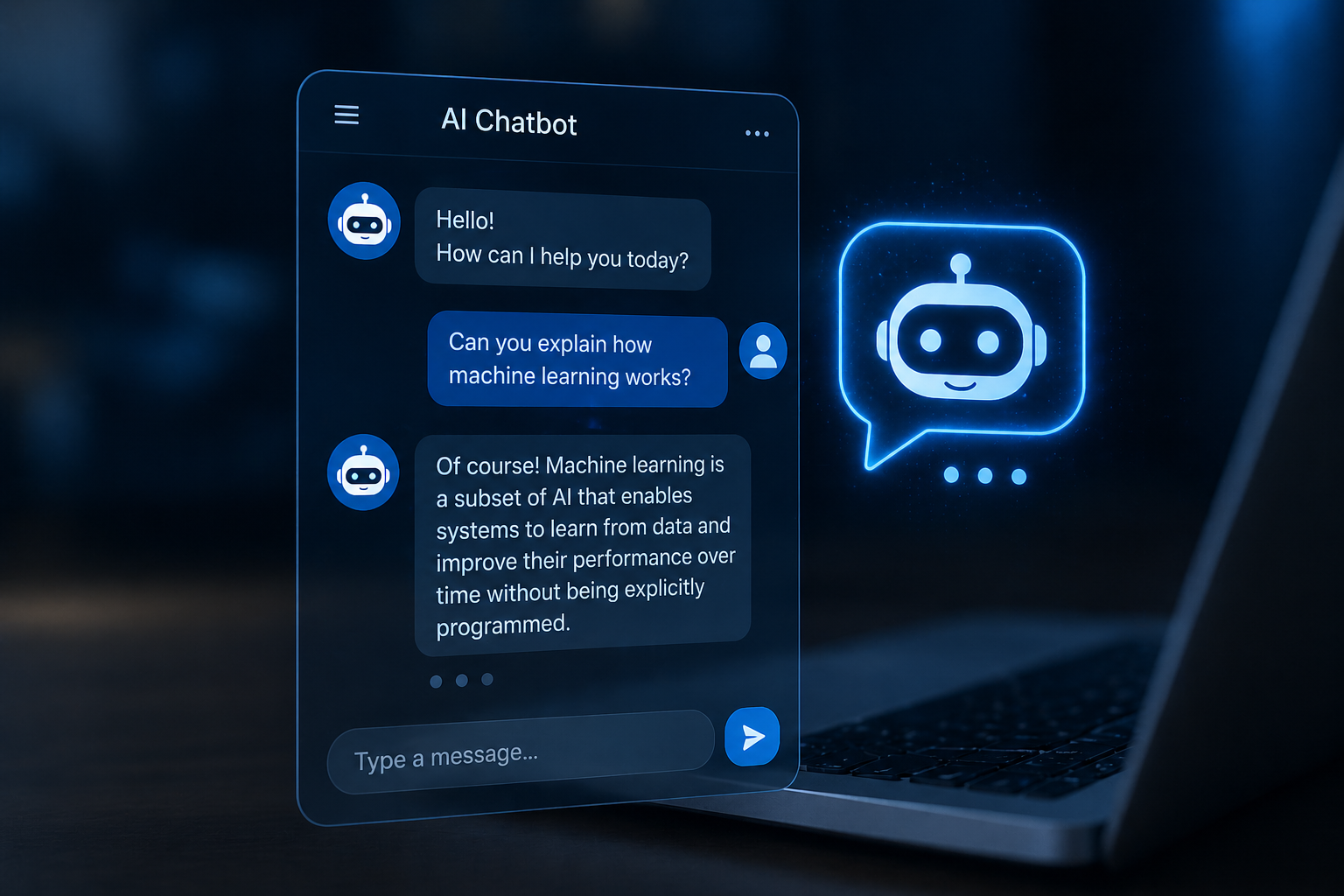
Artificial intelligence is changing how businesses handle customer service. AI-powered chatbots can answer questions, help customers complete tasks, retrieve information, and route more complicated problems to human agents.
Unlike older chatbots that relied heavily on fixed menus and scripted responses, newer AI systems can interpret natural-language questions and maintain more context during a conversation. Some can also connect to business systems and take actions, such as updating an account, booking an appointment, or helping with an order.
But the technology is not a replacement for human customer service in every situation. The most effective systems are increasingly designed to combine AI’s speed and availability with human judgment when an issue is complex, sensitive, or outside the system’s capabilities.
What Are AI Chatbots?
An AI chatbot is software that uses artificial intelligence to communicate with people through text or voice.
Traditional chatbots often depended on predefined rules. A customer might have to select from a menu or use specific phrases for the system to understand what they wanted.
Modern AI chatbots can use large language models and other AI technologies to interpret natural language and generate responses. Depending on how they are built, they may also retrieve information from a company’s knowledge base, use conversation history, or connect with other business systems.
This makes them considerably more flexible than older rule-based systems.
However, an AI-generated answer is not automatically correct. Modern AI systems can still misunderstand questions, provide incomplete information, or generate incorrect statements. NIST identifies this type of confidently stated but erroneous output as a significant generative-AI risk, commonly referred to as a hallucination or confabulation.
Businesses therefore need appropriate testing, monitoring, and safeguards.
How Are AI Chatbots Used in Customer Service?
Businesses use AI chatbots for a growing range of customer-service tasks.
Common examples include:
- Answering frequently asked questions
- Providing information about products and services
- Tracking orders and deliveries
- Helping customers with returns and refunds
- Scheduling appointments
- Assisting with account questions
- Guiding customers through troubleshooting
- Collecting information before a human agent takes over
- Summarizing customer interactions for support staff
- Routing requests to the appropriate department
The technology can be particularly useful for repetitive questions that have relatively straightforward answers.
More advanced systems are moving beyond simply providing information. Customers increasingly expect AI to help them complete tasks, such as submitting documents, changing account information, booking appointments, or managing a subscription.
A Gartner survey conducted in February and March 2026 found that 58% of customers who use GenAI had used it to complete a task on their behalf. Among B2B customers, that figure was 74%.
This represents an important shift from chatbots that simply answer questions toward AI systems that can help customers actually accomplish something.
Why Are Businesses Adopting AI Chatbots?
One of the biggest attractions is availability.
A chatbot can potentially handle customer requests outside normal business hours and respond to multiple customers simultaneously. This can be especially useful for businesses that receive large volumes of routine inquiries.
AI can also help human agents by taking care of repetitive tasks, retrieving information, summarizing conversations, and assisting with responses.
But the financial case is not automatic.
AI systems require development, integration, monitoring, security measures, maintenance, and ongoing evaluation. Businesses also need to consider what happens when an AI system gives a wrong answer or fails to resolve an issue.
Recent Gartner research illustrates this distinction. Service and support leaders reported increasing AI investment, but only 24% of surveyed leaders demonstrated positive financial returns across their AI use cases.
The lesson is simple: using AI does not guarantee lower costs or higher profits.
The value depends on whether the technology solves a real customer-service problem and whether it is implemented effectively.
What Are the Benefits for Customers?
When they work well, AI chatbots can make customer service more convenient.
Faster Responses
Customers do not necessarily have to wait for a support representative to become available for simple questions.
An AI system can respond almost immediately, allowing customers to resolve straightforward issues without waiting in a queue.
24/7 Availability
AI systems can provide assistance outside traditional business hours.
This can be particularly useful for businesses serving customers across different time zones or for people who need help when a company’s support department is closed.
Availability does not necessarily mean that every problem can be solved automatically, however. More complicated issues may still require human assistance.
Easier Access to Information
Instead of searching through multiple pages of a website, customers can ask a question in ordinary language and receive a direct response.
This can make information easier to find, particularly when a customer does not know the terminology used by the company.
Help With Routine Tasks
Modern AI systems can increasingly do more than answer questions.
When properly connected to business systems, they can help customers complete tasks such as scheduling appointments, submitting documents, managing subscriptions, or checking an order.
More Consistent Support
For straightforward questions with well-defined answers, an AI system can provide consistent information without requiring every customer to speak with a different representative.
However, consistency is only useful when the underlying information is accurate and up to date.
How AI Can Help Human Customer-Service Agents
AI is not only useful when customers interact with it directly.
Businesses can also use AI behind the scenes to assist human representatives.
For example, an AI system can:
- Find relevant information quickly
- Suggest possible responses
- Summarize previous conversations
- Identify the customer’s likely reason for contacting support
- Help organize customer information
- Translate or summarize conversations
- Identify relevant company policies
- Reduce time spent on repetitive administrative work
This can allow human agents to spend more time on problems that require judgment, empathy, negotiation, or detailed investigation.
Gartner reported in 2026 that 85% of surveyed customer-service and support leaders were expanding human-agent responsibilities as AI changed the nature of frontline work. Only 31% had implemented or were planning AI-driven frontline layoffs through the first quarter of 2027.
That suggests a more complicated future than simply “AI replaces customer-service workers.”
Personalization and AI Chatbots
AI can also make customer interactions more personalized when it has access to appropriate information.
For example, a system might use a customer’s previous interactions, account information, or current order status to provide more relevant assistance.
However, personalization comes with an important tradeoff: the more customer information an AI system uses, the more carefully that information needs to be handled.
Businesses need to consider what information is collected, why it is needed, how long it is retained, who can access it, and whether customers understand how their information is being used.
The Government of Canada recommends minimizing the collection of personal information in AI help applications and avoiding unnecessary retention or secondary use of information from customer conversations.
The Limitations of AI Chatbots
AI chatbots can be impressive, but they are not infallible.
Incorrect or Misleading Answers
Generative AI systems can sometimes produce information that sounds convincing but is incorrect.
In customer service, this can be especially problematic if a chatbot gives customers inaccurate information about prices, policies, refunds, accounts, or other important matters.
Businesses can reduce these risks through testing, controlled data sources, retrieval systems, monitoring, and clearly defined limits, but no system should be assumed to be perfect.
Complex Problems
Some customer issues require judgment or investigation that an automated system cannot perform reliably.
A customer disputing a complicated charge, dealing with a sensitive personal issue, or trying to resolve a problem that falls outside normal procedures may be better served by a human representative.
Emotional Situations
Customers who are angry, worried, grieving, or dealing with a serious problem may need empathy and discretion that automated systems cannot genuinely provide.
AI can recognize certain emotional signals, but recognizing an emotion is not the same as possessing human empathy.
Privacy and Security
Customer-service conversations can contain personal, financial, or other sensitive information.
AI systems therefore need appropriate security and privacy controls. Organizations also need to consider what information is sent to external AI providers and how that information is stored or processed.
NIST’s AI Risk Management Framework emphasizes managing risks associated with trustworthy AI, including privacy and other risks that can arise throughout the AI system lifecycle.
Customer Frustration
An AI chatbot becomes particularly frustrating when it repeatedly fails to understand the customer while preventing access to a human representative.
This is an important distinction: automation can reduce customer effort when it works, but increase customer effort when it becomes a barrier.
AI Chatbots vs. Human Customer Service
The question is not necessarily whether AI or humans are better.
Each has different strengths.
AI is well suited to fast responses, routine requests, information retrieval, and handling large volumes of interactions.
Human agents are better suited to complex problems, emotional situations, negotiation, unusual circumstances, and cases requiring judgment.
For many businesses, the strongest approach is therefore a hybrid model.
The AI can handle straightforward requests and gather relevant information. When the issue requires human judgment, the customer can be transferred to an agent with the relevant context already collected.
This can allow businesses to use automation without removing the human support customers still need.
Why Human Support Still Matters
Customers are becoming more comfortable with AI, but that does not mean they want AI to be the only way to receive support.
A Gartner survey of 3,566 B2B and B2C customers conducted in February and March 2026 found that 50% said their interactions were easier when companies used GenAI. At the same time, 87% said it was essential for companies using GenAI in customer service to provide an option to reach a human agent.
Gartner also found that customers are increasingly using third-party generative AI tools for service issues rather than company-provided chatbots. In its 2026 research, customers were approximately three times more likely to use third-party GenAI than a company chatbot during a service interaction.
This suggests that businesses cannot assume customers will automatically use the chatbot they provide.
The quality of the experience matters.
A good customer-service chatbot should not trap customers inside an automated system. If it cannot resolve the problem with reasonable confidence, it should make the next step clear.
Are AI Chatbots Replacing Customer-Service Jobs?
AI is changing customer-service work, but widespread replacement is not the only outcome.
Some routine tasks can be automated, which can reduce the amount of work that human agents need to perform. At the same time, companies may use those productivity gains to change what human employees do.
Human agents may increasingly handle escalations, complex cases, relationship management, quality control, AI oversight, and situations requiring judgment.
Gartner reported in April 2026 that 85% of surveyed service and support leaders were expanding human-agent responsibilities, while 31% had implemented or were planning AI-driven frontline layoffs through the first quarter of 2027.
The long-term effect will vary by industry, company, technology, and the types of tasks being automated.
The more likely near-term picture is not simply humans versus machines, but humans working with increasingly capable AI systems.
AI Chatbots Are Becoming More Action-Oriented
One of the biggest changes in customer-service AI is the shift from answering questions to taking actions.
An older chatbot might tell a customer where to find a return form.
A more advanced system could potentially identify the order, determine whether it qualifies for a return, initiate the process, and provide the customer with the next steps.
This is part of the broader shift toward AI agents and agentic systems that can interact with business software and perform tasks rather than simply generate text.
Gartner’s 2026 research identifies GenAI chatbots, voicebots, and agentic AI platforms among the technologies customer-service leaders expect to deliver significant value in the coming years.
That also introduces additional risks.
The more authority an AI system has to change accounts, issue refunds, access records, or perform other actions, the more important security controls, permissions, monitoring, and human oversight become.
What Does the Future of AI Customer Service Look Like?
AI chatbots are likely to become more deeply integrated into customer-service systems rather than remaining standalone website pop-ups.
Future systems may combine:
- Text-based AI chat
- AI-powered voice assistants
- Human-agent assistance
- Business databases
- Customer accounts
- Knowledge bases
- Automated workflows
- AI agents capable of completing tasks
Gartner reported in August 2026 that customer-service organizations had increased their AI spending by 38%, while overall service and support budgets increased by only 2%. The research also found that leaders expect GenAI chatbots, voicebots, and agentic AI platforms to become increasingly valuable.
But greater capability also means greater responsibility.
AI systems that can access business systems or act independently need strong security controls. Organizations need to know what an AI system is allowed to access, what actions it can take, and when human approval is required.
The future of customer service is therefore unlikely to be completely human or completely automated. It is more likely to involve increasingly capable AI working alongside people, with the balance depending on the complexity and sensitivity of the interaction.
How Should Businesses Use AI Chatbots Responsibly?
Businesses can improve the chances of a successful AI deployment by starting with problems the technology can reliably solve.
That means:
- Clearly defining what the chatbot can and cannot do
- Testing it before deploying it widely
- Using reliable and up-to-date information
- Monitoring its responses
- Protecting customer data
- Giving customers a clear way to reach a human
- Measuring successful resolutions rather than simply counting conversations
- Reviewing failures and improving the system
- Limiting AI access to sensitive systems when it is not necessary
Businesses should also avoid collecting more personal information than they actually need.
Government of Canada guidance for AI help applications recommends collecting only information necessary for the system to function and minimizing the amount of personal information sent to or retained by the AI service.
A smaller chatbot that reliably solves common problems can be more useful than a highly ambitious system that frequently fails.
The Bottom Line
AI chatbots are changing customer service, but the transformation is more nuanced than simply replacing human agents with machines.
Today’s systems can answer questions, retrieve information, personalize interactions, assist employees, and increasingly perform tasks on behalf of customers. They can make support faster and more accessible when they are deployed effectively.
But AI also brings limitations. Chatbots can provide incorrect information, misunderstand complicated requests, create privacy and security risks, and frustrate customers when there is no easy path to human support.
The strongest customer-service strategies are therefore likely to combine AI automation with human judgment.
AI can handle speed, scale, and routine work. People remain important when customers need empathy, accountability, flexibility, or complex problem-solving.
The real revolution may not be customer service without humans. It may be customer service in which AI handles more of the routine work while humans focus on the interactions where they add the most value.
Frequently Asked Questions
What is an AI chatbot?
An AI chatbot is software that uses artificial intelligence to communicate with people through text or voice and respond to their requests.
How are AI chatbots used in customer service?
They can answer questions, provide information, track orders, assist with returns, schedule appointments, troubleshoot problems, collect information, and route complicated issues to human agents.
What is the difference between traditional chatbots and AI chatbots?
Traditional chatbots often rely on predefined rules, menus, and scripted responses. Modern AI chatbots can use language models and other AI technologies to interpret natural-language requests and generate more flexible responses.
Are AI chatbots replacing human customer-service agents?
AI is automating some customer-service tasks, but it is not simply replacing all human agents. Many organizations are changing human roles so employees can focus on more complex tasks, escalations, and interactions requiring judgment.
What are the advantages of AI chatbots?
Potential benefits include faster responses, 24/7 availability, the ability to handle large numbers of routine requests, easier access to information, and assistance for human customer-service agents.
What are the disadvantages of AI chatbots?
They can produce inaccurate information, misunderstand complex questions, frustrate customers, create privacy and security concerns, and struggle with situations requiring human judgment or empathy.
Can AI chatbots understand every customer question?
No. Even advanced AI systems can misunderstand ambiguous, complex, or unusual requests. Businesses should provide a clear path to human support when the system cannot reliably resolve an issue.
Will AI chatbots become more advanced?
Yes. AI systems are increasingly moving from simple question-answering toward systems that can retrieve information, interact with business software, and complete tasks. However, increased capability also increases the need for security, privacy controls, testing, and human oversight.
Do customers prefer AI or human customer service?
It depends on the situation. Many customers appreciate the speed and convenience of AI for straightforward problems, but research shows that customers strongly value the ability to reach a human when AI cannot resolve an issue or when the situation is complex.
SOURCES: Gartner, “Gartner Survey Finds Customers Are 3x More Likely to Use Third-Party GenAI Than Company-Provided Chatbots for Customer Service” (2026); Gartner, “Gartner Survey Finds 85% of Service and Support Leaders are Expanding Human Agent Responsibilities Despite Expectations of Mass AI Layoffs” (2026); Gartner, “Gartner Survey Finds 87% of Customers Say Companies Using GenAI for Customer Service Must Provide Access to a Human Agent” (2026); Gartner, “Gartner Survey Finds AI Spending by Customer Service Leaders Has Surged by 38%, Despite Overall Service and Support Function Budgets Rising by Just 2%” (2026); NIST, Artificial Intelligence Risk Management Framework: Generative Artificial Intelligence Profile (2024); Government of Canada, “Privacy and security for AI help applications” and “Content guidance for AI help applications.