Quantum computers are not faster laptops. They will not replace the machine you are reading this on.
They use quantum states — superposition, entanglement, and interference — to run certain algorithms that ordinary computers handle poorly. Potential applications include chemistry and materials science, some types of factoring, and certain simulation problems. For almost everything else, classical computers remain the better tool.
Today’s machines are real and relatively small. They make errors. The useful question is not “when do they take over computing?” It is whether anyone can build enough reliable logical qubits to run those special algorithms at a scale that matters.
Bits and qubits
A classical bit is 0 or 1. Billions of them run websites, video, and the AI models already in use.
A qubit is a quantum system that can be measured as 0 or 1. Before measurement, its state can be written as α|0⟩ + β|1⟩. The probabilities of measuring 0 or 1 are |α|² and |β|², and they add up to 1.
With multiple qubits, the combined quantum state grows rapidly. n qubits can represent a state across 2ⁿ possible basis states. Two qubits have four possible basis states; 10 qubits have 1,024. But that does not mean a quantum computer gives you 1,024 answers when you measure it. You only get a limited classical result. A useful algorithm has to manipulate the quantum state so that the right answer becomes more likely to appear.
Superposition, entanglement, interference
Superposition allows a qubit to exist in a combination of possible states before measurement.
Entanglement creates correlations between qubits that cannot be described as independent classical objects. It is an important resource in quantum algorithms, but it does not allow information to travel faster than light.
Interference is what allows a quantum algorithm to favor useful outcomes. Quantum amplitudes can reinforce or cancel one another, allowing a well-designed circuit to increase the probability of the desired answer while suppressing others. More qubits without an effective algorithm do not automatically make a quantum computer more powerful.
How a run actually works
Prepare the qubits. Apply gates. Measure. A normal computer sets the problem up and reads the result. The quantum chip is a specialist in the middle, not a new operating system.
Why the hardware is hard
Quantum states are fragile. Heat, stray fields, and defects can disturb a qubit and cause errors. This loss of quantum information is known as decoherence. Classical computers also deal with noise, but quantum systems are much more sensitive to it.
Error correction encodes one logical qubit across many physical qubits so errors can be detected and corrected without directly measuring the quantum information being protected. The tax is steep. A machine that matters is measured in logical qubits and error rates, not just in a press-release qubit count.
A fault-tolerant machine is designed to keep producing reliable results even when individual components experience errors. That is the milestone the field is actually chasing. Today’s devices are noisy. They can run useful experiments and short circuits, but errors still limit their scale.
The fridge and the other boxes
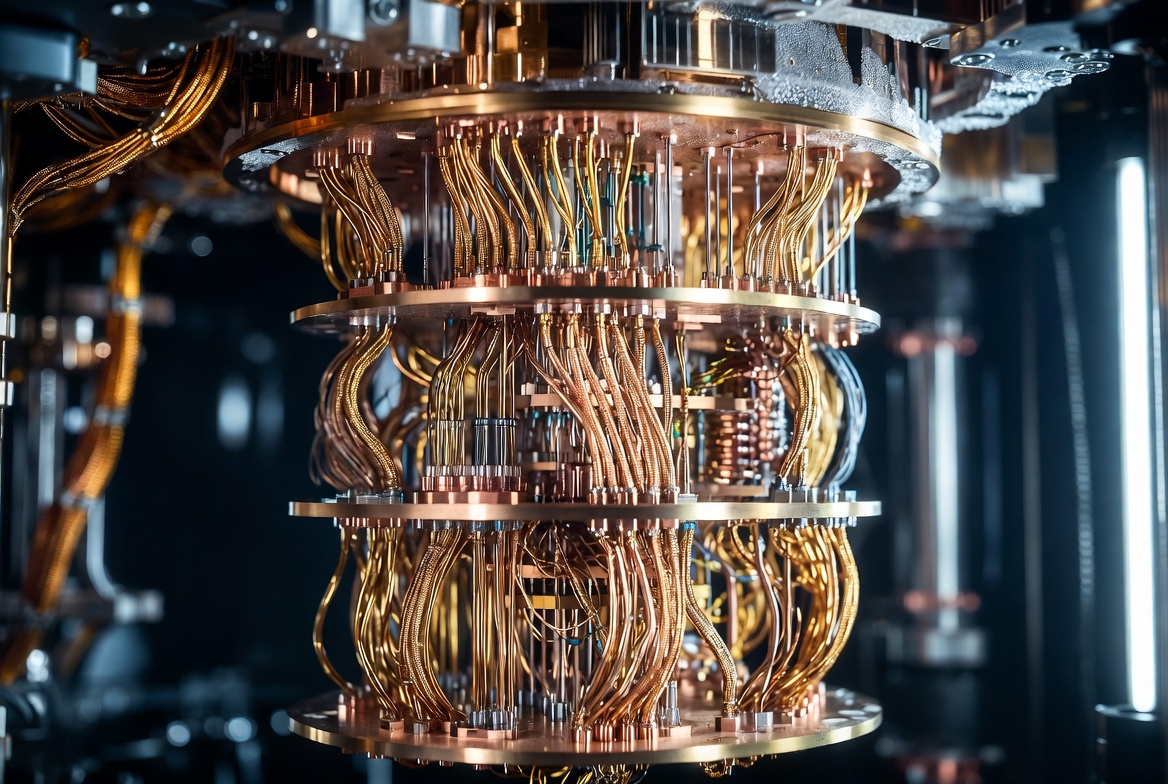
There are several competing ways to build quantum computers. Superconducting circuits operate near absolute zero, where their materials can exhibit the quantum behavior needed to function as qubits. Trapped-ion systems use electromagnetic fields and lasers to control charged atoms. Neutral-atom systems use lasers to arrange and manipulate atoms, while photonic systems use particles of light. No single approach has won yet, and each comes with its own engineering challenges.
The algorithm that changed cybersecurity
In 1994, Peter Shor showed that a sufficiently powerful quantum computer could factor large integers efficiently. That matters because many public-key encryption systems rely on the difficulty of factoring or related mathematical problems. It is one reason governments and cybersecurity organizations are moving to post-quantum cryptography now.
Today’s quantum computers are nowhere near powerful enough to use Shor’s algorithm to break real-world internet encryption at a practical scale. The concern is what a future fault-tolerant machine could do, not what today’s machines can do. Passwords stored as hashes are a different problem, so it is misleading to simply say that “quantum computers break passwords.”
What they might be for
Simulating molecules and materials is one of the clearest potential applications of quantum computing. Nature itself follows quantum mechanics, and accurately simulating complex quantum systems can become extremely difficult for classical computers as those systems grow. A sufficiently powerful quantum computer could eventually help researchers study chemistry, materials, drugs, and other problems at the molecular level.
Optimization and “quantum machine learning” are also being researched, but neither has yet established a broad practical advantage over classical computing. GPUs already handle the machine-learning workloads that power much of today’s AI. Quantum processors are more likely to become specialized tools for particular problems than replacements for GPUs or other conventional hardware.
Timelines
In June 2026, the U.S. Department of Energy announced Quantum Genesis, with a 2028 target for a scientifically useful fault-tolerant capability. That is a program goal, not a delivered computer. Treat it as a development target, not a calendar guarantee.
Labs and companies already allow researchers to run jobs on small quantum processors. That is real use, but it is not yet the same as having a practical commercial advantage.
Bottom line
A quantum processor is a specialist working alongside classical machines. It becomes useful only when the right algorithm can be run with enough reliable logical qubits. Until the error-correction challenge is solved at scale, a large physical-qubit count is a research milestone, not proof of a computing revolution.
The realistic future is not “quantum replaces computing.” It is classical machines handling almost everything, with quantum processors taking on the smaller number of problems where their unique physics provides an advantage.
SOURCES: Shor (1994); NIST on post-quantum cryptography and quantum information; IBM Quantum learning materials; U.S. Department of Energy, Quantum Genesis announcement (June 2026); standard reviews of quantum error correction and hardware platforms (superconducting, trapped-ion, neutral-atom, photonic).