Large language models can answer questions, write articles, generate code and analyze information in seconds. But behind that convenience is a physical infrastructure that consumes electricity, requires cooling and depends on enormous data centers.
That has created a growing question around artificial intelligence: How much does using AI actually cost the environment?
The answer is more complicated than saying that every AI prompt consumes a certain amount of electricity or water.
The environmental impact of large language models depends on the model, the hardware running it, the data center where the computation takes place, the electricity supplying that facility, the cooling system it uses and even the type of task being performed.
And while AI systems are becoming dramatically more efficient, demand for them is growing at an extraordinary pace.
Why AI uses so much energy
Large language models require powerful computer chips to perform their calculations.
During training, enormous amounts of data are processed repeatedly to adjust the model’s parameters. This can require large clusters of specialized processors operating for extended periods.
But training is only part of the story.
Once a model has been released, every request from a user requires computing resources. This process is commonly called inference.
A simple question may require relatively little computation compared with training a model. More demanding tasks, however, can require substantially more processing.
Reasoning systems that perform multiple steps before producing an answer, AI agents that interact with other software and video-generation models can be particularly demanding.
That means there is no single number that represents the energy cost of “using AI.”
Data centers are the physical foundation of AI
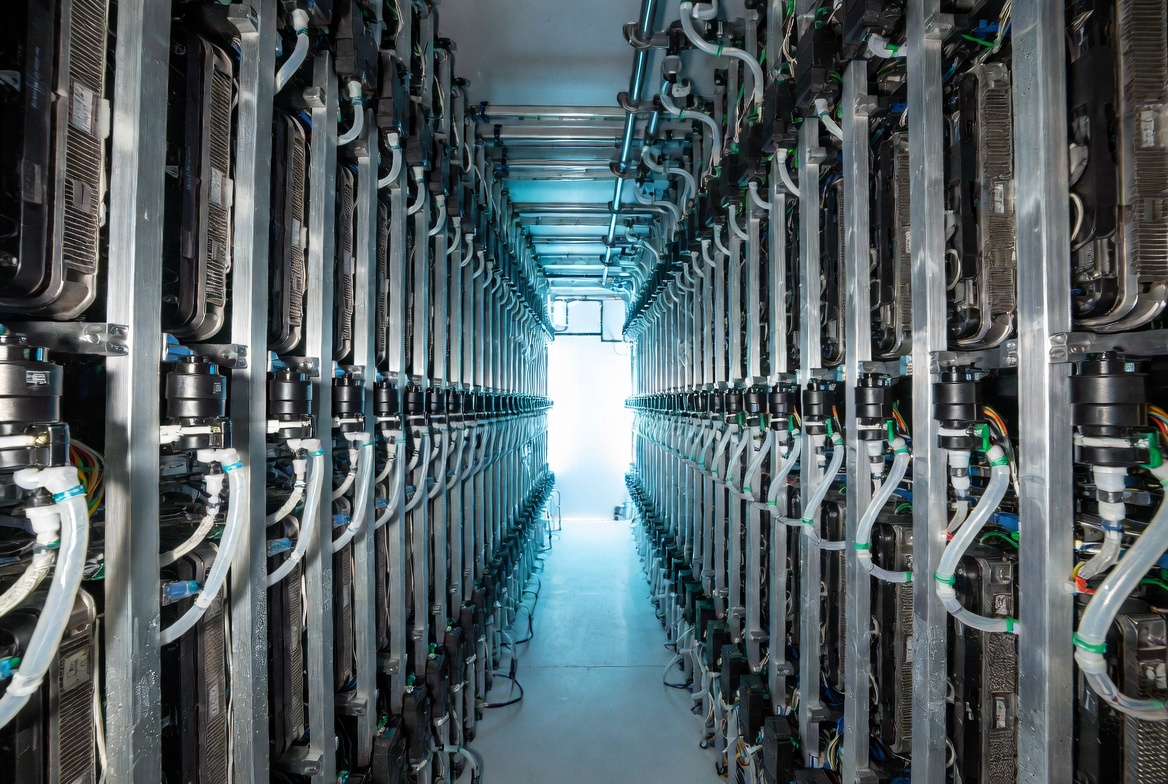
Large language models do not run in the cloud in an abstract sense.
They run on physical servers inside data centers.
Those facilities consume electricity not only for the processors performing computations, but also for memory, networking, storage, power equipment and cooling systems.
The International Energy Agency estimates that data centers consumed about 415 terawatt-hours (TWh) of electricity worldwide in 2024, equivalent to around 1.5% of global electricity consumption.
The IEA expects global data-center electricity consumption to more than double to around 945 TWh by 2030 in its base case. AI is expected to be one of the most important drivers of that growth.
That does not mean AI itself is responsible for all of that electricity.
Data centers also host cloud computing, websites, enterprise software, storage and many other services. But the rapid construction of AI-focused computing infrastructure is becoming an increasingly important source of new electricity demand.
AI’s electricity footprint is growing even as chips become more efficient
There is an important contradiction at the heart of the AI energy debate.
Computing is becoming more efficient.
Hardware manufacturers are developing more powerful processors that can perform more calculations using less energy per operation. Software developers are also improving models and inference systems so that individual tasks can require less computation.
But people are using AI much more frequently.
That creates a potential rebound effect: efficiency can improve while total energy consumption still rises because demand grows faster than efficiency.
The IEA expects data-center electricity consumption to grow by roughly 15% per year between 2024 and 2030 in its base case, substantially faster than overall electricity demand.
So saying that AI is becoming “more efficient” does not necessarily mean its overall environmental footprint is shrinking.
It can mean that we are getting substantially more computing for every unit of electricity while simultaneously using vastly more computing.
How much electricity does one AI prompt use?
This is where many explanations become misleading.
You will sometimes see a precise figure attached to a single AI query, but such numbers should be treated cautiously.
The energy required can change depending on the model, the length of the input and output, the hardware being used, the efficiency of the data center and what the model is actually doing.
A short request to summarize a sentence is not equivalent to asking an AI system to perform a long reasoning task, analyze a large collection of documents or generate a video.
Even within the same data center, workloads can have very different resource requirements.
The most useful conclusion is therefore not that every AI question consumes a particular amount of electricity.
It is that AI workloads have an energy cost, and that cost can vary substantially depending on what the system is being asked to do.
Why AI data centers use water
Electricity is only part of the environmental equation.
Many data centers also require significant cooling.
Computer processors generate heat as they operate. If that heat is not removed, equipment can become less efficient or suffer damage.
One common approach is evaporative cooling, which can consume water as heat is transferred away from the equipment.
But not every data center uses the same cooling technology.
Some facilities rely heavily on air cooling. Others use chilled-water systems, cooling towers or increasingly sophisticated liquid-cooling systems designed for high-density AI hardware.
The local climate also matters.
A data center in a cool region may have very different cooling requirements from one operating in a hot or humid environment.
There isn’t one universal “water footprint” for AI
This is one of the most important points to understand.
Claims that an AI prompt always consumes a specific number of milliliters or liters of water can create a false sense of precision.
Research from Lawrence Berkeley National Laboratory found that workload-level water consumption can vary by more than 10,000-fold, driven by major differences in water consumption per unit of electricity and differences in the efficiency of the computing workload itself.
Water use can depend on:
- The cooling technology used by the data center
- Local temperature and climate
- The source of the electricity
- The efficiency of the servers
- The efficiency of the workload
- Whether water is withdrawn, consumed or returned to the environment
- The location where the computing takes place
This is why a single global “water cost per prompt” is not a particularly useful way to describe AI’s environmental impact.
Electricity can have a water footprint too
There is another layer that is easy to overlook.
A data center can consume water directly for cooling, but the electricity supplying it can also have an indirect water footprint.
Some forms of electricity generation require water for cooling and other processes.
That means the environmental impact of AI cannot always be understood simply by looking at how much water a data center uses on site.
The electricity source matters as well.
Two data centers performing identical AI workloads could therefore have different environmental footprints depending on their cooling systems, local conditions and electricity mix.
What about carbon emissions?
Electricity consumption does not automatically translate into a fixed amount of carbon dioxide.
The emissions associated with running an AI model depend heavily on how the electricity was generated.
A data center powered largely by low-carbon electricity can have a substantially different operational emissions profile from one relying heavily on coal or natural gas.
The IEA estimates that data centers currently account for a relatively small share of global energy-related emissions, but their rapid growth makes the electricity sources used to supply them increasingly important.
There are also emissions associated with manufacturing servers, processors and other infrastructure.
So the environmental footprint of AI extends beyond the electricity consumed while a model is answering a question.
The U.S. is facing a particularly large data-center expansion
The issue is especially visible in the United States, where AI infrastructure is expanding rapidly.
A 2025 update from Lawrence Berkeley National Laboratory estimates that U.S. data centers could account for 11.8% of total U.S. electricity consumption by 2030, with a projected range of 9.5% to 15.3% depending on how the industry develops.
The lab’s earlier analysis found that U.S. data-center electricity consumption had already risen from 58 TWh in 2014 to 176 TWh in 2023. It estimated that consumption could reach between 325 and 580 TWh by 2028.
These figures cover data centers broadly, not AI alone.
But the rapid growth of AI servers has been an important contributor to the increase.
That can create challenges for local electricity grids, particularly in regions where several large facilities are being built at once.
Can AI become more environmentally friendly?
Yes.
There are several ways to reduce the environmental impact of AI.
More efficient processors can perform more work using less electricity. Smaller or specialized models can sometimes accomplish a task without requiring the resources of a much larger system.
Data centers can also improve cooling efficiency, use less water-intensive technologies and locate facilities where environmental conditions make cooling easier.
Electricity generation matters as well. Increasing the use of renewable energy and other low-carbon sources can reduce the emissions associated with the electricity consumed by data centers.
The IEA expects renewable energy to provide a substantial portion of the additional electricity needed by data centers through 2030, although natural gas, nuclear power and other sources will also contribute depending on the region.
The real environmental question is scale
It is easy to focus on whether one person asking an AI a question has a meaningful environmental impact.
At an individual level, a single text interaction is generally a very small event compared with the total energy consumption of society.
The larger question is what happens when billions of interactions, increasingly powerful models and entirely new AI applications are combined.
AI is moving beyond simple chat.
People are using models for coding, research, image generation, video creation, reasoning and autonomous tasks. Some of these applications require considerably more computation than a short text response.
At the same time, AI companies are building increasingly large data centers to support that demand.
That creates a situation where efficiency improvements and environmental growth can happen at the same time.
A model can become far more efficient per task while the overall industry consumes more electricity because there are vastly more tasks being performed.
So, is AI bad for the environment?
There is no simple yes-or-no answer.
Large language models and other AI systems have a real physical footprint. They require electricity, computing hardware, data centers and cooling infrastructure. Some facilities consume significant amounts of water, and the emissions associated with their electricity depend partly on the energy sources supplying them.
But some of the most dramatic claims about AI’s environmental impact oversimplify a complicated system.
There is no universal amount of water used by every AI query. There is no single electricity figure that applies to every model or task. And not all data-center electricity consumption can be attributed to AI.
What can be said with much greater confidence is that AI is contributing to rapidly growing demand for data-center infrastructure, while improvements in computing efficiency are helping determine how large that footprint ultimately becomes.
The environmental story of AI is therefore not simply about how much energy one prompt consumes.
It is about what happens when increasingly efficient machines are used at an increasingly enormous scale.
SOURCES: International Energy Agency, Energy and AI (2025); Lawrence Berkeley National Laboratory / U.S. Department of Energy, 2024 United States Data Center Energy Usage Report and 2025 Update (2026); Lei et al., Resources, Conservation and Recycling (2025).