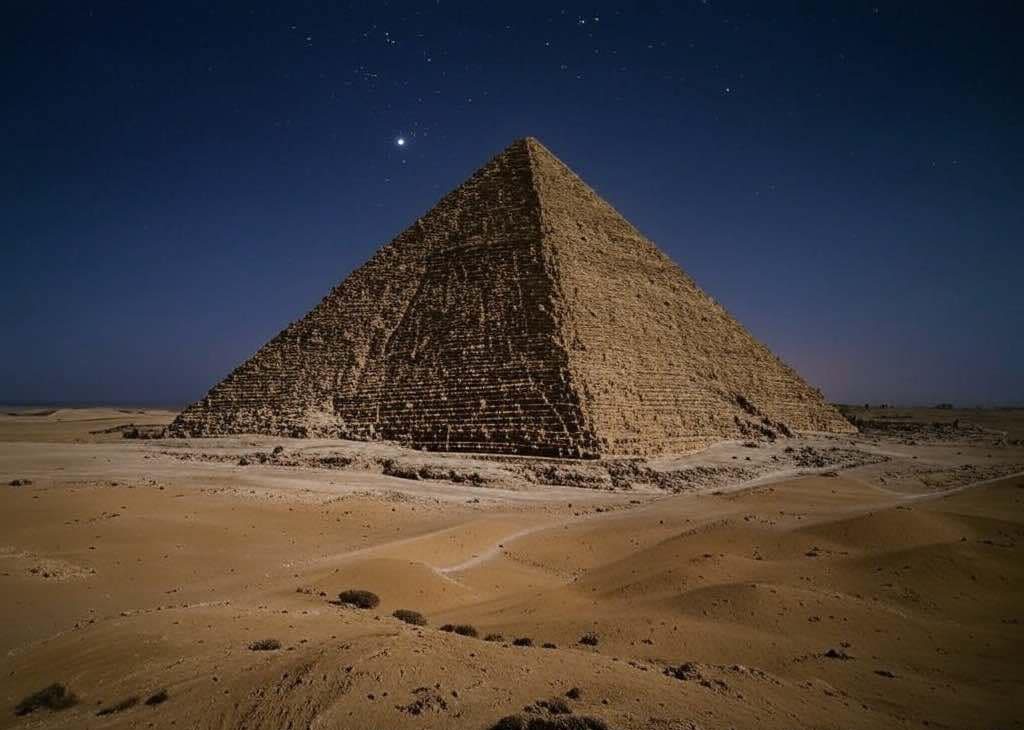
Imagine this: Cleopatra, the iconic queen of Egypt who lived around 30 BCE, was closer in time to us today—about 2,055 years—than she was to the construction of the Great Pyramid of Giza, built around 2630 BCE. That’s a staggering gap of roughly 2,600 years between the pyramid’s creation and Cleopatra’s reign. This simple fact alone hints at the profound antiquity of these monumental structures, yet their mysteries stretch far beyond their age. The pyramids of Egypt, particularly the Great Pyramid, have long captivated historians, archaeologists, and curious minds alike. While mainstream history offers a compelling narrative about their construction, mounting evidence—like the puzzling signs of water erosion—suggests that these wonders might be far older and more enigmatic than we’ve been taught.
The traditional story, widely accepted by Egyptologists, places the construction of the Giza pyramids during the Fourth Dynasty of the Old Kingdom, roughly between 2630 and 2500 BCE. Pharaohs like Khufu, Khafre, and Menkaure are credited with commissioning these massive tombs, built with astonishing precision using limestone and granite blocks. The Great Pyramid, standing at 481 feet tall, was the tallest man-made structure in the world for nearly 4,000 years. Egyptologists argue that thousands of workers, using ramps, levers, and sheer manpower, hauled millions of stones into place over decades. The evidence? Ancient texts like the Merer Diary, discovered in 2013, which details the transport of limestone blocks to Giza during Khufu’s reign, and the alignment of the pyramids with the cardinal points, suggesting advanced astronomical knowledge.
But here’s where the mystery deepens. If the pyramids were built in a dry, arid climate around 2600 BCE, why do some of their features hint at a much wetter past? The Sphinx, sitting proudly beside the Giza pyramids, offers a tantalizing clue. Geologist Robert Schoch, after studying the Sphinx’s enclosure in the 1990s, pointed to deep vertical fissures and undulating patterns in the limestone—marks he argues are consistent with heavy rainfall and water erosion. Mainstream climate research indicates that the African Humid Period began around 14,500 years ago and gradually ended across different parts of North Africa, with the Sahara transitioning toward its modern arid climate roughly 5,000 years ago. This means the transition toward modern arid conditions occurred thousands of years before the construction of the Great Pyramid. Could the Sphinx, and perhaps the pyramids themselves, predate the Fourth Dynasty by millennia?
This theory isn’t without its skeptics. Egyptologists counter that the erosion could be the result of occasional rains over thousands of years or even chemical weathering from morning dew. Yet Schoch’s observations aren’t easily dismissed. The patterns he identified resemble those found in regions exposed to prolonged water flow, not sporadic desert storms. If he’s right, the Giza plateau might have been a very different place when these structures were built—a lush, green landscape rather than the barren desert we know today.
The pyramids themselves add fuel to the mystery. The Great Pyramid’s construction is a marvel that still baffles engineers. Its base covers 13 acres, and its sides are aligned to within 0.015% of true north—precision that seems almost impossible without modern tools. Some researchers, like engineer Christopher Dunn, have suggested that the pyramid’s internal chambers, such as the King’s Chamber, show signs of machining or advanced technology. While mainstream archaeology attributes this to skilled craftsmanship, the sheer scale and accuracy raise questions: Could a civilization from 2600 BCE—or earlier—have possessed knowledge we’ve yet to fully understand?
Then there’s the question of purpose. Were the pyramids really just tombs? No mummies have ever been found inside the Great Pyramid, and its internal design—narrow shafts pointing to specific stars like Orion’s Belt—hints at a possible astronomical or ceremonial function. Alternative theories propose that the pyramids could be relics of a lost civilization, perhaps linked to the mythical Atlantis or a pre-dynastic culture erased by time. While these ideas stray into speculation, the water erosion evidence keeps the door open to a timeline that challenges the history books.
So, how mysterious are the pyramids, really? They stand as silent witnesses to a past we’re still piecing together. The traditional narrative offers a solid foundation, backed by texts and archaeological finds, yet anomalies like the Sphinx’s erosion suggest there’s more to the story. Were they built by Khufu’s workers under a scorching desert sun, or do they whisper of an older, wetter world—a time when the Nile Valley thrived in ways we can scarcely imagine? Until we unearth more evidence, the pyramids remain one of humanity’s greatest enigmas, daring us to look beyond the sands of time.
SOURCES: Mark Lehner, Miroslav Verner, Robert Schoch, Christopher Dunn, Toby Wilkinson, NOAA National Centers for Environmental Information, Timothy M. Shanahan, Glen Dash, Pierre Tallet.