Rock salt does not heat the ice. It makes a brine that freezes colder than water, and that brine has a floor. On a real driveway or road, ordinary sodium chloride becomes a poor bet around –9°C, although published working-temperature ranges extend lower depending on conditions, application and the standard being used.
The bag most people buy is sodium chloride. In a lab, a perfect mix of that salt and water can stay liquid down to about –21°C. That laboratory floor is called the eutectic point. It is not the temperature at which pavement clears. Winter-maintenance guidance generally treats untreated rock salt as increasingly slow and less effective as pavement temperatures fall, with published working ranges extending to roughly –15°C depending on conditions, application and the standard being used. A Canadian road-salt assessment listed a working band of roughly 0°C to –15°C.
The two figures get sold as if they were the same. They are not. The eutectic number is the coldest a brine can exist in ideal conditions. The working temperature is the coldest pavement can be at which the product still melts ice fast enough to be worth spreading.
Salt does not burn a hole through ice. A few crystals dissolve into a thin wet film — leftover melt, damp air, or water from a tire. That mix is brine, and brine freezes colder than pure water, so more ice turns to liquid and more salt dissolves. The loop needs salt, a bit of liquid, and enough heat in the pavement to keep going. On dry, bitter-cold pavement there is often no film. The crystals bounce or blow off. A second bag does not create that moisture.
As temperatures fall below –9°C, dry salt becomes progressively slower and less effective, and below its practical working range it may do almost nothing before the next footstep. Sodium chloride also takes heat from the pavement when it dissolves. Calcium chloride releases heat when it dissolves. That is why the more expensive bags still work after cheap rock salt has stalled. It is not a slogan. It is the heat of solution.
The radio temperature is the wrong number. Air can sit at –6°C while a bridge deck is already colder. Air can sit at –12°C while a dark driveway in the sun is still warm enough for brine. Salt follows the surface, which is why crews spray brine or pre-wet salt before a storm. It is easier to stop ice from bonding than to break a bond that has already set.
Hardware-store blends that claim –30°C are often cheap rock salt with a little calcium chloride or magnesium chloride mixed in. Read the first ingredient. If it is sodium chloride, treat the bag as rock salt. Calcium chloride’s laboratory floor is about –51°C and it still works in the field well below rock salt’s range, often near –25°C to –29°C. Magnesium chloride sits between the two; manuals usually put its useful band colder than rock salt and not as far down as calcium chloride. Sand melts nothing. It only adds grip.
Brine — typically about 23 percent salt in water — is already liquid, so it does not wait for a film. That is why it is useful for anti-icing in the band where sodium chloride still works. Colder than that band, crews change the chemical in the tank. A stronger sodium-chloride mix will not fix it.
Municipal crews and private contractors use the same chemistry, but not for the same reason.
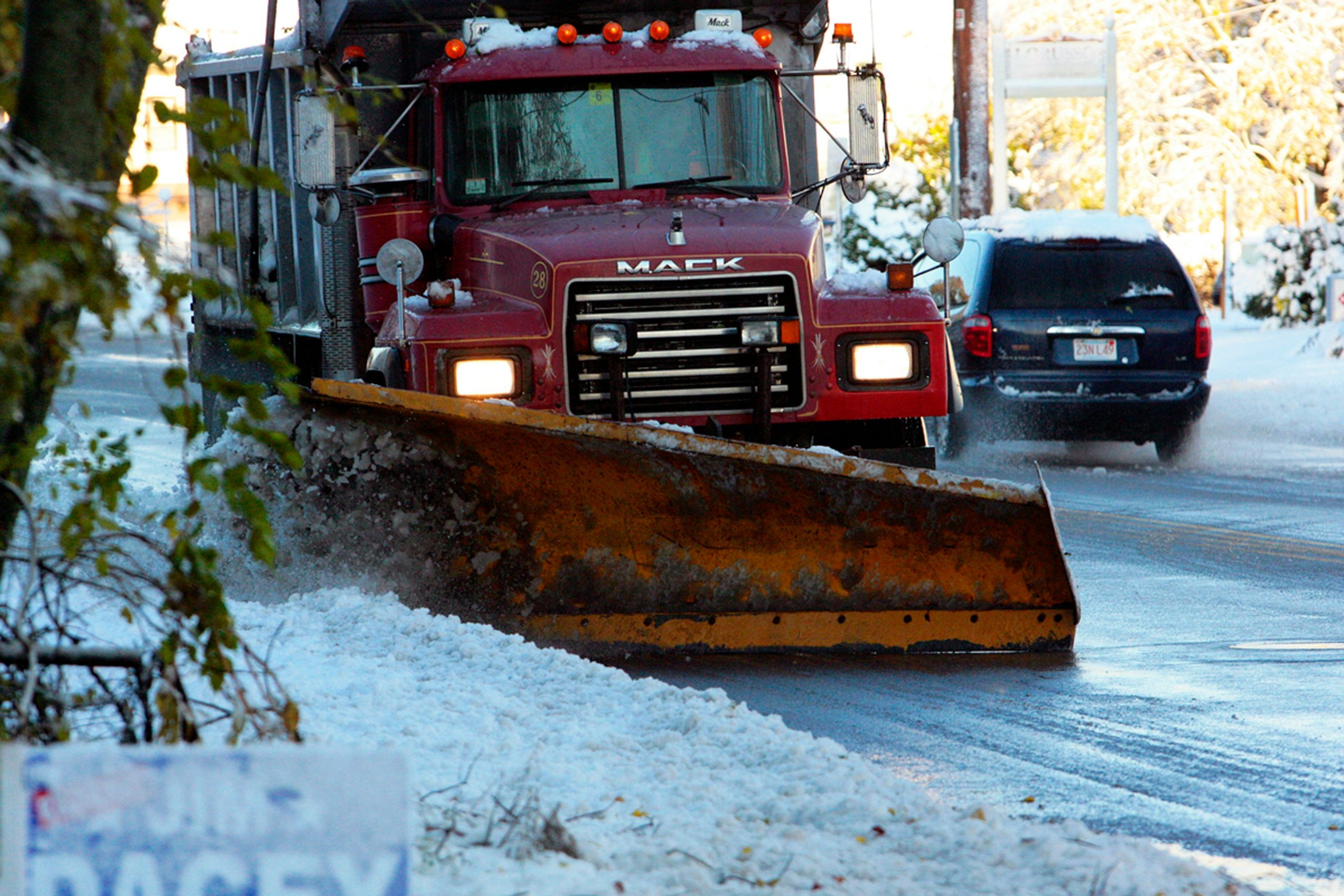
A city or county is trying to keep a classified road inside a winter standard: bare pavement on some routes, snow-packed but passable on others, within a set number of hours after the storm. The usual tools are rock salt, pre-wet salt, salt brine, and sand. Many Canadian agencies still treat untreated salt as the default while pavement is in the milder band — often around –8°C to –10°C — then lean on sand or a treated mix when it is colder, because the salt will not stay and melt. Brine goes down before the storm on bridges and known frost spots so ice never bonds. That is anti-icing. Salt after the ice is already glued to the asphalt is de-icing.
The public truck is also trying not to throw chloride into streams for no gain. Environment Canada’s road-salt work has encouraged better salt-management practices, including pre-wetting and improved spreader calibration. More salt on a –20°C night does not buy a better standard. It buys rusted trucks and spring complaints about the ditch.
Private contractors on driveways, plazas, and apartment lots are usually selling a different product: nobody falls. Their customers and contracts may place greater emphasis on keeping surfaces safe and documenting treatment than on the eutectic point. That is why a plaza can look white with salt when the city street beside it has already switched to sand. The contractor is often using the same rock salt. They are just less willing to leave ice on the ground while they wait for the chemistry to work. In a cold snap, or when rock salt is short, they mix sand in — not because sand melts, but because grit is the only thing that still changes traction.
Same phase diagram. Different boss. The city is measured on a maintenance standard and a salt budget. The contractor is measured on a slip-and-fall. Neither can make sodium chloride work below its floor. They can only choose, once that floor is crossed, whether to change chemical or to throw sand and say the surface was treated.
You cannot make sodium-chloride brine freeze colder than its eutectic by dumping more crystals. Past the useful mix they just sit there. Extra salt costs more, rusts more, and sends more chloride into ditches and wells. Environment Canada assessed road salts as a risk to freshwater life and roadside plants. The chloride does not vanish.
Shovel first. Salt is for the film a shovel could not break, not for a packed slab. If the pavement is below rock salt’s working range, either switch to a product whose working temperature matches that surface or use sand or another traction material. Highway practice in parts of Ontario follows the same split: salt or pre-wet salt while it still works, sand when it is too cold for salt to stay and melt.
Black ice after a thaw is a film that refroze. Salt that worked at noon can be useless at 2 a.m. if the surface dropped through the floor. Chlorides also attack rebar and concrete pads. That is a separate problem from whether the bag still melts.
The short version is the phase diagram, not the scoop. Salt works by making brine. For the rock salt most people buy, practical performance falls sharply around –9°C, even though the ideal brine has a eutectic point near –21°C. Colder than that, change the chemical or use grit. More of the same salt will not change the physics.
SOURCES: Environment Canada / Health Canada, Priority Substances List Assessment Report for Road Salts; National Research Council of Canada, CBD-191 Chemicals for Snow and Ice Control Around Buildings; Conservation Ontario, salt and winter-maintenance guidance; municipal winter operations pages; winter-maintenance eutectic versus effective temperature guides; phase-diagram references for sodium chloride brine.