Imagine walking across a perfectly ordinary patch of ground when, without any obvious warning, the surface suddenly gives way.
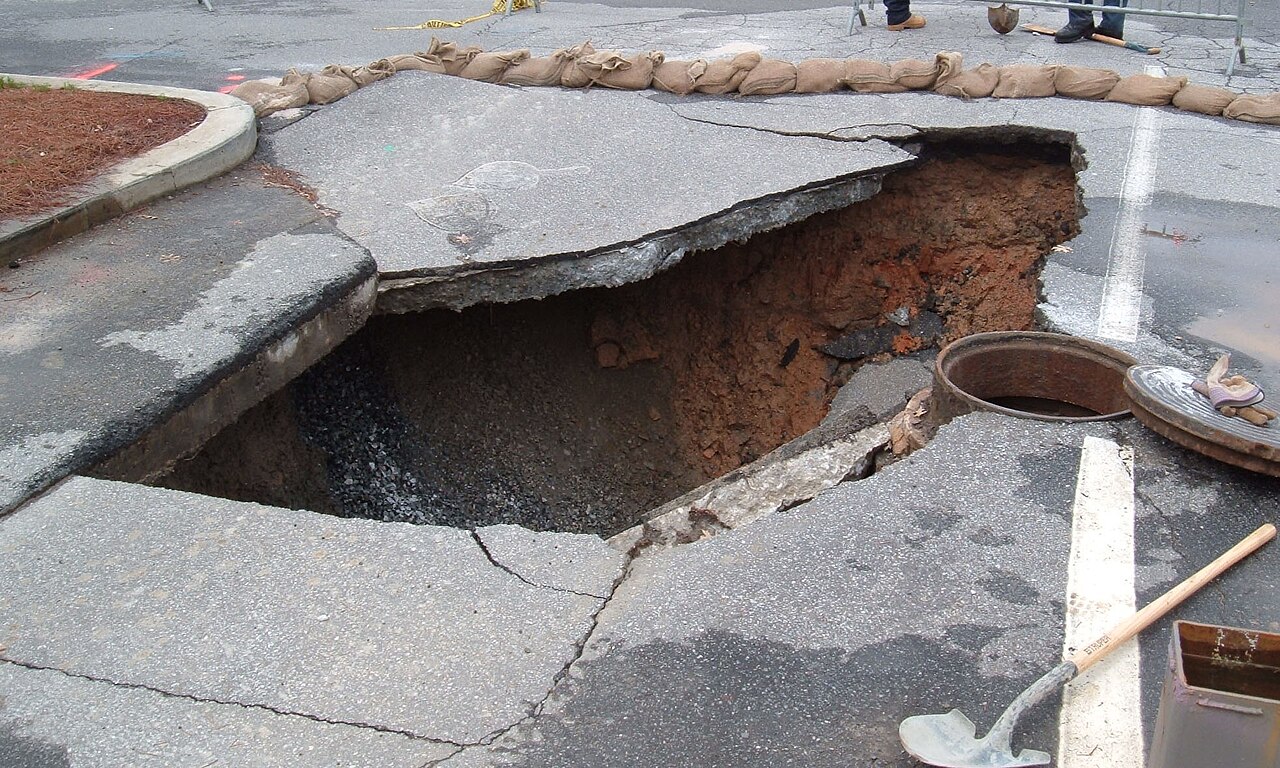
A road disappears into a deep hole. Part of a backyard collapses. In extreme cases, entire sections of buildings can be swallowed by the earth.
These events can seem almost impossible. The ground beneath our feet feels solid and permanent, so how can it suddenly disappear?
The answer often lies in a process that has been happening quietly underground for years, decades, or even centuries.
These collapses are commonly associated with sinkholes, a geological phenomenon that reveals just how much can be happening beneath a seemingly stable surface.
What Exactly Is a Sinkhole?
A sinkhole is a depression or hole in the ground caused by the movement or collapse of material beneath the surface.
Some sinkholes develop slowly, creating shallow depressions that grow over time. Others appear suddenly when the ground above an underground cavity can no longer support its own weight.
Sinkholes vary enormously in size. Some are only a few feet across, while others can reach hundreds of feet in diameter.
Although dramatic collapses attract the most attention, not every sinkhole forms in a single catastrophic event.
Many develop gradually through natural geological processes that are largely invisible from above.
The key to understanding them is recognizing that the ground beneath us is not always as solid as it appears.
How Water Can Make Solid Ground Disappear
One of the most common natural causes of sinkholes is something surprisingly ordinary: water.
Rainwater absorbs carbon dioxide from the atmosphere and soil, making it slightly acidic. As this water moves underground, it can gradually dissolve certain types of rock.
Limestone is particularly vulnerable, although other soluble rocks, including gypsum and salt, can also be affected.
Over long periods, this process can enlarge natural cracks and fractures, creating underground channels, cavities, and drainage systems.
Geologists call landscapes shaped by the dissolution of soluble rock karst terrain.
These landscapes can contain caves, underground streams, disappearing rivers, and sinkholes.
The process is usually extremely slow. A cavity may develop beneath the surface without producing any visible change above it.
Eventually, however, the material covering that cavity may become unstable.
If the roof of the cavity or the soil above it can no longer support the weight overhead, the ground can collapse.
What looks like a sudden disaster at the surface may actually be the final stage of a geological process that began long before anyone noticed a problem.
Why Some Sinkholes Appear Almost Instantly
Not all sinkholes form in the same way.
Scientists generally distinguish several types based on the geology and the processes involved.
Dissolution sinkholes form where soluble bedrock is exposed or covered by relatively thin soil. Water gradually dissolves the rock, producing depressions that may develop slowly.
Cover-subsidence sinkholes occur when loose sediment gradually moves downward into openings in the rock below. The surface may sink over time, sometimes so slowly that the changes are difficult to notice.
Cover-collapse sinkholes can be much more dramatic.
These occur when a layer of cohesive soil, often containing clay, temporarily bridges an underground opening.
As material beneath it erodes or falls away, the unsupported layer becomes increasingly unstable.
Eventually, the remaining soil can fail, causing a sudden collapse at the surface.
This explains why a location can appear perfectly normal shortly before a sinkhole opens.
The underground support may already be severely weakened even though the surface shows few obvious signs of trouble.
Can Human Activity Trigger a Sinkhole?
Although sinkholes are natural geological features, human activities can sometimes contribute to their formation.
Changes to underground water conditions are especially important.
Groundwater helps support and stabilize certain underground materials. When large quantities of water are pumped from the ground, changes in water levels and underground pressures can contribute to instability in susceptible areas.
Construction and changes to surface drainage can also alter how water moves through the soil.
For example, directing large amounts of stormwater into a concentrated area may accelerate erosion or the movement of sediment into underground openings.
Leaking water pipes and damaged sewer systems can wash away soil beneath roads, sidewalks, and buildings.
These failures may produce collapses that resemble natural sinkholes, even when the underlying mechanism is different.
This distinction matters.
Not every sudden hole in the ground is a geological sinkhole.
Some collapses are caused by broken infrastructure, abandoned underground structures, mining activity, or other forms of subsurface erosion.
Understanding the cause is essential when determining whether nearby ground may also be unstable.
Are There Warning Signs Before the Ground Collapses?
Despite their reputation for appearing without warning, some sinkholes produce clues before a major collapse.
These signs can include:
New or expanding depressions in the ground.
Cracks appearing in foundations, walls, roads, or pavement.
Doors and windows suddenly becoming difficult to open or close.
Unusual changes in drainage, including water collecting in previously dry areas.
Sections of ground that begin sinking or feel unusually soft.
However, none of these signs automatically means a sinkhole is forming.
Buildings settle, soil compacts, and cracks can develop for many reasons unrelated to underground cavities.
The difficulty is that some dangerous sinkholes produce few noticeable warning signs at all.
A surface layer may remain intact until the moment it fails.
If a suspicious depression develops rapidly, or significant cracking or ground movement occurs, people should stay away from the affected area and contact appropriate local authorities or qualified professionals.
Attempting to investigate a potentially unstable opening from its edge can be dangerous.
Where Are Sinkholes Most Likely to Form?
Sinkholes are not equally likely to occur everywhere.
The greatest natural risk generally exists in areas where soluble rock lies beneath the surface and groundwater can circulate through it.
These conditions are common in limestone-rich regions.
Florida is one of the best-known examples in the United States because much of the state is underlain by limestone.
Other parts of the United States, including Kentucky, Tennessee, Missouri, and Pennsylvania, also contain areas susceptible to sinkhole formation.
Similar geological conditions exist elsewhere in the world, including parts of Europe, Asia, and Canada.
However, the presence of limestone does not mean a collapse is inevitable.
The thickness and composition of the overlying soil, the movement of groundwater, the structure of the underlying rock, and local human activities all influence the risk.
Two properties located relatively close together can have very different underground conditions.
Can Scientists Predict Where a Sinkhole Will Appear?
Scientists can identify areas that are more susceptible to sinkholes, but predicting exactly when and where an individual collapse will occur remains extremely difficult.
Geologists study bedrock, groundwater conditions, historical sinkhole activity, and the movement of soil beneath the surface.
In some situations, specialists use ground-penetrating radar, electrical resistivity surveys, and drilling to investigate possible underground cavities.
These methods can reveal features that would otherwise remain hidden.
However, no single technique can reliably detect every dangerous cavity.
Ground conditions can interfere with measurements, and some openings are too small, deep, or complicated to identify confidently.
Even when an underground void is discovered, determining whether it will collapse tomorrow, decades from now, or ever can be uncertain.
For this reason, sinkhole investigations generally focus on evaluating susceptibility, identifying existing hazards, and reducing risk rather than predicting an exact collapse date.
Can Sinkholes Be Prevented?
Natural sinkholes cannot always be prevented because the geological processes responsible for them may continue over extremely long periods.
However, some risks can be reduced.
In susceptible regions, geological investigations before major construction can help identify potentially unstable ground.
Proper drainage design can limit the concentration of water in vulnerable locations, while maintaining underground water and sewer infrastructure can help prevent erosion caused by leaks.
Engineers may also use specialized foundations, ground improvement techniques, or other measures when construction must take place in areas with known underground cavities.
The appropriate solution depends on the local geology and the nature of the hazard.
These measures cannot guarantee that a sinkhole will never develop, but they can reduce the likelihood of certain failures and limit potential damage.
The Ground Beneath Us Is More Complicated Than It Looks
The most surprising thing about sinkholes may not be how suddenly they appear, but how long the conditions responsible for them can remain hidden.
Beneath an ordinary field, road, or neighborhood, groundwater may be slowly dissolving rock, moving sediment, or enlarging underground openings.
For years, nothing visible may happen.
Then, when the remaining material can no longer support the surface, a collapse can occur in a matter of moments.
Sinkholes are a reminder that the landscape is not a fixed structure. It is constantly being shaped by water, gravity, geology, and sometimes human activity.
What appears to be solid ground today may have a far more complicated history beneath it.
SOURCES: United States Geological Survey, British Geological Survey, Florida Geological Survey.