Imagine opening a fish’s mouth and discovering that its tongue has been replaced by a living parasite.
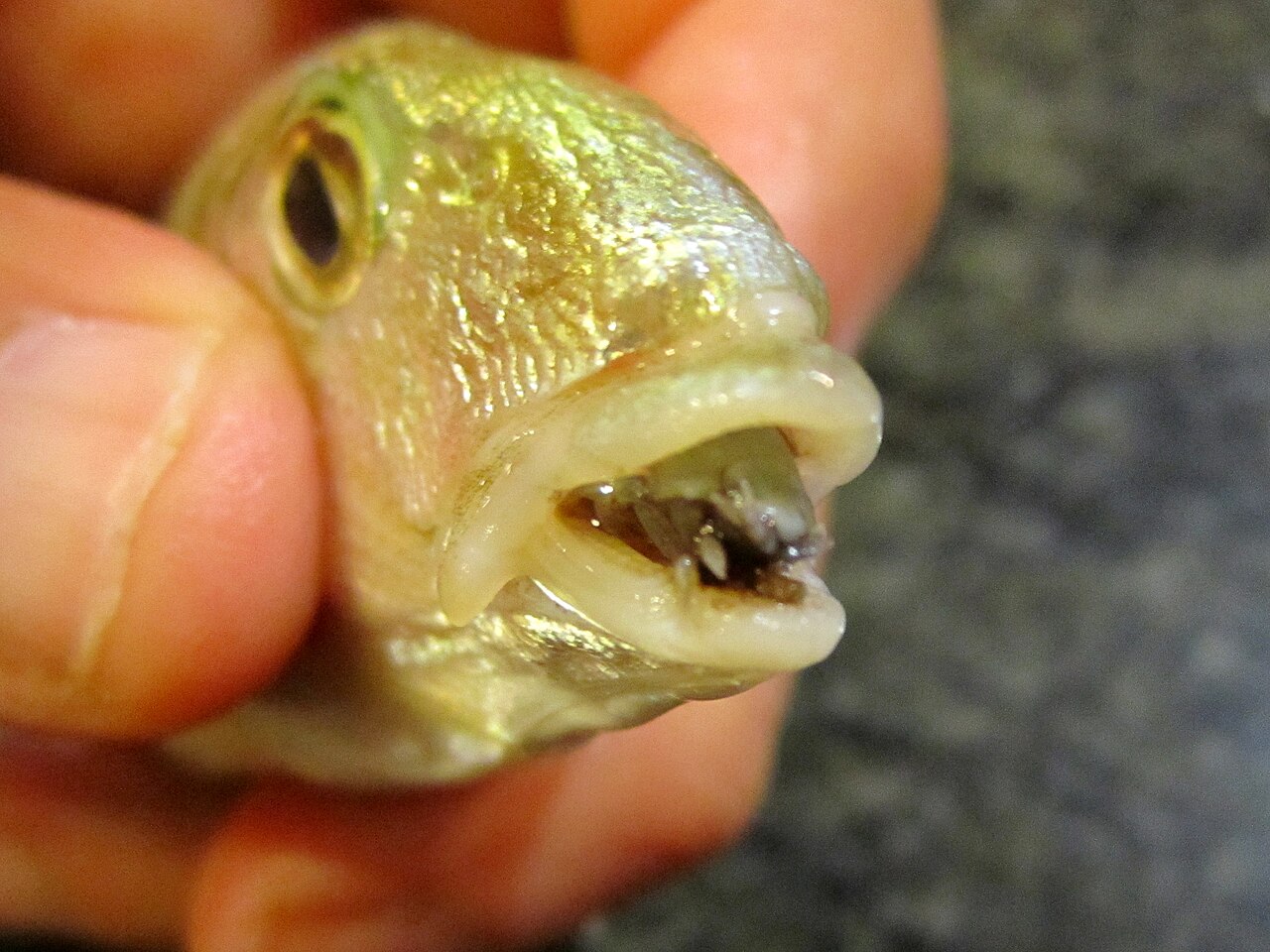
Not something that looks like a tongue. Not a growth or a strange deformity. An actual animal, firmly attached inside the fish’s mouth, occupying the space where its tongue once was.
This is the extraordinary biology of Cymothoa exigua, commonly known as the tongue-eating louse.
And despite its horrifying reputation, the most surprising part of the story might be that some infected fish can continue living and feeding with the parasite still inside their mouths.
A Parasite That Makes Its Home Inside a Fish’s Mouth
Cymothoa exigua is a parasitic isopod, a type of crustacean related to woodlice and other isopods.
It has a segmented body, multiple pairs of legs, and specialized claws that allow it to grip its host.
Rather than living on the outside of a fish, the parasite establishes itself inside the mouth.
Researchers have documented it in several fish species, including snappers. Its unusual relationship with its hosts has made it one of the most remarkable examples of parasitism in the animal kingdom.
But how does a small crustacean end up replacing an organ?
How the Tongue Gets Replaced
The process begins when a juvenile parasite enters a fish’s gill or mouth cavity.
As it develops, a female can attach herself to the fish’s tongue using specialized gripping appendages.
The parasite feeds on blood and other bodily fluids. Over time, the fish’s tongue can deteriorate, with tissue loss associated with the parasite’s feeding and attachment.
Eventually, much of the original tongue may disappear.
But the parasite doesn’t leave.
Instead, it remains attached to the remaining tongue structures, occupying the position of the missing organ.
The result is almost unbelievable: a living crustacean sitting where the fish’s tongue used to be.
The parasite is often described as functioning as a replacement tongue, although the extent to which it performs the tongue’s normal functions varies and is not fully established.
The Fish Can Keep Living
You might expect losing a tongue to be fatal for a fish.
Yet infected fish have been observed surviving with these parasites attached.
Some continue feeding despite the dramatic changes inside their mouths.
That doesn’t mean the relationship is harmless.
Parasites can impose physiological costs on their hosts, and the effects may depend on the fish species, the parasite’s size, and the severity of infection.
But the fact that a fish can sometimes continue functioning with another animal occupying the position of its tongue is extraordinary.
It also reveals something important about parasitism: a parasite does not necessarily benefit from immediately killing its host.
For an organism that depends on a living fish for food and shelter, keeping that fish alive can be advantageous.
It Can Change Sex During Its Life
The tongue-eating louse has another remarkable biological characteristic.
Like several related parasitic isopods, Cymothoa exigua is protandrous, meaning individuals can begin reproductive life as males and later develop into females.
This reproductive strategy can help parasites establish breeding pairs within a host.
Females are generally larger than males, and researchers have documented males living alongside females in infected fish.
The reproductive biology of these crustaceans adds another layer of complexity to an already unusual life cycle.
They are not simply attaching themselves to a fish and feeding.
They are adapted to surviving, developing, and reproducing within a very specific environment.
Is It Dangerous to Humans?
The appearance of Cymothoa exigua is disturbing, but it is not known to parasitize humans.
Its life cycle is adapted to fish hosts, and there is no established evidence that it can replace human tissue in the same way.
Handling a live specimen could potentially result in a painful pinch or bite, so direct contact is best avoided.
The parasite’s presence in a fish also does not automatically mean the fish is unsafe to eat. Food safety depends on factors such as the fish’s condition, handling, storage, and preparation.
The tongue-eating louse is primarily a biological curiosity rather than a direct human parasitic threat.
Why Would Evolution Produce Something Like This?
It is tempting to imagine the tongue-eating louse as a creature designed to inflict suffering.
But evolution has no such intention.
Natural selection favours traits that help organisms survive and reproduce in their environments.
For Cymothoa exigua, attaching inside a fish’s mouth provides access to nourishment and a relatively protected location.
Its specialized claws, feeding structures, and reproductive biology reflect adaptations associated with that lifestyle.
The loss of the fish’s tongue is a consequence of the parasitic relationship, not evidence that the parasite deliberately sets out to replace an organ.
Nevertheless, the outcome is one of the most extraordinary examples of how closely a parasite can become associated with its host.
Nature Can Be Stranger Than Horror Fiction
The tongue-eating louse doesn’t need to control a fish’s brain or turn it into a zombie.
Its survival strategy is disturbing enough without anything supernatural.
It enters a fish, attaches to its tongue, contributes to the loss of that tissue, and remains in place as a living occupant of the mouth.
And in some cases, the fish continues swimming and feeding.
Somewhere in the ocean right now, a fish is swimming, hunting, and feeding as though nothing is wrong. But inside its mouth, where its tongue should be, another animal has taken its place.
SOURCES: National Oceanic and Atmospheric Administration, Smithsonian Institution, Journal of Parasitology.