The ocean covers more than 70% of Earth’s surface, yet much of it remains a mystery. Scientists have mapped portions of the seafloor, discovered ecosystems thriving in complete darkness and explored places once considered unreachable. But how much of the ocean have humans actually explored?
The answer depends on what counts as explored. Mapping the ocean floor is not the same as seeing it firsthand. And when scientists measure how much of the deep seafloor humans have directly observed, the figure is astonishingly small.
Less Than 0.001% of the Deep Seafloor Has Been Visually Observed
A 2025 study published in Science Advances examined records of deep-sea dives conducted between 1958 and 2024. Researchers found that humans have visually observed only a tiny fraction of the deep seafloor: approximately 0.001% or less.
The area directly observed is roughly one-tenth the size of Belgium. Despite decades of oceanographic research and advances in underwater technology, scientists have seen remarkably little of the deep ocean with their own eyes.
This does not mean the rest of the ocean is completely unknown. Researchers can study large areas using sonar, satellites and other remote-sensing methods. However, those techniques do not provide the same detail as directly observing the seafloor and its ecosystems.
How Much of the Ocean Floor Has Been Mapped?
Mapping provides a different measure of how much we know about the ocean.
According to the International Hydrographic Organization, 28.7% of the world’s ocean floor had been mapped to modern standards as of April 2026. That means more than two-thirds of the global seafloor had not yet been mapped to that level of detail.
Seafloor mapping uses technologies such as sonar to measure underwater depths and create detailed representations of the ocean floor. These maps help scientists identify underwater mountains, trenches, ridges and other geological features.
However, a mapped area has not necessarily been visually explored. A sonar map can show the shape of the seabed without revealing the organisms living there or the details of its environment.
That distinction explains why the mapped percentage is far higher than the percentage of deep seafloor humans have directly observed.
Why Is the Deep Ocean So Difficult to Explore?
The deep ocean presents some of the most challenging conditions on Earth.
Sunlight gradually disappears as depth increases. Below roughly 1,000 meters, sunlight no longer reaches the water in meaningful amounts, leaving the deep ocean in near-total darkness.
Pressure is another major obstacle. It increases by approximately one atmosphere for every 10 meters of depth. At the deepest parts of the ocean, pressure is immense, requiring specialized equipment and carefully engineered submersibles.
Distance and cost also make exploration difficult. Research vessels, underwater robots, support crews and specialized instruments are expensive to operate. A single expedition can require substantial planning and resources.
Even when researchers reach a location, they can only observe a limited area at a time.
What Lives in the Unexplored Ocean?
The limited amount of direct observation means scientists continue to discover unfamiliar marine organisms and ecosystems.
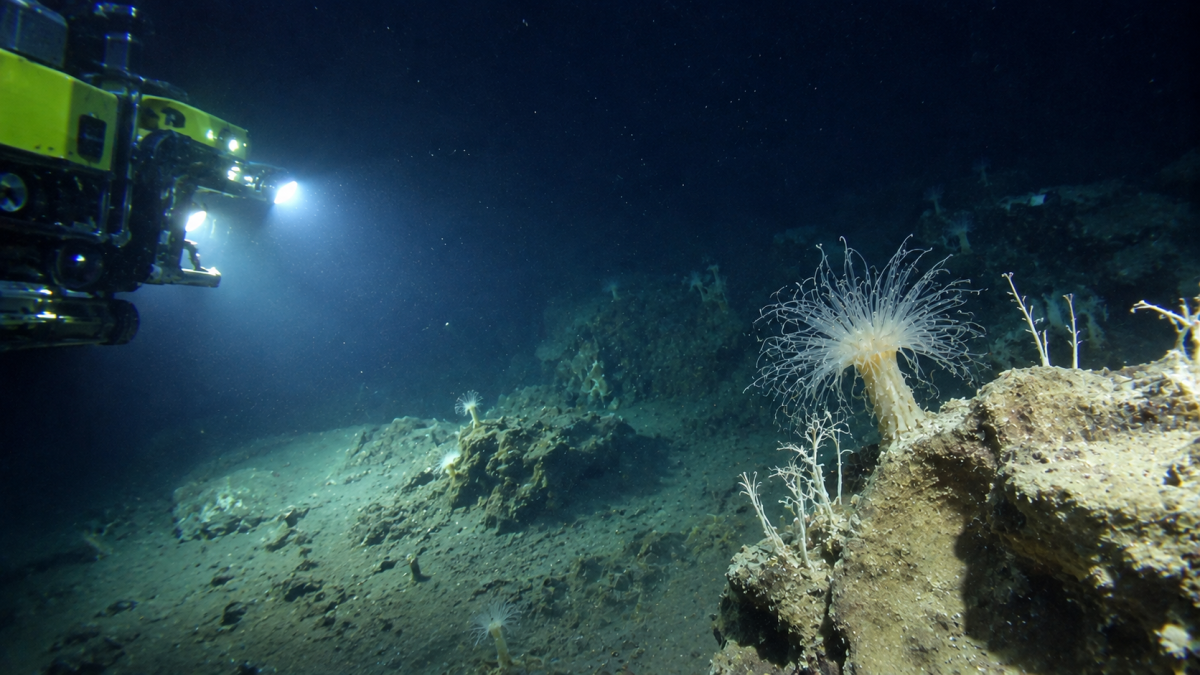
Some of the most remarkable discoveries have come from hydrothermal vents, where superheated, mineral-rich water flows from cracks in the seafloor. These environments support communities of organisms that do not depend on sunlight as their primary energy source.
Instead, certain microorganisms use chemical energy through a process called chemosynthesis. These microbes form the foundation of food webs that support animals such as tube worms, clams and other deep-sea species.
Other deep-sea environments contain unusual fish, transparent organisms, glowing animals and species adapted to extreme pressure and darkness.
NOAA estimates that the ocean may contain between 700,000 and one million animal species, with a substantial portion still awaiting discovery or formal description. The true number remains uncertain, partly because so much of the marine environment has not been studied.
How Do Scientists Explore the Ocean?
Researchers use several technologies to investigate the deep sea, each with different capabilities.
Sonar: Sends sound waves through the water to measure depth and map the seafloor.
Remotely operated vehicles (ROVs): Tethered underwater robots controlled by operators aboard a ship. They can carry cameras, lights and sampling equipment.
Autonomous underwater vehicles (AUVs): Uncrewed vehicles that follow programmed routes to collect data and map underwater environments.
Crewed submersibles: Specialized vessels that carry scientists to extreme depths, allowing direct observation and sample collection.
These technologies have transformed ocean research, making it possible to investigate places that would otherwise be inaccessible. But they have not eliminated the enormous challenge of exploring an environment that spans such a vast area.
Can We Map the Entire Ocean by 2030?
The international Seabed 2030 project aims to bring together ocean-mapping data from around the world to produce a complete map of the global seafloor by 2030.
The initiative is supported by the Nippon Foundation and the General Bathymetric Chart of the Oceans (GEBCO). It encourages governments, research institutions, companies and other organizations to contribute bathymetric data.
A complete map would be an important achievement for science. It could improve understanding of ocean geology, support marine conservation, help with navigation and provide valuable information about underwater hazards.
However, mapping the entire seafloor would not mean the ocean had been fully explored. A map can reveal the shape of the seabed, but it cannot document every species, habitat or ecological process beneath the waves.
The Ocean Remains One of Earth’s Greatest Unknowns
Humans have explored the ocean for centuries, but modern technology has revealed just how much remains beyond our direct observation.
Nearly 29% of the seafloor had been mapped to modern standards by April 2026, yet scientists have visually observed less than 0.001% of the deep seafloor, according to a 2025 study.
Those figures measure different things, but together they illustrate the scale of the challenge. Even with advanced submersibles, underwater robots and increasingly detailed maps, much of the deep ocean remains unseen.
Some of the most remarkable discoveries on Earth may still be waiting in the darkness beneath the waves.
SOURCES: Science Advances, International Hydrographic Organization, NOAA, UNESCO.