Ants work as a team without anyone giving orders. A colony can find food, care for young, defend the nest, and even construct temporary structures because each ant responds to what is immediately around it—other ants, chemical trails, or the task at hand. The queen lays eggs. She does not assign jobs or manage daily work. The coordination comes from the workers themselves.
This is what biologists mean when they call an ant colony a superorganism. The group behaves in ways that look organized and purposeful, yet no individual holds a plan or a picture of the whole colony. The same pattern appears across thousands of ant species. It is one reason ants have become so widespread and successful.
How do ants decide who does what without a boss?
Workers choose tasks based on their own age, size, recent experiences, and the ants they meet. In many species, younger workers stay inside the nest and care for the queen, eggs, larvae, and pupae. Older workers leave to forage or defend the colony. This age-related shift is common enough that researchers have a name for it: temporal polyethism.
Size can matter too. Some species produce workers of different physical forms. Larger individuals may cut leaves, carry heavy loads, or fight. Smaller ones handle finer work such as tending brood or maintaining delicate fungal gardens. The split is not assigned by a manager. It emerges from which ants are present and what work needs doing at that moment.
Deborah Gordon’s research on red harvester ants in the American Southwest shows one clear mechanism. Foragers waiting near the nest entrance do not leave until they meet enough returning ants that have found food. The rate of those brief antennal contacts tells them whether conditions outside are good. More successful returns mean more food is available, so more foragers leave. Fewer returns mean the colony slows down. No ant counts the total number of workers or checks a weather report. The pattern of local meetings is enough.
How do ants talk to each other?
Most ant communication is chemical. Ants release pheromones that other ants detect with their antennae. Different glands produce different signals. A trail pheromone says “this way leads to food.” An alarm pheromone says “danger.” Colony-specific scents on the body surface help ants recognize nestmates and reject outsiders.
They also communicate through touch. When two ants meet, they often touch antennae. The contact is quick, but it carries information about what the other ant has been doing. Some species share liquid food mouth-to-mouth (trophallaxis). The exchange can pass both nutrition and chemical signals that reflect the colony’s overall condition.
These channels are local. An ant does not broadcast a message to the entire colony. It leaves a scent, meets a neighbor, or responds to an alarm nearby. The larger pattern appears only because many ants are doing the same simple things at once.
How do ants build trails that find the best food?
When a forager finds a good food source, it lays a pheromone trail on the way back to the nest. Other ants follow the scent and, if they also find food, reinforce the trail on their return. Stronger trails attract more ants. Weaker trails fade. Over time the colony concentrates on the richer or closer sources without any ant comparing options or making a group decision.
This is a classic positive-feedback loop. It works because pheromones evaporate. Once the food is gone, returning ants stop reinforcing the trail, the scent disappears, and traffic shifts elsewhere. The system is self-correcting.
Researchers have studied the same principle in many species. The exact chemicals differ, and some ants use additional cues, but the core idea is consistent: repeated local reinforcement turns scattered discoveries into efficient colony-level foraging routes.
How do some ants farm and build living structures?
Leafcutter ants take division of labor further. They cut pieces of leaves and carry them underground, but they do not eat the leaves. The vegetation becomes the growing medium for a fungus that feeds the colony. Larger workers cut and transport. Smaller workers process the material, tend the garden, remove competing molds, and care for the brood. Bacteria living on the ants produce compounds that help protect the fungus from pathogens. The whole operation depends on many specialized roles working in sequence. No single ant performs every step.
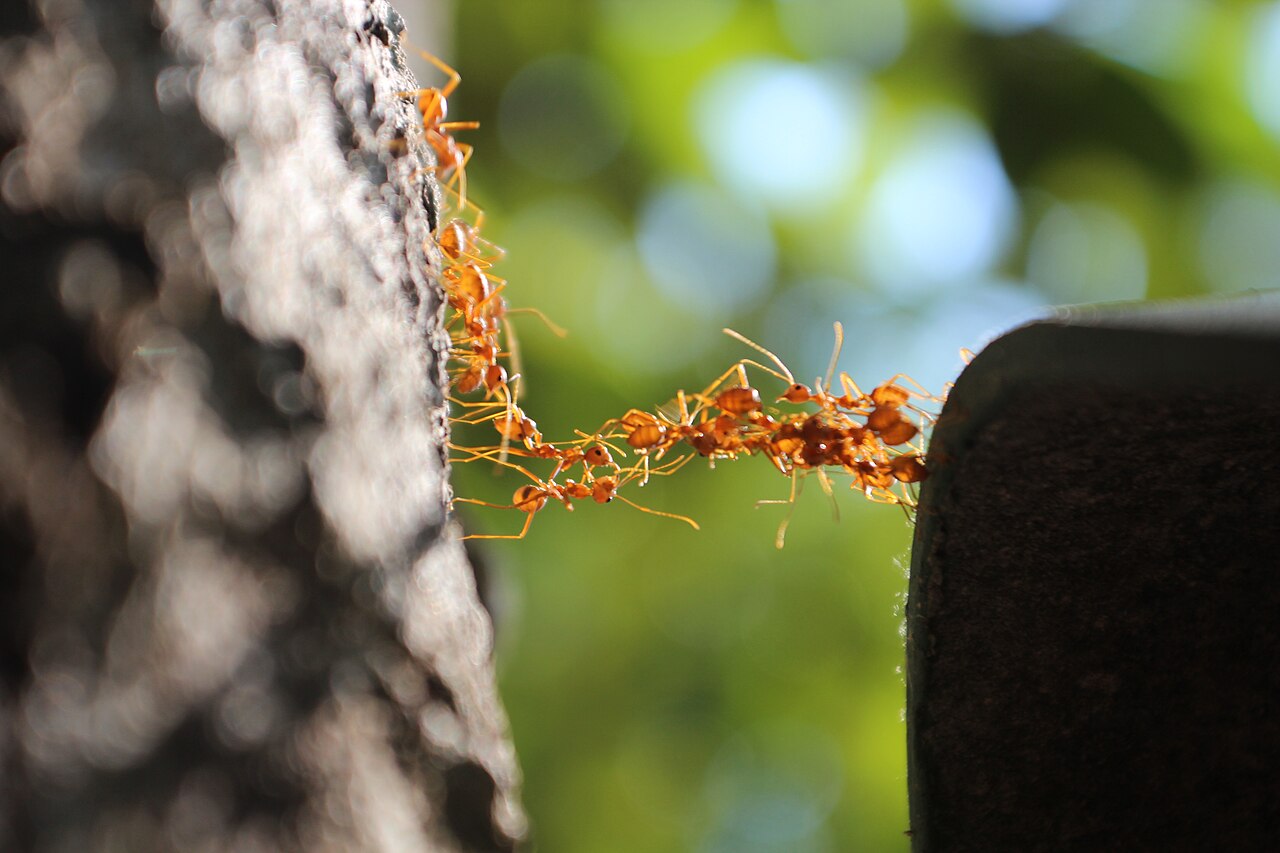
Army ants and fire ants show another form of teamwork: using their bodies as temporary construction material. Army ants form living bridges across gaps in the forest floor. An ant that steps into empty space and feels others walking over its back freezes in place. The next ant does the same. The bridge grows until the gap is spanned and shrinks again when traffic drops. The rule is simple—“if ants are walking on you, stay put”—yet the result is a functional structure that appears and disappears as needed.
Fire ants do something similar with rafts. When floodwaters rise, they link legs and mandibles, trapping air bubbles that keep the mass afloat. Individual ants sink; the linked group floats for days or weeks. The same local linking behavior can produce towers or other temporary structures. In both cases the colony gains a capability that no single ant possesses.
What makes ant teamwork so effective?
The system has no single point of failure. If some ants die or get lost, others continue responding to the same local cues. Information is distributed. Decision-making is distributed. The colony can adjust the number of foragers, shift from one food source to another, or rebuild a trail without waiting for instructions.
It is also robust to imperfect information. Individual ants make mistakes, follow outdated trails for a while, or respond to incomplete signals. The aggregate still tends toward useful outcomes because of the feedback loops. More ants reinforcing a good path outweigh the ones that wander. Researchers studying these systems note that the lack of central control is not a limitation; it is part of what makes the organization scalable and adaptable.
Colony size varies widely. Many species live in groups of dozens or a few hundred. Some leafcutter colonies reach several million workers. Argentine ants can form supercolonies that stretch for hundreds of kilometers and contain billions of individuals that treat one another as nestmates. The same basic mechanisms operate across these scales.
Where does ant cooperation have limits?
Not every task is equally flexible. Queens remain specialized for egg-laying. Physical castes in polymorphic species are set by developmental pathways, not by daily choice. Some decisions, such as choosing a new nest site in certain species, involve more back-and-forth assessment by scouts, yet even those processes rely on local recruitment and quorum-like thresholds rather than a central planner.
The system can also produce inefficiencies. Ants can get stuck in circular mills, following one another in loops until they exhaust themselves. Strong pheromone trails can lock a colony onto a mediocre food source for a time. And while the colony as a whole is resilient, individual ants are expendable. The evolutionary success of the group does not guarantee safety or optimal outcomes for every worker.
These limits do not cancel the larger pattern. Across species and environments, ants repeatedly solve problems—finding food, protecting young, crossing gaps, surviving floods—by combining simple individual responses with shared chemical and physical signals. The result looks like sophisticated teamwork. It is produced by rules that each ant can follow without knowing what the colony as a whole is doing.
SOURCES: Scientific American, Ask A Biologist, Quanta Magazine, Proceedings of the National Academy of Sciences, Behavioral Ecology, National Geographic, Smithsonian.