Almost everything people “know” about Jesus arrives through worship, not through a file in an archive.
That is not a slight. It is the first fact a historian has to live with. The man at the centre of Christianity left no letters that survived in his name. No Roman court transcript of his trial has ever been found. No contemporary portrait exists. What exists is a small Jewish preacher in a small province, executed by Rome, after which his followers made claims that remade the Mediterranean.
The useful question is not “Did Jesus matter?” He did. The useful question is what can be said about him without preaching, and what cannot.
The problem of the sources
The main narratives are the four Gospels in the New Testament: Mark, Matthew, Luke, and John.
Most scholars who work on the texts date Mark to around 70 CE, Matthew and Luke to the 70s or 80s, and John later still, often in the 90s. Jesus’s death is usually placed around 30 or 33 CE. That means even the earliest Gospel is about four decades after the crucifixion. The writers were not court reporters. They were believers arranging memory, scripture, and teaching for churches that already existed.
The gap does not make the Gospels useless. It tells you what they are.
They are not court transcripts. They are theological narratives built on earlier tradition: short sayings, arguments with other teachers, and a death under Pontius Pilate. Historians read them the way they read other ancient lives. They ask which scenes show up in more than one stream of tradition, which scenes reflect later church disputes, and which traditions may be less likely to have been created for apologetic reasons.
A few pieces are widely treated as early. Jesus taught as a Jew in Galilee. He is tied to John the Baptist’s movement, including a baptism. He had a reputation as a healer. He went to Jerusalem at Passover and was crucified under Pilate.
Those items show up in more than one stream of tradition. Some of them also create difficulties for later Christian writers. A Messiah baptized by someone else, then killed on a Roman cross, was a hard story to sell. That awkwardness does not prove the scenes are true, but it is one reason some historians have regarded these traditions as less likely to have been invented purely for apologetic purposes.
Outside the New Testament the record is thin.
The Jewish historian Flavius Josephus, writing in the 90s CE, mentions Jesus twice in his Antiquities of the Jews. One passage was later touched by Christian copyists. Most specialists think Josephus originally wrote a shorter note: a teacher was executed, and his followers were still around. The second passage is more secure. It refers to the execution of James, “the brother of Jesus who was called Christ.”
A Roman historian and a Roman governor add checkpoints, not a biography. Tacitus, around 116 CE, writes that “Christus” was executed under Tiberius by Pontius Pilate, and that the movement later reached Rome. Pliny the Younger, governing Bithynia around 112 CE, describes Christians singing a hymn to Christ “as to a god.”
None of those Jewish or Roman lines give a biography. They give checkpoints. Josephus and Tacitus provide non-Christian references connecting Jesus or Christus with an executed founder, while Pliny provides evidence for an established Christian movement worshipping Christ. Josephus and Tacitus also place an execution under Pilate. That is a low bar. For antiquity, it is not nothing. Surviving evidence for non-elite people from the period is generally sparse.
A Jewish life under Rome
The setting is not a Christmas card.
Judea and Galilee sat inside the Roman system. Herod the Great had ruled as a client king. After his death the territory was split. By the late 20s CE, Pontius Pilate was prefect of Judea. Galilee was under Herod Antipas. Taxes, land pressure, and a Temple establishment in Jerusalem were ordinary facts of life. Periodic unrest was also ordinary. Rome’s answer to public trouble in a festival city was short.
Jesus is generally understood as a Galilean Jew preaching the kingdom of God. In Jewish scripture and in first-century hope, that phrase meant God’s rule breaking in. It was not a motto for private self-help. He taught in parables. He argued about Torah. He gathered disciples. He went to Jerusalem at Passover, when the city was packed and the garrison was nervous.
Passover is the political detail people skip. The festival commemorates the Israelites’ escape from Egypt. A preacher talking about a coming kingdom, in that week, in that city, was not speaking into a vacuum. The Gospels say Jesus caused a scene in the Temple: overturned tables, drove out money-changers, and accused people of turning a house of prayer into a market. We cannot prove the details. Many historians regard the Temple incident as a likely factor in his arrest.
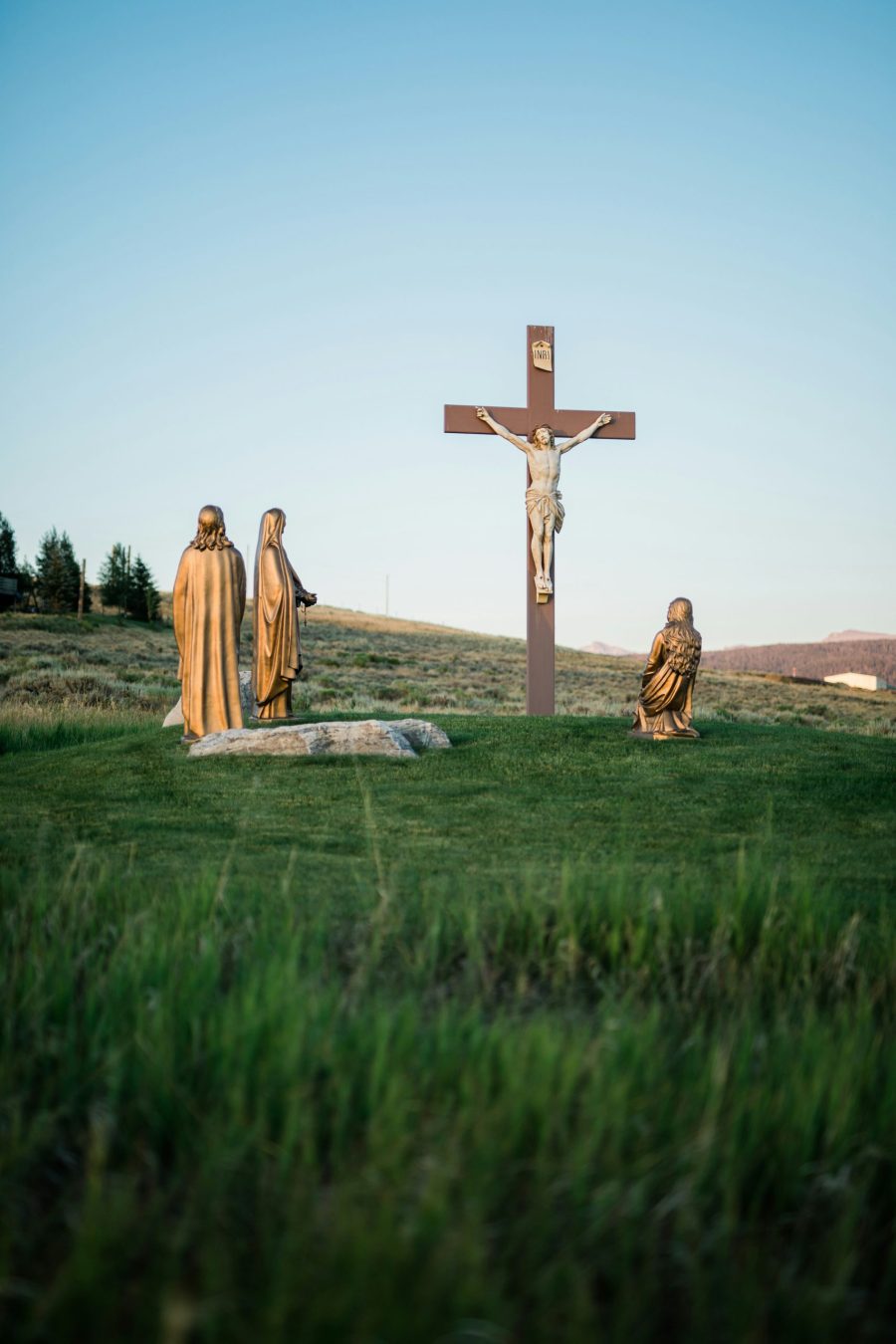
Crucifixion was a Roman penalty, used on slaves, rebels, and people the state wanted forgotten. Crucifixion was a Roman form of execution, and Jesus’s death by crucifixion points to Roman authority in the case. Pilate’s name in the creed is not decoration. He is the Roman official consistently associated with Jesus’s execution in the surviving sources.
What he taught, without the sermon
Set the later church titles aside and a few themes still hold.
He said the kingdom of God was near. He told people to love God and neighbour, including the enemy. That is sharper than “be nice.” He taught in short stories: a Samaritan who stops to help, a father who runs toward a wasteful son, seed that falls on different ground. He said the Sabbath was made for people, not people for the Sabbath. That put him in an argument already happening among Jews. It did not put him outside Judaism.
He is also remembered as eating with socially marginal people and as emphasizing the poor. These themes appear in multiple early Christian traditions.
What a historian cannot do is turn those teachings into a modern political program and call it research. The texts were not written to settle a Canadian tax debate or a culture-war thread. They were written inside an apocalyptic Jewish world that expected God to act.
The resurrection is a claim, not a footnote
Christianity does not exist because Jesus told people to forgive.
It exists because his followers proclaimed that Jesus had been raised from the dead and that they had seen him alive.
Paul of Tarsus wrote in the 50s CE, before the Gospels. In a letter that still survives, he lists the people who, he says, saw Jesus alive after the crucifixion: Peter, the twelve disciples, more than five hundred others at one time, James, the rest of the apostles, and finally Paul himself. No earlier surviving Christian text records the claim in writing.
History can record that the claim was made early, that it was central, and that people were willing to stay with it under pressure. History cannot verify a resurrection the way it can verify a prefect’s name. Treating the resurrection as “disproved” is as much a leap as treating it as a lab result. The honest sentence is simpler: it is the load-bearing belief of the movement, and it is not the kind of event ancient evidence can settle.
Islam later honours Jesus (Isa) as a prophet and rejects the crucifixion as Christians tell it. Judaism does not accept him as Messiah. Those positions belong in a map of religions. They do not add first-century documents.
How a preacher became a world religion
The jump from a Galilean following to a Mediterranean religion is the part that still needs explaining.
The first communities were Jewish. They stayed in Jerusalem and in the synagogues of the diaspora. Paul, a Pharisee who became the movement’s most energetic letter-writer, argued that gentiles could belong without becoming Jews first. That argument — fought in letters we still have — opened the sect to the Greek-speaking cities of the empire.
Rome then did something empires often do by accident. It built roads, a common language of trade, and a habit of moving people. A message that could travel with merchants and slaves could move farther than a message that stayed in one valley. Persecution was real in places and periods. It was not a film running for three centuries without a break. What changed the scale was the fourth century. After 312, Constantine backed the church, and bishops gained increasing public authority and imperial patronage. The preacher from Nazareth never saw that. The institution did.
What this page is for
A site that asks readers to check the file should not sell certainty it does not have.
Jesus of Nazareth is unusually well attested for a non-elite person of the period, although the surviving evidence remains limited. He was a Jew. He taught. He died on a Roman cross around 30 CE. His followers said death was not the end, and they built churches on that sentence. Everything else — the manger, the exact words on the mount, the physics of a miracle — sits at different distances from that core.
Faith can go further than the documents. History has to stop with them.
SOURCES: New Testament Gospels and undisputed letters of Paul (especially 1 Corinthians 15); Josephus, Antiquities 18 and 20; Tacitus, Annals 15.44; Pliny the Younger, Letters 10.96–97; E.P. Sanders, The Historical Figure of Jesus; Geza Vermes, Jesus the Jew; Bart D. Ehrman, Did Jesus Exist? and Jesus: Apocalyptic Prophet of the New Millennium; John P. Meier, A Marginal Jew; Paula Fredriksen, When Christians Were Jews; standard handbook discussions of Gospel dating and the Testimonium Flavianum.