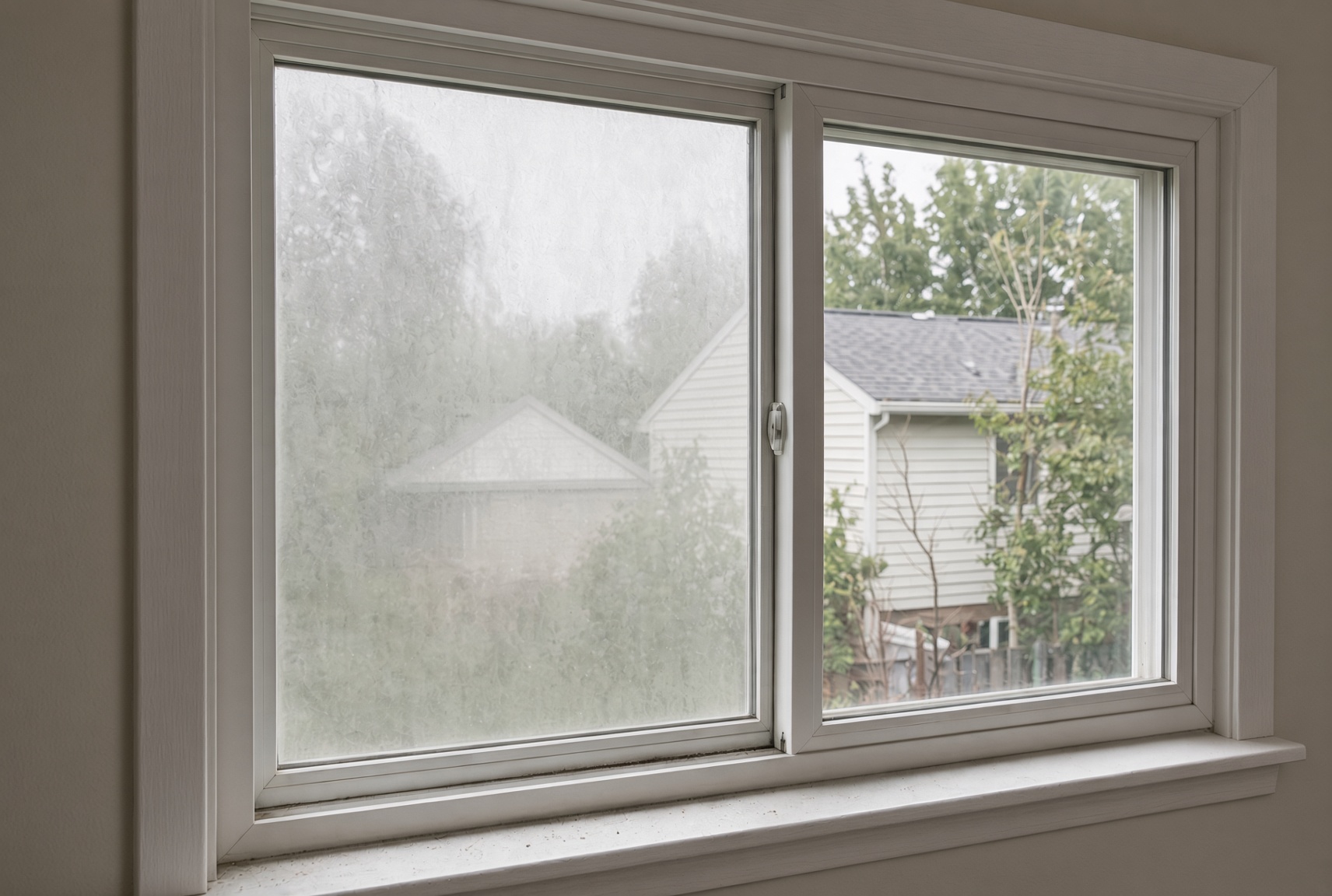
A cloth will not clear haze between the panes. If the haze is inside the sealed unit, you cannot wipe it away from either side. In many cases, especially if the haze comes and goes with temperature, it indicates that moisture has entered the cavity because the IGU seal has failed.
But not every haze between the panes is necessarily moisture. Internal deposits can produce similar visual effects. The key question is whether the cloudiness is on a surface you can reach or inside the sealed glass unit.
Foggy windows confuse people because the same word can describe three different things.
If the fog is on the glass you can touch from inside the room, a cloth usually clears it. That is indoor humidity hitting a cold pane. Natural Resources Canada notes that interior condensation becomes more likely when indoor humidity is higher and the glass is colder.
If the fog is on the outdoor face on a cool morning and burns off as the sun warms the glass, that is ordinary exterior condensation or dew. A well-insulating window can make that outer dew more likely because the outer pane can stay colder.
The third case is the one this page is about: mist, streaks, or a milky film between the panes. You cannot reach it from either side. In many cases, moisture from a failed IGU seal is responsible, although internal deposits can produce similar visual effects.
What is inside a sealed double-pane unit
The factory name is insulated glass unit, or IGU. Two panes of glass are held apart by a spacer. The edges are sealed. The cavity may contain dry air or an insulating gas such as argon. Many modern units also use a low-E coating to improve thermal performance. The U.S. Department of Energy identifies insulating glass and low-E coatings as common ways to reduce heat flow through windows.
The spacer contains desiccant, which absorbs moisture and helps keep the cavity dry. The edge seals help keep moisture out and, on a gas-filled unit, help retain that gas.
As long as that system remains intact, moisture should not build up between the panes.
Why moisture gets between the panes
When the edge seal no longer keeps the cavity dry, moisture can enter the space between the panes. The desiccant absorbs some of that moisture, but its capacity is limited.
Once enough moisture is present, water vapor can condense on the inner glass surfaces and show up as fog, streaks, or a milky film.
The haze may come and go with temperature at first. Repeated wetting and drying can leave deposits on the glass, so the cloudiness can become more permanent.
If a pane looks filmed and no cleaner reaches the film, the problem is often inside the unit.
Does visible fog mean the argon is gone?
Not necessarily all of it.
A failed seal can let insulating gas escape while allowing moisture into the cavity. That is different from the gradual gas loss a properly sealed unit can experience over many years while still remaining clear.
Visible fog means the cavity is no longer maintaining the dry conditions it was designed to maintain. How much insulation is lost depends on the unit, how severe the seal failure is, and how long it has been present.
The cloudy glass is a visible sign of the problem, not necessarily the first thing that went wrong.
Why window seals fail
Glass, spacers, and sealants expand and contract at different rates as temperatures change. Those repeated cycles put stress on the edge seals, especially over many years.
Sun exposure can increase those temperature swings. Water sitting around the frame, clogged drainage in some vinyl frames, installation damage, a twisted sash, building movement, aging sealant, ultraviolet exposure, and a weak original seal can also contribute to failure.
Age matters, but there is no single expiration date for every insulated glass unit. Many units can last for decades, while others fail sooner depending on climate, materials, exposure, installation, and manufacturing quality.
The wipe test
Stand at the glass with a dry cloth. Wipe the room face. Wipe the outdoor face.
If the haze leaves, you have surface condensation or another surface problem. The fix may involve humidity, ventilation, or a warmer interior pane — not a new IGU.
If the haze stays exactly where it was, the moisture is likely in the gap.
A cracked pane can also compromise the cavity. The test is still the same: can you wipe it?
Will a dehumidifier fix fog between the panes?
No.
A dehumidifier can reduce condensation on the room-side glass. It cannot dry a sealed cavity.
Lowering the humidity in the house does not give you access to the space between the panes.
Does window defogging actually work?
Some shops drill the glass or work through the spacer. They remove moisture, clean what they can, and seal the access holes.
The haze can disappear, and the window may look better.
But a typical field defogging procedure does not restore the original factory-sealed system. The failed edge seal remains the underlying problem, and the original insulating gas fill is generally not restored.
Treat defogging as a way to improve visibility, not as the same thing as installing a new IGU.
Replace the glass unit or the whole window?
The lasting repair is usually a new insulated glass unit.
In many sashes, the failed IGU can be removed and a new one set in. That is glass-only work. It can cost less than replacing the entire window when the frame, sash, hardware, and flashing are still in good condition.
Replace the whole window when the sash is rotten, the frame is badly damaged or distorted, or the opening has other installation problems that go beyond the glass.
One fogged pane in an otherwise sound window often indicates a failed IGU.
If several windows are fogging
Look at their age first.
One failed unit can be a fluke. Several units from the same installation period fogging in sequence can indicate that their seals are aging at a similar rate.
That still does not prove the frames are finished. Check the sash, hardware, drainage, and flashing before replacing entire windows that may only need new glass units.
Check the remaining warranty on the sealed unit before anyone prices a full tear-out. Terms vary by manufacturer and year. When coverage exists, it may apply specifically to the insulated glass unit rather than the entire window.
Does a fogged window still insulate?
Not necessarily as well as it did when the cavity was dry and the original gas fill was intact.
However, it is also not accurate to say every cloudy unit has lost all of its insulating ability. The amount of performance loss depends on the construction of the unit and the extent of the seal failure.
The fog is a sign of a problem. It does not mean the glass provides zero insulation.
The short version
Fog on the room-side glass is usually humidity.
Fog on the outdoor face can be dew or exterior condensation.
Persistent fog or haze between the panes is a strong sign of an internal IGU problem. Moisture entering through a failed seal is a common cause, although internal deposits can produce similar visual effects.
Wipe both faces. If the cloud stays, the IGU seal has likely failed.
A dehumidifier cannot dry that cavity. Defogging can improve the view, but it does not typically restore the original factory-sealed system.
A new insulated glass unit provides a new sealed, dry cavity. If the frame is sound, that is often all you need.
SOURCES: Natural Resources Canada, U.S. Department of Energy, National Glass Association, Vitro Architectural Glass, Fine Homebuilding, Window + Door, Crystal Glass, This Old House.