The phrase sounds like folklore. It was not.
In 1816, parts of northeastern North America and Europe experienced a growing season so abnormal that summer seemed to disappear. Frost returned during months that were supposed to be warm. Snow fell in New England in June. Crops failed, grain prices rose, and communities that depended on short growing seasons suddenly faced food shortages.
The cause was not a local cold snap. It was a volcanic eruption more than 10,000 miles away.
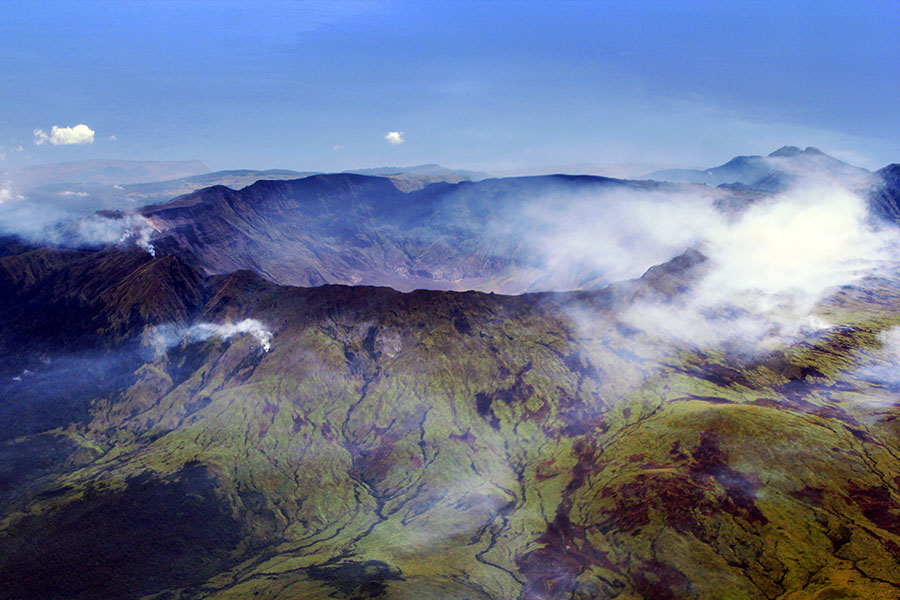
In April 1815, Mount Tambora erupted on the Indonesian island of Sumbawa in what is now Indonesia. The eruption injected enormous quantities of sulfur into the stratosphere, where it was transformed into sulfate aerosols that spread around the planet and reduced the amount of sunlight reaching Earth’s surface.
The following year became known as the Year Without a Summer.
But the name can be misleading. Summer did not literally disappear everywhere. The eruption produced a complicated climate disturbance whose effects varied by region. In some places, cold and frost destroyed crops. In others, excessive rain did the damage. The consequences were then amplified by food shortages, weak transportation networks, limited reserves, and disease.
That is what made Tambora so destructive: a volcanic eruption became a global climate shock, and the climate shock became a human crisis.
What exploded at Mount Tambora?
Mount Tambora stands on Sumbawa, part of the Indonesian archipelago.
In April 1815, it produced the largest explosive eruption in recorded history. The eruption is classified as VEI 7 on the Volcanic Explosivity Index, a level associated with exceptionally large explosive eruptions. The climactic phase occurred on April 10, although the eruption began earlier and continued afterward.
The eruption devastated Sumbawa and neighboring islands. Pyroclastic flows reached the sea, ash buried agricultural land, and the eruption’s immediate effects killed thousands. The larger death toll came afterward, as destroyed crops, contaminated water, food shortages, and disease created a prolonged crisis.
Estimates vary considerably. Modern summaries commonly put the total number of deaths on Sumbawa and neighboring islands at around 60,000, while earlier scholarship produced estimates above 70,000. The uncertainty is substantial because the demographic and historical records from the affected region are incomplete.
That distinction matters. There is no single precise death count for Tambora.
What is much less uncertain is what happened next.
The eruption put an enormous amount of sulfur into the stratosphere.
How a volcano stole a summer
The material that caused 1816’s distant climate effects was not primarily the ash that fell near Tambora.
It was sulfur.
A major explosive eruption can inject sulfur dioxide high into the atmosphere. In the stratosphere, sulfur dioxide undergoes chemical reactions that produce sulfate aerosols. These tiny particles scatter and reflect incoming sunlight, reducing the amount of solar energy reaching Earth’s surface.
Unlike particles released into the lower atmosphere, stratospheric aerosols are not quickly washed out by ordinary rain. They can spread around the globe and remain in the atmosphere for months or years. Tambora’s sulfate veil produced substantial cooling, particularly across the Northern Hemisphere.
Climate reconstructions indicate that Tambora contributed to cooling of roughly 0.4–0.8°C in annual mean temperature across the tropics and extratropical Northern Hemisphere relative to the preceding decades. The actual temperature response varied greatly by season and location.
That last point is crucial.
A global or hemispheric average does not tell you what happened to a farmer in Vermont.
The climate disturbance changed atmospheric circulation and precipitation as well as temperature. Some regions became colder and wetter. Others experienced different combinations of cold, dryness, rainfall, or delayed seasonal warming.
In western and central Europe, for example, 1816 was exceptionally cold and wet. In parts of North America, severe frosts and snow damaged crops during the growing season.
The volcanic veil did not create one uniform global winter.
It disturbed the climate system.
What “Year Without a Summer” actually looked like
In New England and parts of eastern Canada, the problem was timing.
Farmers did not need the annual average temperature to be dramatically lower. They needed enough warmth, for long enough, for crops to mature.
In 1816, that warmth repeatedly failed to arrive.
Snow fell in New England in June, while frost struck during the growing season. Historical records document unusually cold conditions through June and July in parts of the northeastern United States and Canada, damaging crops and contributing to agricultural losses.
The cold was especially damaging because the agricultural calendar was short to begin with.
Corn and other crops could be planted, damaged by frost, replanted, and then run out of time before the season ended. Hay shortages also became a problem because livestock depended on the summer harvest.
This is why the phrase “Year Without a Summer” can obscure what actually happened.
There was still summer weather.
There simply was not enough reliable summer weather for agriculture in some of the hardest-hit regions.
The consequences continued into the following year. Food became more expensive, livestock were slaughtered when farmers could no longer feed them, and some New England residents eventually left for areas farther west.
Historical research has linked the agricultural crisis to increased migration from New England toward the developing Midwest, although migration had multiple causes and Tambora was not the sole reason people moved.
Europe experienced a different kind of disaster
Europe did not experience an identical version of the New England freeze.
The summer of 1816 was characterized in much of western and central Europe by a combination of unusual cold and excessive precipitation. Crops suffered, harvests declined, and food prices increased.
Switzerland provides a particularly clear example.
Historical and instrumental evidence shows an exceptionally cold and wet summer. Poor harvests contributed to food shortages and rising grain prices, while the unusual precipitation also produced major hydrological consequences in the years that followed.
The crisis extended beyond weather itself.
When harvests fail, the outcome depends partly on whether food can be moved from places with surpluses to places with shortages. In the early nineteenth century, transportation was slow and expensive compared with modern food systems.
That meant the impact of a bad harvest depended not only on how cold or wet a region became, but also on its reserves, transportation network, local economy, and access to outside food.
The same climate shock could therefore produce very different social consequences in different places.
Tambora affected Asia, too
The Year Without a Summer is often told as a story about New England and Europe, but the volcanic climate disturbance was not confined to the North Atlantic world.
Research using Chinese documentary records and climate proxies has found evidence of a Tambora-related cold excursion in parts of China, including severe frost and unusual snow and ice in southern regions. Yunnan experienced serious crop losses and famine during the 1815–1817 period, with 1816 a particularly severe year.
The regional picture is important, however.
The response was not uniform across China. Some regions experienced substantial agricultural and climatic disruption while others were affected much less severely. Researchers have emphasized that local conditions and the existing climate background shaped how the volcanic disturbance translated into social consequences.
The same principle applies globally.
Tambora did not switch the planet into one identical weather pattern.
It altered the climate system, and different places experienced that disturbance differently.
Why 1816 was worse than a temperature graph suggests
A change of less than a degree in a global or hemispheric average can sound insignificant.
For agriculture, it can be enormous.
Imagine a crop that normally has just enough time to mature before the first autumn frost. Move the seasonal temperature downward and shorten the period of reliable warmth, and the crop may fail even if the average annual change sounds modest.
Now add persistent rain.
Then add livestock that cannot be adequately fed.
Then add grain shortages and higher prices.
Then add poor transportation.
The result is not simply “a colder year.”
It is a cascade:
volcanic eruption → stratospheric aerosols → reduced sunlight and altered circulation → regional temperature and precipitation anomalies → crop failure → food shortages → higher prices and disease risk.
The volcanic eruption created the initial shock. Human vulnerability determined much of the damage that followed.
This is one reason estimates of Tambora’s human toll cannot be reduced to a simple calculation based on temperature alone.
Tambora was not the only unusual thing happening
Tambora was the dominant cause of the extraordinary climate conditions of 1816, but Earth was not starting from a perfectly neutral climate background.
The 1810s were an unusually cool period, and another large tropical eruption occurred around 1808–1809, although the volcano responsible has not been conclusively identified. Solar activity was also relatively low during the period known as the Dalton Minimum.
These factors matter because they provide context, but they should not be treated as equivalent explanations for the Year Without a Summer.
The evidence strongly identifies Tambora as the principal driver of the exceptional 1816 climate anomaly. Researchers nevertheless continue to examine how the earlier eruption, solar activity, and natural climate variability influenced the magnitude and regional expression of the event.
In other words, Tambora supplied the enormous volcanic forcing.
The background climate helped determine how that forcing played out.
The strange skies of 1816
People did not know about stratospheric aerosols.
They only knew that the sky looked wrong.
Observers in the northeastern United States described a persistent “dry fog” that did not disappear with ordinary wind or rain. The sun appeared dimmed, and unusual atmospheric colors were reported. Such observations are consistent with the presence of volcanic aerosols high in the atmosphere.
This is one of the remarkable features of the Tambora story.
The observations came first.
The explanation came later.
Modern scientists can compare historical weather observations with instrumental measurements, tree rings, ice-core sulfate deposits, climate reconstructions, and model simulations. Together, those independent lines of evidence show that the volcanic eruption produced a major climate disturbance.
The diaries and weather reports are therefore not merely colorful anecdotes.
They are part of the evidence.
The summer that helped inspire Frankenstein
The weather also left a mark on cultural history.
In June 1816, a group of English travelers staying near Lake Geneva found themselves spending unusually large amounts of time indoors because of the miserable weather.
At Villa Diodati were Lord Byron and physician John Polidori. Mary Wollstonecraft Godwin, later Mary Shelley, and Percy Bysshe Shelley were also part of the group. Byron proposed that they write ghost stories.
Mary Shelley began developing the story that became Frankenstein, while Polidori developed The Vampyre.
The volcano did not “cause” Frankenstein in any simple sense.
It changed the circumstances in which the writers spent those days together.
That distinction is worth keeping.
Tambora created the strange weather. The weather helped keep the writers indoors. What they did with that time was human creativity.
What people thought was happening
In 1816, nobody could look at a satellite image and see a volcanic aerosol plume circling the planet.
The atmospheric chemistry was not understood.
People proposed many explanations for the strange weather, including changes in solar activity and other astronomical or environmental causes. Earlier naturalists had already considered connections between volcanic eruptions and unusual atmospheric conditions, but the modern explanation was still decades away.
Today, scientists can identify the sulfate signal of Tambora in polar ice cores and compare it with independent climate evidence. The eruption’s climatic fingerprint appears across multiple types of records.
That evidence is much stronger than any individual historical anecdote.
It is the combination of records that makes the case.
What the Year Without a Summer was not
It was not a planet without summer.
The most severe effects were regional and seasonal. Some places experienced much more disruption than others.
It was not simply an ash cloud blocking the Sun.
The most important long-distance climate effect came from sulfur dioxide converted into stratospheric sulfate aerosols.
It was not caused by Tambora alone in every detail.
The eruption was the principal forcing behind the exceptional 1816 climate anomaly, but background climate conditions and natural variability affected regional outcomes.
It was not proof that one eruption permanently changed Earth’s climate.
The volcanic aerosol veil eventually dissipated. The climate disturbance was temporary, although its social consequences lasted longer.
And it was not just a story about cold weather.
It was a story about what happens when an abrupt climate shock hits societies whose food systems have little room for failure.
Why 1816 still matters
Tambora is a useful reminder of how quickly the atmosphere can connect distant parts of the planet.
The eruption happened in Indonesia.
Its sulfate aerosols spread through the stratosphere.
Farmers in North America and Europe then experienced unusual weather months later.
The chain crossed oceans before most of the people affected knew what had caused it.
Smaller eruptions have demonstrated the same basic physical mechanism in the modern era. The 1991 eruption of Mount Pinatubo, for example, produced measurable global cooling for a few years, although it was substantially smaller than Tambora. Tambora remains an extraordinary benchmark for understanding the potential climate and societal consequences of a very large tropical eruption.
The most important lesson of 1816 is therefore not that the world suddenly became cold.
It is that a relatively modest shift in the climate experienced at the human scale can become enormous when it arrives at exactly the wrong time.
Nobody in Vermont needed a global mean temperature.
They needed corn to ripen.
A volcanic eruption thousands of kilometres away made that much harder.
1815 was the blast.
1816 was the weather it left behind.
SOURCES: Smithsonian Institution Global Volcanism Program on Tambora; Raible et al. 2016, WIREs Climate Change; Oppenheimer 2003, Climatic, environmental and human consequences of the largest known historic eruption; Luterbacher and Pfister 2015, Nature Geoscience; Veale and Endfield 2016, The Geographical Journal.