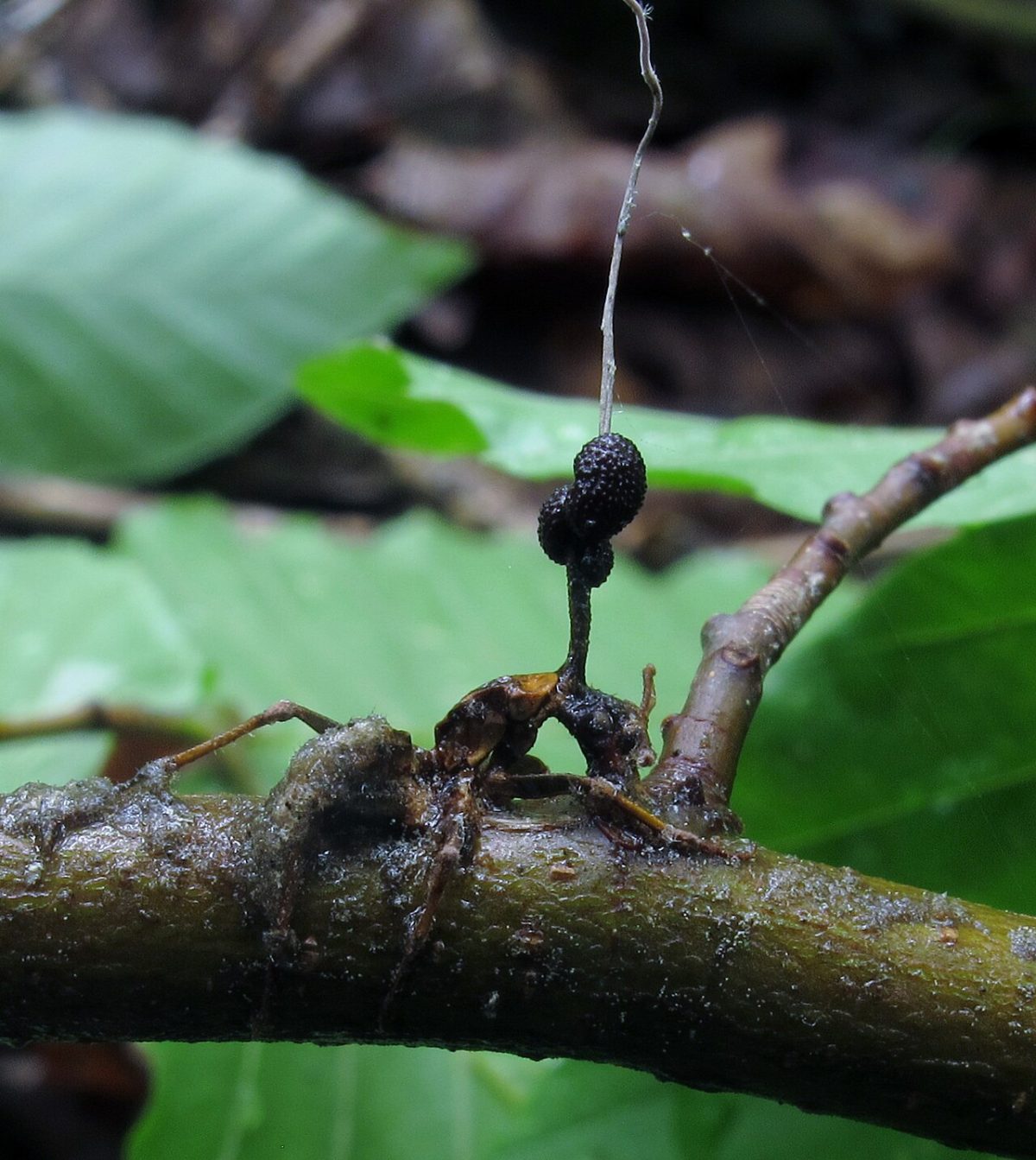
Deep inside tropical forests, an ant is about to do something that will cost it its life.
It abandons its normal routine and begins moving strangely through the vegetation. Its movements become erratic. It may stumble, convulse, or fall as it makes its way through the forest.
Eventually, it reaches a leaf.
Then something extraordinary happens.
The ant clamps its jaws onto the vegetation and remains attached, even as its body begins to fail.
Soon, it dies.
But whatever caused this bizarre behaviour isn’t finished.
Inside the ant, a parasitic fungus continues growing. Eventually, a reproductive structure can emerge from the dead insect, releasing spores that may infect other ants.
It sounds like a scene from a horror movie.
Except this isn’t fiction. It’s a real biological phenomenon, and scientists are still uncovering exactly how it works.
Meet the Fungus That Creates Real-Life Zombies
The organism behind this disturbing process belongs to a group of parasitic fungi called Ophiocordyceps.
Certain species have evolved an extraordinary relationship with ants, particularly some carpenter ants.
These fungi do much more than make their hosts sick.
They can manipulate an infected ant’s behaviour in ways that help the parasite survive and reproduce.
That’s why they’re commonly called zombie-ant fungi.
The ants aren’t actually undead, of course. They’re living insects whose behaviour has been altered by an infection.
But the resemblance to science fiction is difficult to ignore.
A parasite enters an animal, changes what it does, and ultimately uses its body to complete its own life cycle.
And the details become even stranger when scientists look inside the infected ant.
It Starts With a Microscopic Spore
For the ant, the danger can begin with something too small to see.
A fungal spore encounters a susceptible insect and, under suitable conditions, establishes an infection.
The fungus begins developing inside its host, using the ant’s body as an environment in which to grow.
At first, the ant may continue behaving much like an ordinary member of its colony.
But as the infection progresses, something changes.
In a 2011 study conducted in a Thai rainforest, researchers documented the unusual behaviour of carpenter ants infected with zombie-ant fungi.
The insects displayed erratic walking patterns and repeated convulsions that could cause them to fall from vegetation.
Rather than continuing their normal activities, infected ants eventually moved into positions favourable to the fungus.
Then came the most remarkable part.
The ants bit into leaves and remained attached until death.
This wasn’t simply a case of an insect becoming weak or disoriented.
The sequence of behaviours helped position the ant in an environment where the fungus could continue developing and eventually reproduce.
And that brings us to one of the strangest features of the entire infection.
The Death Grip: When an Ant Can No Longer Let Go
Imagine an ant biting into a leaf so firmly that its jaws remain locked around it after death.
Scientists call this behaviour the death grip.
It’s one of the defining characteristics of zombie-ant infections.
But why would a fungus benefit from making an ant bite a leaf?
Because where the ant dies can be critically important.
For the fungus to reproduce successfully, it needs suitable environmental conditions.
Temperature, humidity, and the ant’s position in the forest can influence fungal development.
In the Thai rainforest study, researchers found infected ants attached to leaves in areas where conditions were favourable for the parasite.
Some were positioned roughly 25 centimetres above the forest floor.
That might not sound particularly remarkable until you consider what happens next.
Once the ant dies, the fungus continues developing inside its body.
The dead insect becomes a platform for the parasite’s reproductive structures.
Eventually, spores can be released into the surrounding environment, creating opportunities for additional infections.
The fungus doesn’t just benefit from killing the ant. It benefits from the ant dying in a particular place.
And the death grip helps make that possible.
What Happens to the Ant’s Body Is Even More Disturbing
By the time an infected ant reaches its final resting place, the fungus may already be extensively distributed throughout its body.
Researchers have found fungal cells surrounding and invading muscle tissue.
These cells can form interconnected networks, spreading through the insect and interacting with the structures responsible for movement.
The infection can also cause extensive damage to the muscles controlling the ant’s jaws.
But the process doesn’t end when the ant dies.
The fungus continues growing, consuming resources from its host and developing structures needed for reproduction.
In some zombie-ant fungi, a stalk-like structure eventually emerges from the dead ant, often from the head region.
That structure can develop spore-producing tissues.
When conditions are suitable, the fungus releases spores into the environment.
Other susceptible ants may encounter those spores, allowing the cycle to begin again.
The dead ant has effectively become a biological platform for the organism that killed it.
And yet, perhaps the most surprising discovery has nothing to do with the fungal stalk emerging from the insect’s body.
It has to do with the brain.
Scientists Discovered Something Unexpected About the Ant’s Brain
If a fungus can manipulate an animal’s behaviour, you might assume it must physically invade the brain.
After all, the brain helps control movement, behaviour, and responses to the environment.
But researchers studying zombie-ant fungi discovered something remarkable.
In a 2017 study published in the Proceedings of the National Academy of Sciences, scientists used advanced imaging techniques to examine infected carpenter ants.
They reconstructed the distribution of fungal cells throughout the insects’ bodies.
What they found was extraordinary.
Fungal cells were widespread, including around and within muscle tissue.
They formed networks that surrounded muscle fibres.
But the researchers did not find fungal cells inside the ants’ brains.
The finding suggested that the fungus could influence behaviour without physically invading the brain itself.
That doesn’t mean the brain plays no role.
Other research has found changes in the brains of infected ants, and scientists are investigating how fungal compounds, altered physiology, and interactions with the nervous system may contribute to behavioural manipulation.
The precise mechanisms are not yet fully understood.
But the evidence suggests that the fungus can influence its host through a complicated combination of effects on tissues, muscles, and potentially neurological signalling.
In other words, it may not need to occupy the brain to change what the ant does.
And that’s a fascinating scientific puzzle.
How Does the Fungus Make an Ant Bite Down So Hard?
The death grip presents another mystery.
How can an insect suffering from extensive fungal infection clamp its jaws onto vegetation and remain attached after death?
Scientists have examined the muscles responsible for controlling the ants’ mandibles, the structures they use for biting.
A 2019 study published in the Journal of Experimental Biology revealed unusual changes in infected jaw muscles.
The researchers found evidence of extreme muscle contraction.
They also observed damage to muscle fibres and fungal structures interacting closely with the infected tissue.
Despite extensive fungal colonization, important components of the muscles’ nerve connections remained present.
These findings suggest that the characteristic death grip involves profound changes to the ant’s muscular system.
The researchers also identified fungal structures penetrating muscle cells, although the exact contribution of those structures to the biting behaviour remains uncertain.
What makes the discovery so remarkable is the apparent precision of the outcome.
The infection severely disrupts the ant’s normal functioning while helping produce a final behaviour that benefits the parasite.
The ant bites.
Its jaws remain attached.
And the fungus gets the opportunity to continue its life cycle.
Why Doesn’t the Fungus Just Kill the Ant Immediately?
If the fungus ultimately kills its host, why manipulate its behaviour first?
The answer lies in reproduction.
A parasite that kills its host in an unsuitable location may have fewer opportunities to spread.
For zombie-ant fungi, the position of the dead insect can influence whether the parasite successfully develops and releases spores.
An ant that dies deep inside its colony may also present different challenges from one that dies on exposed vegetation.
Ant colonies have sophisticated social defences against disease, including behaviours that help limit the spread of pathogens.
By manipulating an infected ant into leaving its normal environment and attaching itself to vegetation, the fungus can improve the conditions for its own reproduction.
This doesn’t mean the fungus consciously plans its actions.
It has no intention, strategy, or understanding of what an ant is.
Instead, natural selection can favour fungal traits that increase the chances of successful reproduction.
Over many generations, those traits can produce remarkably specialized relationships between parasites and their hosts.
The result looks almost deliberate.
But it’s evolution, not conscious decision-making.
Could the Zombie-Ant Fungus Infect Humans?
After learning what these fungi can do to ants, one question becomes almost unavoidable.
Could something like this happen to us?
Fortunately, there is no evidence that the zombie-ant fungi studied by researchers can infect humans and manipulate their behaviour in the same way.
These fungi have evolved specialized relationships with particular insect hosts.
And that specialization matters.
Research has shown that some zombie-ant fungi can infect and kill certain ant species without producing the same behavioural manipulation seen in their usual hosts.
In other words, being able to infect an organism doesn’t automatically mean a parasite can control what it does.
Human bodies are also very different from those of ants.
Our nervous systems, immune defences, body temperatures, and overall physiology create a very different biological environment.
Some fungi can cause serious infections in humans, but that does not mean they can produce zombie-like behaviour.
The remarkable manipulation observed in certain ants is not evidence that a comparable human infection could occur.
For now, the real zombie-ant story belongs to the insect world.
And the science is strange enough without imagining a human apocalypse.
The Fungus Has an Unexpected Evolutionary History
The zombie-ant fungus might seem like such a specialized organism that it’s difficult to imagine how its unusual abilities evolved.
But researchers have investigated that question, too.
In a 2019 study published in Current Biology, scientists examined the evolutionary relationships of zombie-ant fungi and their relatives.
Their findings suggested that these fungi descended from ancestors associated with beetle larvae living in soil or decaying wood.
Those ancestors were not known for the same elaborate behavioural manipulation seen in modern zombie-ant systems.
The research suggests that the ability to manipulate ants evolved over time as the fungi adapted to different hosts and environments.
That makes the phenomenon even more interesting.
Nature didn’t need to produce a fully developed zombie-making fungus in a single evolutionary step.
Instead, changes accumulated over generations, eventually producing parasites capable of influencing their hosts in extraordinary ways.
And zombie-ant fungi are not alone.
Other parasites can alter animal behaviour in ways that improve their own survival or reproduction.
The natural world contains numerous examples of organisms exploiting the biology of other species.
The zombie-ant fungus is simply one of the most dramatic.
Nature’s Real Zombies Are Stranger Than Fiction
When we imagine zombies, we usually think of fictional viruses, walking corpses, and creatures that have somehow lost control of their own actions.
But deep inside tropical forests, a real parasite has evolved a way to manipulate the behaviour of living insects.
It infects susceptible ants, spreads through their bodies, and can alter their movements.
The ants may wander erratically, convulse, and eventually clamp their jaws onto vegetation.
Then they die.
But the fungus continues growing, eventually producing reproductive structures that can release spores and begin the process again.
Scientists have discovered that fungal cells can form extensive networks around muscle tissue without necessarily invading the brain.
They’ve also found evidence that the infection produces extraordinary changes in the muscles responsible for the ant’s final bite.
Yet exactly how the fungus coordinates such complex behavioural manipulation remains an active scientific question.
The ants aren’t truly undead, and the fungus isn’t consciously controlling them like a puppet master.
But the biological reality is extraordinary.
Somewhere in a tropical forest, an infected ant may be making its final climb, carrying a parasite that has already changed the course of its life.
It will bite down, die, and leave behind a body from which the fungus can continue its own life cycle.
And that may be the most unsettling part of the entire story.
For the ant, death is the end. For the fungus, it’s another step toward reproduction.
SOURCES: BMC Ecology, Proceedings of the National Academy of Sciences, Journal of Experimental Biology, Current Biology.