Nearly 1,800 metres beneath the Red Sea, scientists exploring the ocean floor encountered something extraordinary.
A lake.
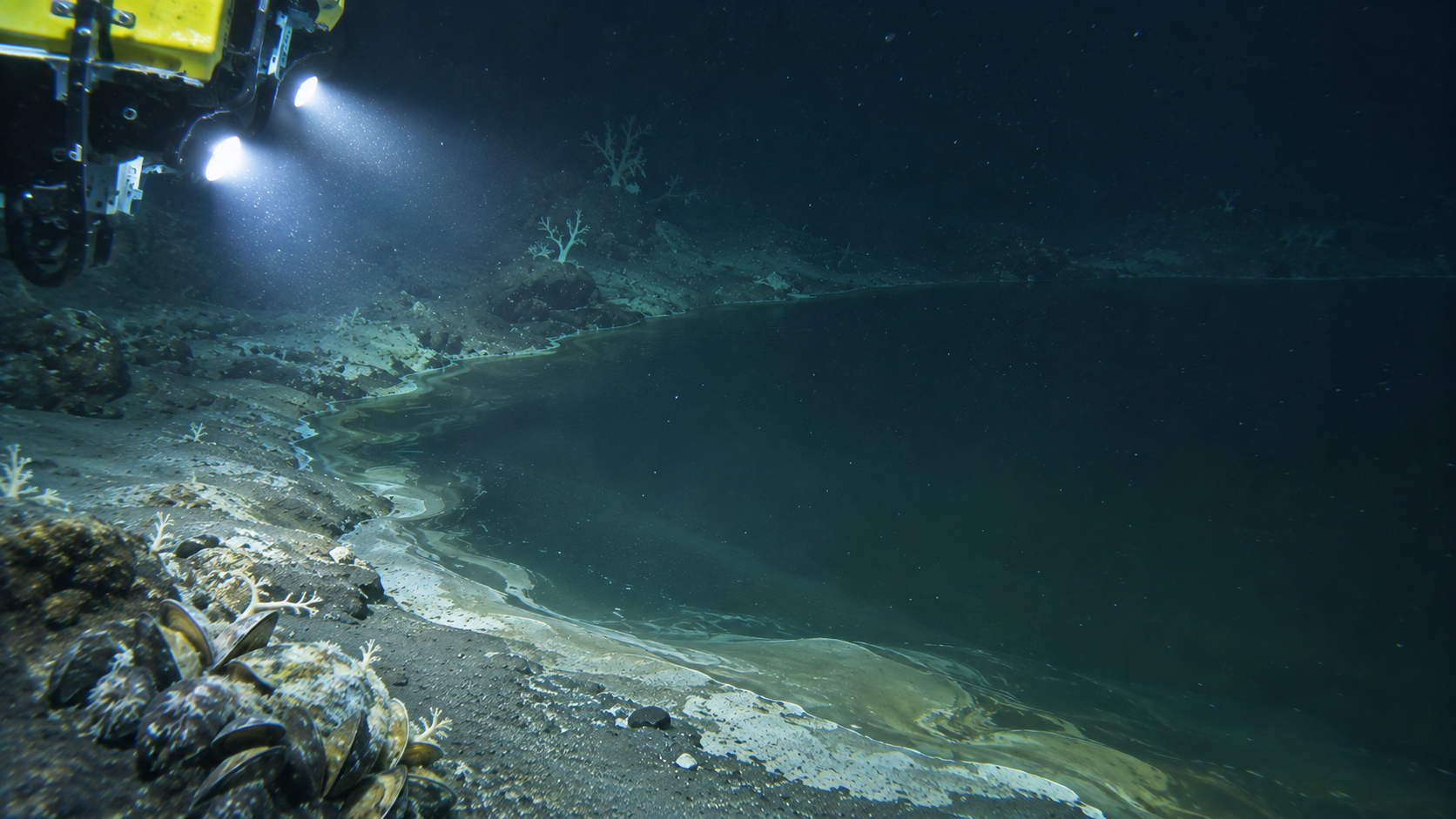
Not a lake hidden beneath the seafloor, but a body of water sitting directly on it, with a distinct boundary separating it from the surrounding ocean.
And for many marine animals, crossing that boundary can be deadly.
It sounds impossible. After all, how can a lake exist underwater when it’s already surrounded by water?
The answer involves an unusual combination of salt, chemistry, and geology. And these strange formations, known as deep-sea brine pools, are revealing some remarkable secrets about life in the ocean.
How Can a Lake Exist Underwater?
The secret is salt. A tremendous amount of it.
Ordinary seawater is already salty, but the water inside these underwater lakes contains far higher concentrations of dissolved salt.
That difference changes how the water behaves.
Think about how oil floats on water. Something similar happens here, except both liquids are water. One is so heavily loaded with salt that it becomes much denser than the other.
The heavier, saltier water sinks into depressions on the ocean floor, while the lighter seawater stays above it.
Instead of immediately mixing together, the two form a distinct boundary.
From the perspective of an underwater camera, that boundary can look surprisingly like the surface of an ordinary lake. It may shimmer, ripple when disturbed, and appear to have a shoreline where it meets the surrounding seafloor.
The separation isn’t perfect. Some mixing does occur, but the difference in density can keep the layers distinct.
And what lies beneath that boundary is very different from the ocean above.
A Remarkable Discovery Beneath the Red Sea
In 2020, researchers exploring the Gulf of Aqaba, a northern extension of the Red Sea, discovered a previously unknown group of underwater brine pools.
The discovery was described in a study published in Communications Earth & Environment in 2022.
Using a remotely operated underwater vehicle, the team found the pools approximately 1,770 metres beneath the surface.
The largest was roughly 260 metres long and 70 metres wide, with three smaller pools nearby.
Researchers named them the NEOM Brine Pools.
What made the discovery especially interesting was their location. They were found only about two kilometres from shore, much closer to the coastline than other previously known deep brine pools in the region.
But their location wasn’t the strangest part.
Measurements showed that the water inside the main pool was approximately four times saltier than the seawater immediately above it.
Oxygen levels also dropped sharply beneath the boundary.
For many marine animals, that combination can be deadly.
What Happens When a Fish Swims Into One?
Imagine a fish moving along the ocean floor and encountering what looks like an ordinary stretch of water.
There may be no obvious physical barrier stopping it from entering.
But the conditions inside a brine pool can be radically different from those just outside.
The extreme salt concentration can interfere with an animal’s ability to regulate water and salts within its body. And because some brine pools contain little or no dissolved oxygen, animals that depend on oxygen-rich seawater can quickly find themselves in serious trouble.
Depending on the species and conditions, entering a pool may cause severe stress, incapacitation, or death.
Some deep-sea brine pools also contain chemicals that make them even more hostile to marine life.
Yet there’s an unexpected twist.
While these underwater lakes can be dangerous to many animals, they aren’t necessarily lifeless.
In fact, some organisms have adapted to conditions that would be intolerable to most creatures in the ocean.
Life Finds a Way — Even Here
At first glance, an extremely salty, oxygen-depleted pool might seem like the last place to look for life.
But microorganisms don’t always follow the same rules as fish, crabs, or other familiar marine animals.
Some microbes can survive in environments with very little oxygen. Others obtain energy from chemical reactions rather than sunlight.
These organisms are often described as extremophiles, meaning they are adapted to conditions that are extreme by the standards of most familiar life.
Around the boundaries of certain brine pools, scientists have found communities of microorganisms living where the salty water meets the surrounding ocean.
The NEOM Brine Pools also support specialized biological communities along their margins.
These environments can be surprisingly complex.
A place that is dangerous to one animal may provide the conditions another organism needs to survive.
And the organisms living around these pools aren’t the only reason scientists are interested in them.
The pools themselves can preserve evidence of events that happened long before anyone discovered them.
These Underwater Lakes Can Hold Clues to the Past
One of the most surprising things about some brine pools is their ability to preserve layers of sediment.
On much of the ocean floor, animals constantly disturb the sediment as they burrow, feed, and move around. Over time, that activity mixes layers that were originally deposited at different times.
But inside certain oxygen-depleted brine pools, many of those animals cannot survive.
With fewer creatures disturbing the bottom, sediment can accumulate in relatively undisturbed layers.
Think of it as a natural record book.
Each layer may contain clues about what was happening in the surrounding environment when it formed.
Researchers studying the NEOM Brine Pools identified sediment records extending back at least 1,200 years.
Those layers contained evidence associated with past floods, seismic activity, and the movement of sediment during tsunami-related events.
By studying them, scientists can learn more about the geological history of the region.
So these underwater lakes aren’t just unusual places where life struggles to survive.
Some also preserve clues about Earth’s past.
But there’s another mystery worth exploring: where does all that salt come from in the first place?
Where Does All That Salt Come From?
The answer can begin millions of years before the brine pools themselves formed.
In some parts of the world, ancient seas left behind enormous deposits of salt.
As water evaporated, dissolved minerals became increasingly concentrated. Eventually, salt accumulated in thick layers that were later buried beneath sediments.
Over geological time, those deposits became part of the landscape beneath the ocean floor.
When seawater comes into contact with buried salt, some of the salt can dissolve, creating water far saltier than the surrounding sea.
That dense brine can then collect in low areas on the seafloor.
Not every brine pool forms in exactly the same way, but the result can be remarkably similar: an underwater basin filled with exceptionally salty water.
And these formations aren’t unique to the Red Sea.
Scientists have discovered brine pools in the Gulf of Mexico and parts of the Mediterranean Sea as well.
Some are small. Others extend across much larger areas of the seafloor.
Each provides scientists with another opportunity to investigate the unusual chemistry and biology of the deep ocean.
And some of what they learn could eventually help answer questions far beyond Earth.
Could These Lakes Tell Us Something About Life on Other Worlds?
Here’s where the story becomes even more fascinating.
Earth isn’t the only place in our solar system where scientists believe large bodies of liquid water may exist.
Jupiter’s moon Europa and Saturn’s moon Enceladus are thought to contain oceans hidden beneath thick layers of ice.
Whether those oceans could support life remains an open question.
But scientists know that life on Earth can survive in places once considered extraordinarily hostile.
Deep-sea brine pools are one example.
Their unusual chemistry, extreme salinity, and oxygen-poor conditions make them valuable places to study how microorganisms survive under difficult circumstances.
Researchers can investigate how these organisms obtain energy, tolerate high salt concentrations, and function in environments without sunlight.
That knowledge may help scientists better understand the conditions under which life could exist elsewhere.
Of course, studying a brine pool on Earth doesn’t prove that life exists on Europa, Enceladus, or anywhere else.
And the conditions inside Earth’s brine pools aren’t necessarily identical to those on distant moons.
But these environments offer an important reminder.
Life doesn’t always require the comfortable conditions we’re familiar with.
Sometimes, it survives in places that seem almost impossible.
An Entirely Different World Beneath the Waves
When we imagine the ocean, we tend to picture one enormous body of water stretching from the surface to the seafloor.
But the reality is far more complicated.
Thousands of metres beneath the waves, differences in salt concentration and density can create distinct bodies of water, complete with boundaries that resemble the surfaces and shorelines of lakes.
Some are dangerous to marine animals. Others support remarkable microbial communities. And some preserve records of events that happened centuries ago.
We’ve mapped distant planets, photographed black holes, and sent spacecraft into the outer solar system.
Yet here on Earth, deep beneath the ocean, there are still extraordinary environments that scientists are working to understand.
There are lakes at the bottom of the ocean. And what scientists are discovering around them may be just as remarkable as the lakes themselves.
SOURCES: Communications Earth & Environment, Smithsonian Ocean, NOAA Ocean Exploration.