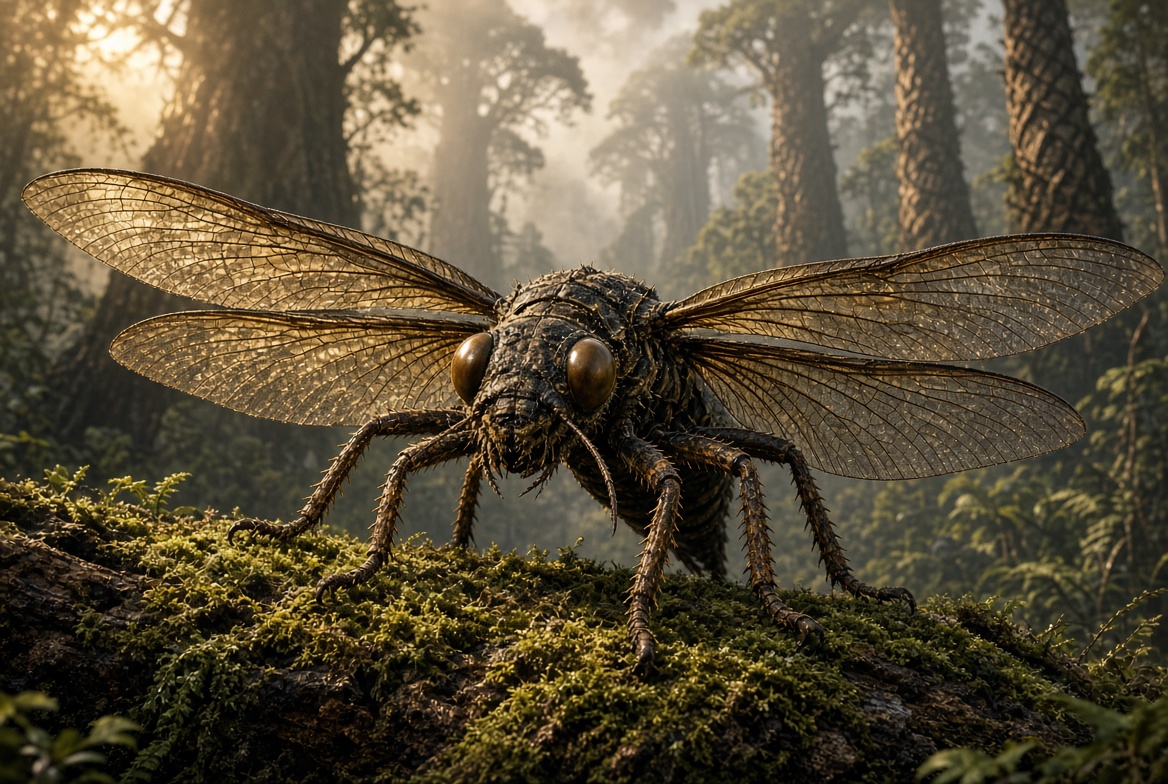
Roughly 300 million years ago, the largest flying insect known from the late Carboniferous had a wingspan of about 65 to 75 centimetres—roughly the length of a human arm. Its name is Meganeura monyi. It belonged to an extinct group called griffinflies (Meganisoptera), close relatives of modern dragonflies but not true dragonflies themselves. On the ground lived Arthropleura, a millipede-like animal that grew to roughly two to two and a half metres long. Neither was a dinosaur. Both lived in dense coal-swamp forests tens of millions of years earlier, when the air held more oxygen and nothing with feathers, fur, or leathery wings yet hunted in the sky.
The usual explanation for these sizes is oxygen. Models of the atmosphere place late Carboniferous and early Permian oxygen levels at roughly 30 to 35 percent, well above today’s 21 percent. Insects do not have lungs. They move air through a network of tubes that branch through the body. Higher oxygen, the long-standing argument goes, let that system support larger bodies. The timing matches: the giants appear when oxygen was high and disappear as levels fall.
A 2026 study in Nature makes the picture less simple. Researchers looked at the finest oxygen-delivery tubes inside the flight muscles of 44 modern insect species, covering a huge range of body sizes. Those tubes took up very little space—typically 1 percent or less of the muscle—even in the largest insects. The proportion rose only slightly as body size increased. When the same relationship was applied to Meganeuropsis permiana, a slightly larger early Permian griffinfly with a wingspan near 71 centimetres and an estimated mass of about 100 grams, the tubes still occupied only a tiny fraction of the muscle. The researchers concluded that oxygen delivery at this fine scale does not appear to have been a hard limit on insect size. The finding does not prove oxygen was irrelevant. It does suggest it was not the only factor, and maybe not the main one.
Other conditions lined up at the same time. No birds, bats, or pterosaurs yet existed to hunt large flying insects. The coal forests offered open space and abundant food. Large size may also have helped some of these animals in direct competition with each other. Once flying vertebrates arrived and oxygen levels dropped, the advantages of extreme size shrank. The giants disappeared. Griffinflies themselves lasted into the Permian, and some large forms continued after the Carboniferous peak, which already hinted that oxygen alone was not a simple switch.
Fossils of Meganeura, mainly from the Commentry coal measures in France, show broad, heavily veined wings built more for steady flight than the sharp turns modern dragonflies make. It probably spent a fair amount of time perched, then launched itself after prey. What it hunted is not fully known, but other large insects of the time would have been available. Body-length estimates for the largest individuals run up to about 60–75 centimetres; mass estimates range from under 20 grams in older work to 100–150 grams in later analyses.
Arthropleura is known from body fossils and trackways up to about 50 centimetres wide. A large partial specimen from Northumberland, England, supports length estimates near 2.6 metres and a mass around 50 kilograms for the biggest individuals. A 2024 study of juvenile heads, published in Science Advances, showed a mix of millipede-like and centipede-like features. The mouthparts are consistent with an animal that fed on plant material rather than hunting as an active predator.
The Carboniferous Period itself lasted from about 359 to 299 million years ago. The coal forests of its later part became the source of many of the world’s major coal deposits. Those forests were dominated by lycopsids (scale trees), ferns, horsetails, and early seed plants. Flowering plants had not yet evolved. The combination of high plant productivity, burial of organic matter, and the resulting atmospheric chemistry produced both the coal and the elevated oxygen levels reconstructed by most models.
Meganeura monyi is placed in the Meganisoptera with a wingspan of 65–75 cm and is interpreted as a predator of other insects in coal-swamp forests. Meganeuropsis permiana, also a meganisopteran, reached about 71 cm wingspan in the early Permian and is likewise treated as a predator. Arthropleura, a myriapod relative of millipedes, is estimated at roughly 2–2.6 m long and about 50 kg, living in coal swamps and near-coastal woodlands as a detritivore on plant material. The largest modern dragonflies and damselflies reach wingspans of up to about 19 cm and remain predators in tropical forests and wetlands. The scale difference is clear.
What remains unresolved is the relative weight of oxygen, ecological opportunity, and other factors. Some charcoal-based proxies and newer geochemical work support high late Paleozoic oxygen; other proxy studies have produced lower estimates. The 2026 results remove one proposed mechanical limit but leave open whether higher oxygen still conferred advantages through other pathways, such as overall metabolic support or fire regimes that shaped vegetation. Large size in arthropods also carries structural and developmental costs that are independent of oxygen. The fossils show that the upper limit on insect and arthropod size sat substantially higher in the late Carboniferous and early Permian than it does today. The precise combination of reasons is still only partly understood.
SOURCES: Nature, Science Advances, Wikipedia, Britannica, Fossilguy, Reuters, Science (AAAS), Guinness World Records, Natural History Museum, Journal of Experimental Biology.