Official time in Canada is maintained by the National Research Council in Ottawa as UTC(NRC), Canada’s realization of Coordinated Universal Time. Legal time — the hour a school, court, or bus schedule uses — is generally determined by provincial and territorial law, while federal law also contains rules governing standard time for federal enactments. A phone can display the wrong local time after a law changes because its time-zone database may not yet reflect the new legal rule. Its underlying clock can also drift if it is not synchronizing with a time source. Those three layers are the whole system.
The rest of this page is who keeps the official time scale, how that time reaches the public, why the NRC does not choose your time zone, and what “on time” means when those layers drift apart.
Who keeps official time in Canada?
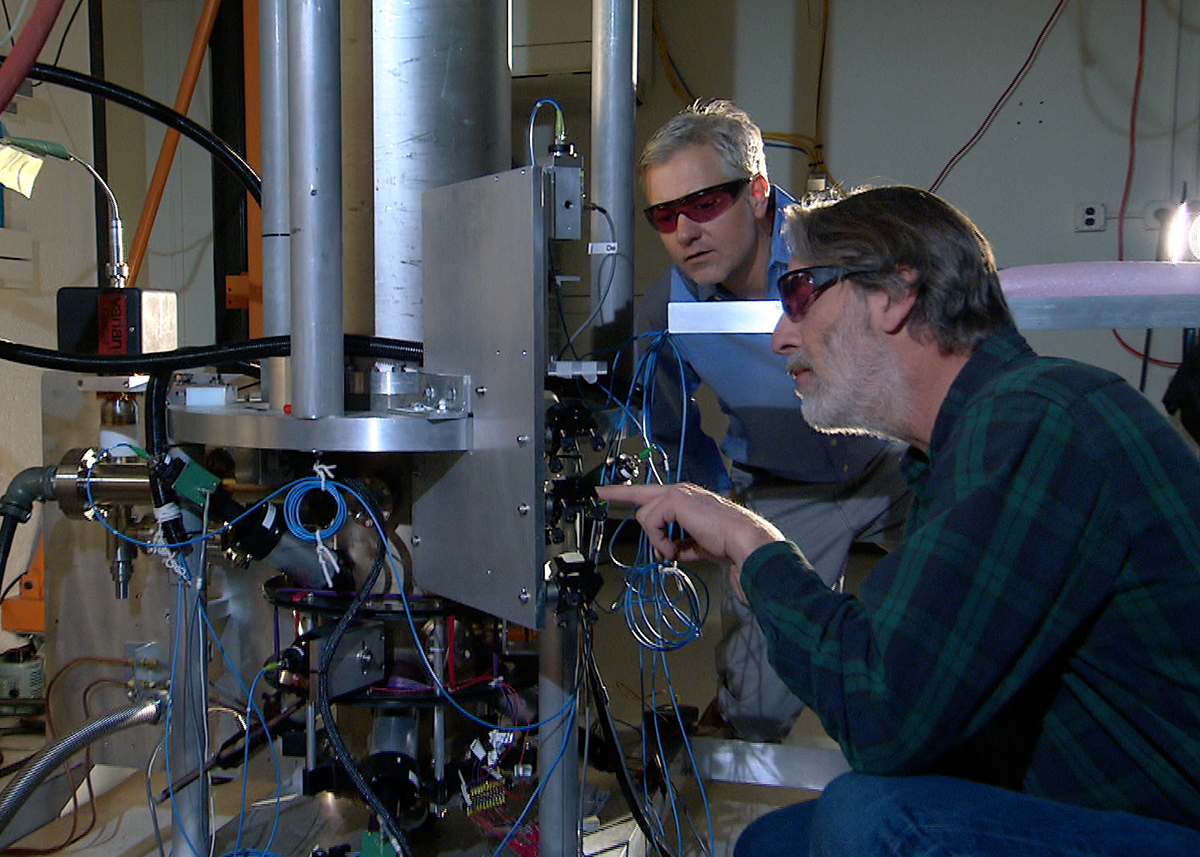
The National Research Council is the federal agency responsible for official time. Metrologists in its frequency and time group run an ensemble of atomic clocks at the time standards laboratory in Ottawa. The scale they produce is called UTC(NRC). It is Canada’s realization of Coordinated Universal Time, the international reference used by national labs around the world.
That role is older than the current lab branding. Civil time signals in Canada began with astronomers. An order-in-council in 1941 named a federal scientific body as the source of official time. In 1970, the work moved from the Dominion Observatory tradition to the NRC, where it sat with atomic frequency standards instead of with the night sky. The institution changed. The job did not: keep a time scale that other clocks can trust.
The NRC does not run the clocks in every kitchen. It keeps the reference. Everything else is a copy, a broadcast, or a legal label applied to that reference.
How does an atomic clock become “the time”?
A cesium atomic clock does not tell 3:00 p.m. in the sense a wristwatch does. It counts a physical frequency. The international definition of the second is a fixed number of oscillations of a cesium-133 atom. The clock measures those oscillations and, after that count, one second has passed.
One clock is not enough. The Ottawa laboratory runs a group of clocks and compares them continuously. Individual clocks can differ by tiny amounts. An average of the ensemble is more stable than any single unit.
UTC(NRC) is then compared with other countries’ official scales so that Canada’s realization stays inside the international UTC system. Official time in Canada is not a private national invention. It is a national realization of a shared international scale.
When daylight saving time starts or ends in a province that still uses it, the NRC does not open the cesium clocks and turn a dial. The atomic ensemble keeps running. The one-hour change applies to the civil-time display and services that present the legal local time, not to UTC(NRC) itself.
What is UTC, and how is it different from the time on the wall?
Coordinated Universal Time is the modern implementation of Greenwich Mean Time as the international reference, although some Canadian laws and regulations still use “Greenwich Mean Time” in their wording. Time zones are written as offsets from that scale: Atlantic Time is four hours behind UTC in winter, Newfoundland Time is three and a half hours behind, and so on.
UTC is not a place you can stand. It is an international time scale realized by national measurement laboratories and coordinated through the global metrology system. Noon UTC is not solar noon in Ottawa or in Greenwich in the old sense. Civil clocks in Canada use an offset from UTC as each province’s or territory’s law requires.
Two other scales sit in the background. International Atomic Time is a pure atomic count with no leap seconds. Earth rotation time, often called UT1, follows the planet as it speeds up and slows down by tiny amounts. UTC is based on atomic time, with leap seconds used when required to keep it from drifting too far from Earth rotation. The NRC publishes the difference values used by navigators and surveyors. None of that changes the hour a store prints on its door.
How does official time reach the public?
The NRC disseminates its official time through several channels. They differ in convenience, not in the source.
Shortwave station CHU used to broadcast the official signal from a site southwest of Ottawa, on 3.330, 7.850 and 14.670 megahertz. That radio service ended in June 2026. American stations WWV and WWVH can still be heard in Canada on shortwave. The NRC’s official time is now reached through the web clock, the telephone talking clock, and Network Time Protocol.
A telephone talking clock in Ottawa announces Eastern Time at regular intervals, then a tone. The English line is 613-745-1576. The French line is 613-745-9426. The call cuts off after a few announcements. From outside the local area, ordinary long-distance rates may apply. The voices are recorded. They are not a person sitting by a microphone all day.
CBC Radio carried an NRC time signal once a day for more than 80 years, but CBC and Radio-Canada stopped broadcasting it in October 2023. That beep was the version many Canadians grew up hearing without knowing the lab’s name.
Computers and servers can use Network Time Protocol. The public NRC host names are time.nrc.ca and time.chu.nrc.ca. They are not websites. They are stratum-2 time servers that obtain their time from NRC’s stratum-1 servers, which are synchronized to atomic frequency standards. A home computer that “sets time automatically” usually talks to a pool of NTP servers, which may or may not be these two. Federal systems that need a traceable Canadian source can use NRC time on purpose. Shared Services Canada’s Enterprise Time Service is one federal example: it relies on NRC TimeLink as its preferred time source for federal networks.
The NRC also runs a web clock that displays official time by zone and shows how far a visitor’s device has drifted. That page is a demonstration of the reference, not the law that names your zone.
Who decides the hour on the wall?
For ordinary civil time, provinces and territories generally determine the applicable legal time through legislation and regulations, including rules on time zones and daylight saving time. Federal law also contains rules governing standard time for federal enactments and can provide exceptions.
Zone boundaries, daylight saving, and year-round locked offsets are written in provincial and territorial statutes and regulations. The NRC publishes time-zone information and notes major changes in official practice. It does not pass those statutes. Saskatchewan, for example, can stay on Central Standard Time all year. Yukon can stay on UTC−7 all year. British Columbia has established a year-round Pacific offset. Alberta has adopted a year-round UTC−6 offset; after the final seasonal change in March 2026, clocks will not move back in November 2026, and the Northwest Territories has adopted a year-round UTC−6 standard, effective August 21, 2026. Ontario continues to use seasonal clock changes. None of that requires the cesium ensemble to change its count.
Some municipalities and regions have local time practices that differ from the general provincial pattern. Blanc-Sablon in Quebec is a statutory example. Atikokan in Ontario is a longstanding local-practice example. Neither is an NRC policy.
Federal offices generally operate according to the applicable legal time where they are located, but a deadline or other time specified by a federal enactment can be governed by the federal Interpretation Act and its definition of standard time. The official time scale underneath both remains UTC(NRC).
Why can a phone disagree with official time?
Phones, laptops, and many cars get the current time from a network or other time source, while software uses a time-zone database such as IANA’s to determine the local civil-time rules. That database is very good. It is not a Canadian statute.
When a province changes its time law in the middle of a year, two things happen on different clocks. The NRC keeps counting seconds. The province’s legal offset changes on the date the law names. Phone makers and app vendors then ship a database update. Until that update arrives, a lock screen can show last year’s rule.
A large error on a device is usually a wrong zone setting, not a wrong official time source. If the NRC web clock and a phone differ by an hour, the phone’s zone or daylight-saving setting is the first place to look. If they differ by a few seconds, the device is ordinary. If they differ by minutes and the zone is correct, the device is not synchronizing.
GPS provides another precise time reference. Its system time is maintained in close relation to UTC, but it is not UTC(NRC). A phone that uses GPS for location is not, by itself, displaying UTC(NRC).
What official time is for
People use legal time to meet. Official time is for systems that have to agree when “the same moment” was.
Telecom networks, power grids, broadcast transmitters, and financial time-stamps need a shared time reference. Navigation and surveying need a time scale that can be traced to a national lab. Science needs a second that matches the SI definition. The NRC’s job is that shared reference. The provincial job is the label printed on the meeting invite.
Those purposes explain the precision. A bus driver does not need a nanosecond. A network that timestamps millions of packets may.
A short history, only as far as it helps
Standard hour zones in Canada descend from nineteenth-century railway practice and from Sandford Fleming’s campaign for a worldwide hour grid. That history explains why most zones are one hour wide and why Newfoundland’s half hour looks odd. It does not explain who keeps the time scale today.
Astronomers once defined official time from Earth rotation and the position of the sun. Atomic clocks replaced that definition because atoms repeat more steadily than the planet turns. Canada followed that shift when official time moved into the NRC’s frequency work. The talking clock and the radio beep are the public remnants of the older service. The lab behind them is an atomic one.
Common mistakes
The NRC does not “change the clocks” for Canada each March. It maintains UTC(NRC). Provinces and territories that use daylight saving change the civil-time label applied to that reference.
UTC is not “the time in England.” It is an international time scale. London’s legal clock is an offset from UTC, the same as Halifax’s.
A phone that updates itself is not reading a provincial gazette. It is reading a time-zone database that usually tracks legal changes, after the relevant software update becomes available.
“Official time” and “the correct time where I live” are not synonyms. The correct local time is the reference time plus the legal offset that applies where you are.
Limits
This page describes the standing system: NRC as Canada’s official timekeeper, UTC(NRC) as Canada’s realization of UTC, and provinces and territories as the primary authorities for ordinary civil time. Federal law also contains rules governing standard time for federal enactments. Service details — a telephone number, an NTP host name, a CHU frequency — can move. If you need the signal itself, use the current NRC time-services page.
Leap seconds and a possible future redefinition of the SI second in terms of an optical clock are live topics in metrology. They do not change how a Canadian court dates an affidavit this year. They are reasons the laboratory exists, not reasons to reset a kitchen clock.
Short wrap
Canada maintains official time in an Ottawa laboratory as UTC(NRC), using an ensemble of atomic clocks and disseminating that reference through telephone, internet time servers, and other services. Provinces and territories generally determine the legal local time people use on the street, while federal law contains its own rules for standard time in federal enactments. A phone is another implementation, usually close and sometimes late. If you want Canada’s official time reference, look to the NRC. If you want the legal hour on the wall, look to the law where you live.
SOURCES: National Research Council Canada; Shared Services Canada; Interpretation Act; Ontario Time Act; Quebec Legal Time Act; IANA Time Zone Database; Canadian Encyclopedia; Government of Alberta, Alberta’s new time system; Government of British Columbia, Adopting permanent daylight saving time; Northwest Territories Time Regulations, R-090-2026; NRC official time services, NTP and time-zone pages.