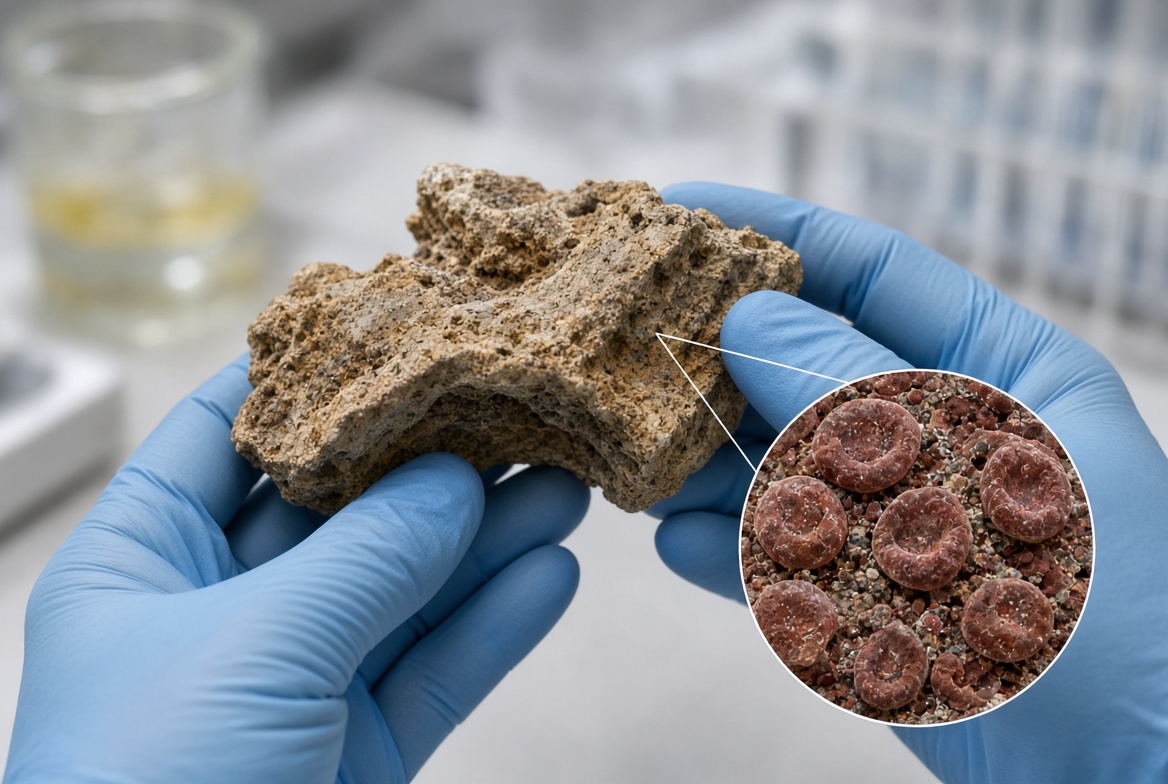
A fragment of leg bone from a small meat-eating dinosaur that lived roughly 115 million years ago in what is now northeastern Brazil contains microscopic structures that researchers interpret as mineralized red blood cells, along with chemical traces of a key component of hemoglobin.
The dinosaur is Aratasaurus museunacionali, a basal coelurosaurian theropod known from a partial right hind limb recovered in 2008 from a plaster mine in the Romualdo Formation. The individual was not fully grown; estimates put it at about 3.1 meters long and roughly 34 kilograms. The bones belong to the holotype specimen and had been studied for years before the soft-tissue work began.
In a paper published in the Proceedings of the National Academy of Sciences, an international team led by organic geochemist Kliti Grice of Curtin University examined thin sections of the limb bones and identified numerous ellipsoidal microstructures inside the vascular canals that once carried blood vessels. The structures average about 23 micrometers in length and 20 micrometers in width. They sit within the canals rather than scattered through the bone, and they are mineralized with hausmannite, a manganese oxide.
The chemical evidence centers on heme B, the iron-containing molecule that allows hemoglobin to bind oxygen, and on altered forms of it such as 3,8-diethyl heme B. High-performance liquid chromatography–mass spectrometry detected these compounds in bone extracts. Raman spectroscopy and transmission electron microscopy placed porphyrin signals and key elements (iron, nitrogen, and carbon) within the same microstructures. The surrounding rock and microbial mat material yielded chlorophyll and bacteriochlorophyll signatures instead, which the authors use to argue that the heme-related molecules are endogenous rather than contamination from the burial environment.
The researchers emphasize that they did not recover intact blood or free hemoglobin proteins. What remains are mineralized cellular outlines and molecular remnants that survived fossilization. Grice has described the find as a mineral and molecular echo of ancient biology rather than a vial of dinosaur blood. No DNA suitable for cloning or sequencing was reported.
Preservation appears to have depended on rapid burial in a low-oxygen setting influenced by microbial activity, followed by early mineralization with manganese oxides that helped lock the structures in place. The Romualdo Formation is already known for exceptional fossil preservation; this specimen adds a molecular dimension to that reputation.
Earlier claims of soft-tissue structures in dinosaur bones, including possible blood cells, have been reported and debated for years. Some researchers have argued that apparent cells can form through other processes or represent bacterial films or mineral artifacts. The present study is presented as stronger than many earlier reports because the cell-like structures are located inside vascular canals, are associated with hausmannite, and carry in-situ chemical evidence linked to heme. Not all specialists are convinced. Paleontologist Mary Schweitzer, who has published on dinosaur soft tissues, has noted that the reported collagen amino acids and heme signals are more persuasive than the identification of the structures themselves as red blood cells, in part because the shapes do not perfectly match typical reptilian red blood cells.
The finding does not rewrite dinosaur physiology in a dramatic way. It does extend the known record of blood-related molecular traces in dinosaurs and suggests that certain biomolecules can persist longer than many models assumed when the right burial and mineralization conditions occur. Museum drawers contain many nondescript bone fragments that have never been examined with the combination of microscopy and molecular techniques used here. Whether similar material exists in other specimens is an open question the authors themselves raise.
What the study securely demonstrates is the co-occurrence, inside vascular canals of a 115-million-year-old theropod limb bone, of ellipsoidal microstructures mineralized by hausmannite and of heme-derived molecules that differ chemically from the surrounding matrix. That combination is what the research team treats as the strongest current evidence for mineralized red-blood-cell remnants in a dinosaur. The precise degree to which the structures retain original cellular morphology, and how widely such preservation occurs, remain subjects for further work.
SOURCES: Proceedings of the National Academy of Sciences, New Scientist, Reuters, Science, Sci.News, Live Science, Wikipedia.