Imagine walking across a vast, empty desert and discovering something that seems impossible.
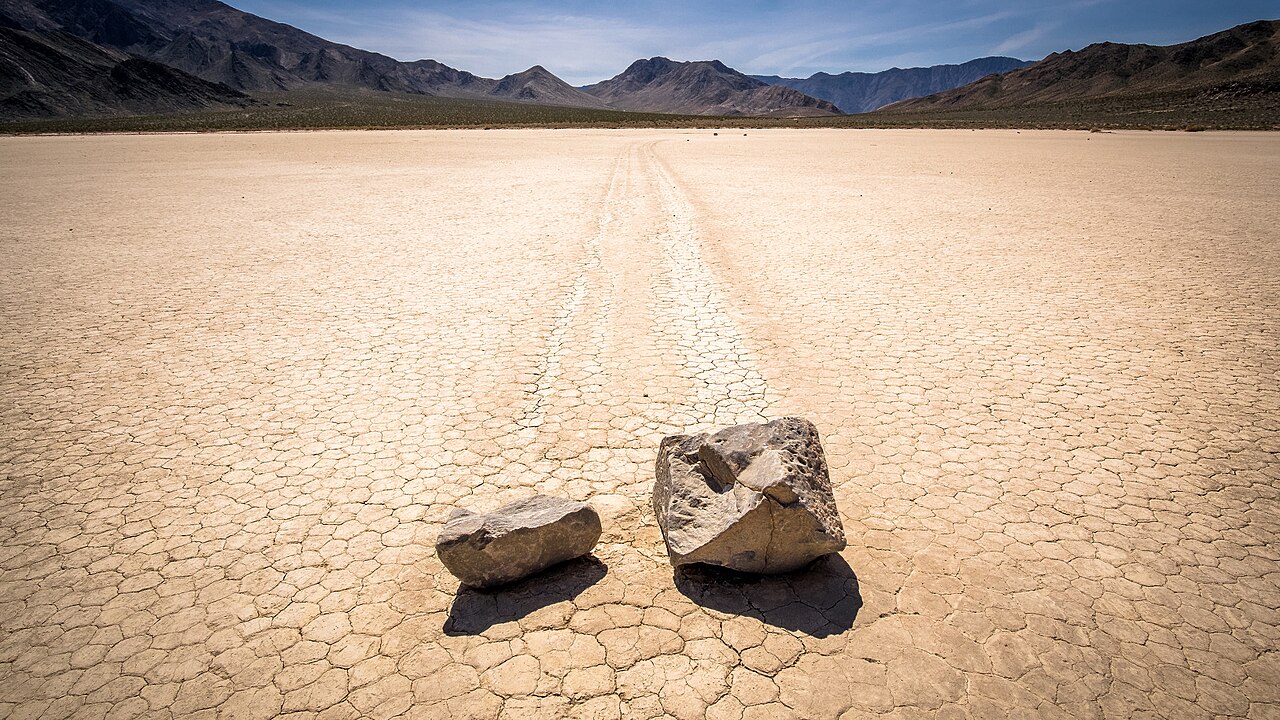
Scattered across the dry ground are dozens of rocks. Some are small, while others are surprisingly heavy.
But behind many of them are long trails carved into the earth.
Some tracks run almost perfectly straight. Others curve, turn, or suddenly change direction.
It looks as though someone has been dragging the rocks across the desert.
Except there’s nobody around.
And for decades, scientists couldn’t directly observe what was moving them.
The mystery became one of the strangest natural phenomena in California’s Death Valley.
Then, after years of speculation, researchers finally caught the rocks in motion.
And the explanation was far more surprising than many people expected.
The Mysterious Moving Rocks of Death Valley
Deep inside Death Valley National Park lies a remote, dry lakebed known as Racetrack Playa.
The landscape is almost perfectly flat, surrounded by rugged mountains and exposed to some of the harshest desert conditions in North America.
Most of the time, the ground is dry and cracked.
Across its surface sit hundreds of rocks, many of which have fallen from nearby mountains.
But these aren’t ordinary-looking rocks.
Behind some of them are trails stretching across the lakebed, showing that the stones have moved from one location to another.
Some trails are relatively short. Others extend for hundreds of meters.
Even stranger, nearby rocks sometimes leave remarkably similar tracks, almost as though they were moving together.
The rocks became known as sailing stones because they appeared to travel across the desert floor.
But how?
Rocks don’t have legs. They don’t roll across the perfectly flat ground in neat lines. And some are far too heavy to be easily pushed around.
For years, their movement remained a mystery.
Scientists Had Plenty of Theories
Researchers had been investigating the moving rocks since at least the 1940s.
One possible explanation was wind.
Death Valley can experience powerful winds, and some scientists wondered whether strong gusts could push the rocks across the ground.
But there was a problem.
Many of the stones were heavy, and moving them across dry mud would require considerable force.
Other researchers suspected water might be involved.
Although Racetrack Playa is usually dry, rain and melting snow can occasionally create shallow pools across its surface.
Perhaps wet mud became slippery enough for rocks to slide.
Ice was another possibility.
During cold winter nights, shallow water on the playa can freeze.
Could ice somehow help move the rocks?
The theories were intriguing, but there was one major obstacle.
Scientists needed to catch the rocks moving to understand exactly what was happening.
And that was much harder than it sounds.
The Rocks Could Sit Still for Years
One reason the mystery lasted so long was that rock movement was extremely rare.
A visitor could spend hours walking across Racetrack Playa without seeing anything unusual.
The rocks might remain in the same place for years.
Then, under the right conditions, some would suddenly move.
By the time someone returned, the rocks might be sitting somewhere else, with fresh trails stretching behind them.
Whatever caused the movement often happened when nobody was watching.
Researchers needed a way to monitor the rocks without standing in the desert waiting indefinitely.
Eventually, they developed a plan.
The Experiment That Finally Solved the Mystery
In 2011, researchers began a project designed to observe the rocks directly.
They installed a weather station and cameras at Racetrack Playa.
They also placed specially prepared rocks equipped with GPS tracking devices on the lakebed.
The instruments could record when the stones moved, how far they traveled, and how quickly they changed position.
The researchers were prepared to wait.
And in December 2013, their patience paid off.
The conditions were finally right.
Water had collected on the playa, and cold temperatures had allowed a thin layer of ice to form.
As the morning sun warmed the surface, the ice began to break apart.
Light winds pushed the floating ice across the shallow water.
And then something extraordinary happened.
The rocks started moving.
On December 20, 2013, researchers observed an event involving more than 60 moving rocks.
For the first time, scientists had directly documented the process responsible for at least some of Racetrack Playa’s mysterious trails.
Their findings were published in the scientific journal PLOS ONE in 2014.
The Secret Was Ice — But Not How You Might Expect
The answer wasn’t powerful winds pushing dry rocks across the desert.
It wasn’t an earthquake or some mysterious force beneath the ground.
It was a rare combination of water, ice, sunlight, and wind.
Here’s how it works.
First, rain or melting snow creates a shallow pool of water across part of Racetrack Playa.
When temperatures fall below freezing, a thin sheet of ice forms on the water.
As sunlight warms the surface, the ice begins to melt and fracture into large floating panels.
A steady breeze then pushes those panels across the water.
When the moving ice presses against rocks protruding through the shallow water, it can push them along the muddy lakebed.
The rocks scrape across the soft surface, leaving trails behind them.
Eventually, the water evaporates or drains away, and the mud dries.
What remains is a rock sitting at the end of a mysterious track.
The remarkable part is how little force is needed once the conditions are right.
Researchers observed rock movement with ice just a few millimeters thick and winds that were relatively gentle.
The rocks weren’t being violently blown across the desert.
They were being slowly pushed by floating ice.
How Fast Do the Rocks Actually Move?
You might imagine the stones racing across the lakebed.
But their movement is usually much less dramatic.
During the documented events, researchers measured speeds of approximately 2 to 5 meters per minute.
That’s slow enough that someone watching from a distance might not immediately notice the movement.
Yet over several minutes, the rocks can travel considerable distances.
Some GPS-equipped stones moved more than 200 meters over multiple movement events during the winter of 2013–2014.
The researchers also discovered that nearby rocks could move in similar directions because they were being pushed by the same ice panels.
That helped explain why some trails appear almost synchronized.
But not every rock moves at the same time.
Some remain stationary while others nearby travel across the lakebed.
The movement depends on how the ice interacts with individual rocks and the changing conditions around them.
Why Doesn’t This Happen All the Time?
If wind and ice can move rocks, why isn’t Racetrack Playa constantly changing?
Because the necessary conditions rarely occur together.
The lakebed needs enough water to form a shallow pool.
Temperatures must become cold enough for ice to develop.
The ice then needs to begin melting while remaining sufficiently intact to push against rocks.
And there must be enough wind to move the floating panels.
If the ground is completely dry, the process cannot happen.
If the ice melts too quickly, it may break apart before moving the stones.
And if the wind isn’t strong enough, the ice may remain nearly stationary.
That unusual combination helps explain why rock movement can be separated by years.
It also explains why the mystery was so difficult to solve.
Scientists weren’t simply waiting for rocks to move.
They were waiting for several specific weather conditions to occur at the same time.
Why Do Some Rocks Leave Curved Trails?
One of the most fascinating details at Racetrack Playa is the shape of the tracks.
Some rocks leave straight lines.
Others create curves, bends, or paths that change direction.
At first glance, these patterns can look almost deliberate.
But the explanation lies in the movement of the ice and water.
As wind direction changes, floating ice panels can shift their course.
Water flowing beneath the ice can also influence the direction of movement.
A rock being pushed by one panel may follow a different path from a rock being pushed by another.
Sometimes several stones move together, leaving nearly parallel tracks.
Other times, their paths diverge.
What appears to be a carefully drawn pattern is actually the result of changing natural forces.
Does This Mean Every Moving Rock Mystery Is Solved?
The 2014 research provided direct evidence for a mechanism capable of moving rocks across Racetrack Playa.
It was a major breakthrough.
However, that doesn’t mean every historical rock movement has been individually explained.
Scientists did not witness every trail being formed, and the observed mechanism doesn’t establish the exact circumstances behind every older track.
Nevertheless, the research demonstrated that thin floating ice driven by wind can move rocks across the playa.
It transformed a long-standing mystery into a documented natural process.
And it revealed something remarkable about the desert.
A landscape that looks completely dry and lifeless can occasionally become the setting for a delicate interaction between water, ice, wind, and stone.
Can Visitors See the Moving Rocks?
Racetrack Playa remains one of Death Valley’s most unusual natural attractions.
Visitors can see the stones and the tracks they leave across the dry lakebed.
But actually witnessing a rock move is extremely unlikely.
The conditions are rare, and movement can occur over relatively short periods.
The location is also remote, with access requiring careful preparation.
The National Park Service warns visitors that the playa surface is fragile.
Driving onto the lakebed is prohibited, and visitors should not move or remove the rocks.
Walking on wet mud can also damage the surface and leave marks that interfere with the natural tracks.
The best way to appreciate the phenomenon is to observe the landscape without disturbing it.
The Bottom Line
For decades, rocks moving across Death Valley’s desert floor seemed to defy explanation.
They left long trails behind them, sometimes changing direction and occasionally moving together.
Yet nobody had directly documented the process.
That changed when researchers equipped rocks with GPS devices and monitored the conditions at Racetrack Playa.
Their observations revealed that a rare combination of shallow water, thin ice, sunlight, and wind can push stones across the muddy lakebed.
The explanation doesn’t require extraordinary forces.
In fact, that’s what makes the discovery so fascinating.
Some of the desert’s strangest movements are caused not by powerful storms, but by thin sheets of ice drifting across shallow water.
SOURCES: National Park Service, PLOS ONE, Scripps Institution of Oceanography, Boise State University.