Imagine growing old, reaching adulthood and then doing something that seems impossible: turning yourself back into a younger version of yourself.
For almost every animal on Earth, life moves in one direction. A creature is born, grows, reaches maturity and eventually dies.
But deep beneath the ocean’s surface lives a tiny animal that can break this biological pattern.
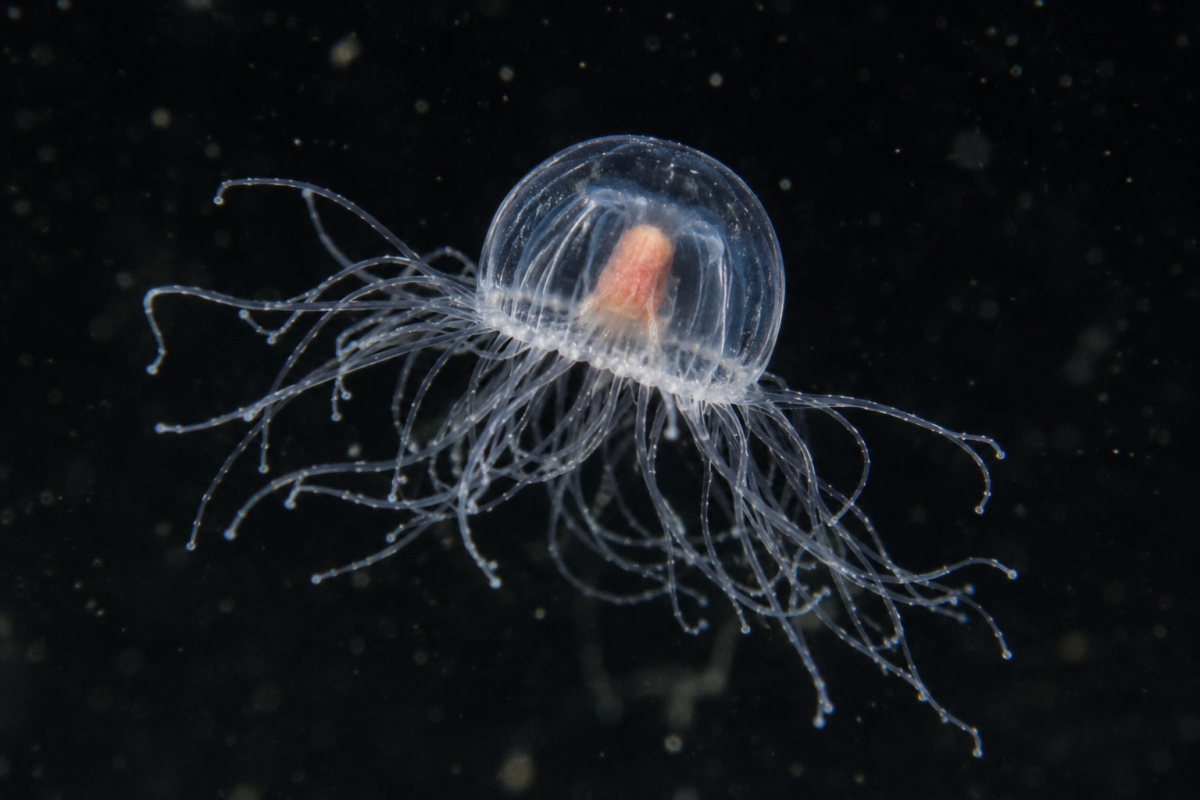
It’s called Turritopsis dohrnii, better known as the immortal jellyfish. Barely a few millimeters across, this remarkable creature has an ability that sounds like science fiction: under certain conditions, it can reverse its development and return to an earlier stage of life.
Instead of simply growing older, it can essentially start over.
Scientists are studying this extraordinary animal to understand how it manages such a transformation, and what its unusual biology might reveal about aging, regeneration and the limits of life itself.
Meet the Immortal Jellyfish
Despite its dramatic nickname, Turritopsis dohrnii is surprisingly small and unassuming.
This species of hydrozoan jellyfish lives in marine environments and has a transparent, bell-shaped body. Its adult form is only a few millimeters in size, making it easy to miss in the vast ocean.
Yet this tiny animal possesses an ability that sets it apart from most other creatures.
When faced with certain stressful conditions, including physical damage or starvation, it can reverse its life cycle. Rather than continuing along the usual path toward the end of its life, it can transform from an adult jellyfish back into a juvenile polyp.
Think of it as biological time travel, except the animal isn’t traveling through time. It’s changing its own developmental stage.
This remarkable ability is the reason scientists and nature enthusiasts have given it the nickname “immortal jellyfish.”
How Does It Turn Back the Clock?
To understand just how unusual this process is, it helps to look at the jellyfish’s normal life cycle.
It begins as a fertilized egg, which develops into a tiny swimming larva. Eventually, the larva settles onto a surface and grows into a polyp.
The polyp is a small, stationary structure that can produce young jellyfish. These develop into free-swimming adults called medusae.
For most jellyfish, this is a one-way journey.
But Turritopsis dohrnii has an extraordinary alternative.
When conditions become unfavorable, its adult body can begin to change dramatically. The jellyfish shrinks, loses its familiar bell shape and settles onto a surface.
It then forms a cyst-like structure. Inside this structure, its tissues undergo an extensive transformation.
Gradually, the animal reorganizes itself until it develops into a polyp once again.
An adult jellyfish has effectively returned to an earlier stage of its life.
And this isn’t just a theoretical possibility. Researchers have observed the transformation in laboratory conditions, including repeated reversals of the life cycle.
The Incredible Science Behind Its Transformation
How can an animal change its own biological identity so dramatically?
One important part of the answer involves a process known as transdifferentiation.
In most animals, cells become specialized to perform particular jobs. Muscle cells help the body move, nerve cells transmit information, and other cells perform their own specific functions.
Transdifferentiation occurs when one specialized cell type changes directly into another type.
During the jellyfish’s transformation, cells and tissues are reorganized as its adult body develops back into a polyp.
This is not simply ordinary healing. The animal undergoes a major biological reorganization that reverses its development.
Scientists are investigating the genes and molecular processes that make this possible.
A 2022 study published in the scientific journal Proceedings of the National Academy of Sciences compared the genome of Turritopsis dohrnii with that of a closely related jellyfish that does not possess the same rejuvenation ability.
Researchers identified genetic differences and biological mechanisms potentially associated with the immortal jellyfish’s unusual capacity to reverse its development.
These included processes connected to DNA repair, cellular communication, stem-cell activity and the maintenance of genetic material.
The findings offer important clues, but scientists have not yet uncovered every detail of how this remarkable transformation works.
Can It Really Live Forever?
Here’s where the story needs a little clarification.
The immortal jellyfish isn’t invincible.
Its nickname refers to its ability to reverse its life cycle, not an ability to survive every possible danger.
A predator can eat it. Disease can kill it. Environmental changes and other threats can end its life.
Its extraordinary advantage is that it may be able to avoid the usual progression of aging by returning to an earlier developmental stage.
Scientists have observed this reversal under controlled conditions, but that doesn’t mean every individual successfully repeats the process forever in the wild.
There is also an important difference between an organism being capable of biological rejuvenation and an individual animal surviving indefinitely.
So, while the jellyfish has one of the most unusual survival strategies in the animal kingdom, it hasn’t discovered a way to escape death entirely.
Could This Discovery Help Humans Live Longer?
This is perhaps the most exciting question surrounding the immortal jellyfish.
If a tiny marine animal can reverse its development, could scientists eventually use what they learn to help humans slow aging or repair damaged tissues?
Researchers are interested in precisely these questions.
Human bodies already have natural mechanisms for replacing damaged cells, repairing tissues and maintaining organs. Scientists study cellular reprogramming and regeneration to better understand these processes and how they might be used in medicine.
The immortal jellyfish offers another fascinating example of how cells can change their identities and how an organism can reorganize its tissues.
However, humans and jellyfish are extraordinarily different.
The jellyfish’s ability cannot simply be transferred to the human body. Reversing the development of an entire adult organism would involve enormous biological challenges.
There are also potential dangers. Uncontrolled cellular reprogramming and abnormal cell growth can contribute to cancer, so any medical application would require careful control.
For now, the value of studying Turritopsis dohrnii lies in what it can teach scientists about cellular regeneration, development and aging.
It may not lead to human immortality, but understanding its biology could help researchers explore new approaches to age-related diseases and tissue repair.
A Tiny Creature With an Extraordinary Secret
The ocean is full of creatures with remarkable survival abilities, but few are as astonishing as Turritopsis dohrnii.
This tiny jellyfish can undergo a transformation that most animals cannot: returning from adulthood to an earlier stage of its life cycle and beginning the process of development again.
It doesn’t live forever, and scientists still have much to discover about the biological mechanisms behind its unusual ability.
But its existence challenges one of our most familiar assumptions about life.
Aging and development may not always be as irreversible as they appear.
And somewhere beneath the ocean’s surface, a creature just a few millimeters wide is demonstrating one of nature’s most extraordinary tricks: the ability to turn back its own biological clock.
SOURCES: Proceedings of the National Academy of Sciences, Genome Biology and Evolution, G3: Genes Genomes Genetics, Natural History Museum.