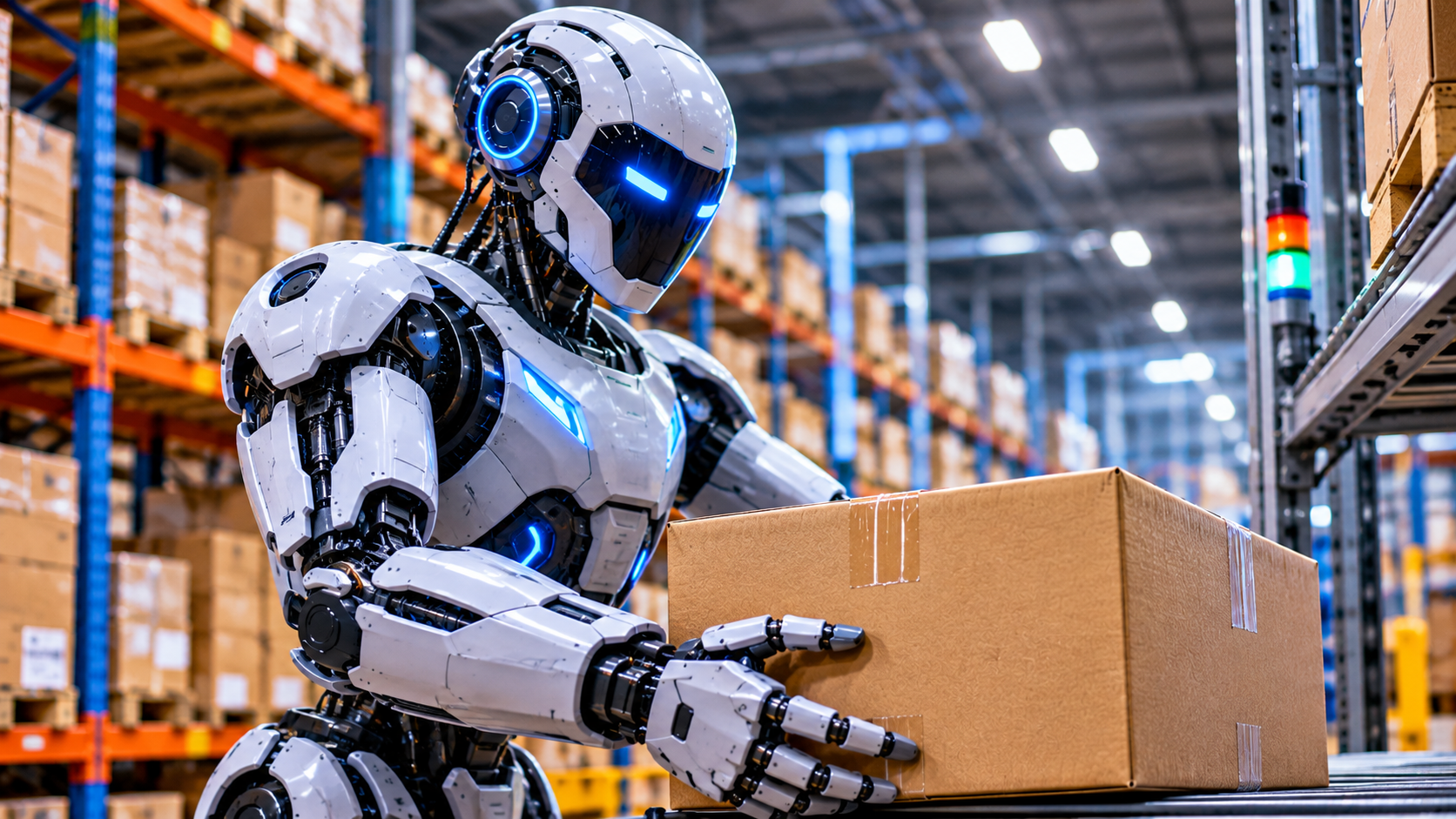
Imagine walking into a warehouse and discovering that the people moving boxes, sorting packages, and transporting goods have been replaced by machines. Instead of human workers filling entire shifts, robots handle much of the physical work, operating around the clock with only a small team needed to supervise them.
That future isn’t here yet, but the technology behind it is advancing. Artificial intelligence is giving robots new abilities, allowing them to recognize objects, respond to their surroundings, and perform physical tasks that once required human workers.
For decades, industrial robots were largely confined to repetitive jobs in factories. Now, technology companies are developing machines that can move through workplaces, handle unfamiliar objects, and adapt to changing conditions.
The implications could be enormous. Could AI-powered robots eventually replace millions of human workers? And which jobs are most likely to disappear first?
Recent research offers a surprising answer: robots may already be capable of performing far more physical work than many people realize. But there is a major obstacle standing between that capability and widespread job replacement.
Robots Are Learning to Do More Than Repeat Movements
Traditional industrial robots are designed to perform specific tasks in controlled environments. A robotic arm on an assembly line, for example, can weld metal, paint vehicle panels, or assemble components with remarkable speed and precision.
These machines are effective because their surroundings are predictable. They know where objects will be, where to move, and what action to perform next.
Artificial intelligence is beginning to change that.
By combining AI with cameras, sensors, and robotic hardware, developers are working on machines that can recognize objects, interpret their surroundings, and adjust their actions when conditions change.
Instead of simply repeating a programmed movement, a robot may be able to identify an object it has not encountered before, determine how to pick it up, and decide where to place it.
This is an important step toward machines that can work in environments designed for people.
Humanoid robots have become one of the most visible examples of this development. Designed with human-like bodies, arms, hands, and legs, they could potentially operate equipment, move materials, and perform tasks in existing workplaces without requiring every facility to be redesigned.
However, looking like a human does not mean a robot can work like one. Walking, balancing, handling delicate objects, and responding to unexpected situations remain difficult technical challenges.
The Jobs Most Likely to Be Affected by AI Robots
Not every occupation faces the same risk from robotic automation. Jobs involving repetitive physical tasks in predictable environments are generally easier to automate than work requiring constant judgment, delicate movements, or personal interaction.
Several industries could see significant changes.
Warehouses and distribution centres
Warehouses are among the most obvious places where robots could replace some human labour. Machines already transport goods, sort packages, and move materials through large facilities.
More capable robots could eventually handle tasks such as loading shelves, picking individual products, packing orders, and preparing shipments. These are activities that often require large numbers of workers, particularly during busy periods.
Manufacturing
Factories have used industrial robots for decades, but AI could expand the range of tasks machines can perform.
Robots may become better at inspecting products, handling different components, identifying defects, and adjusting to changes in production. This could reduce the need for people in some repetitive assembly and material-handling positions.
Transportation and delivery
Driving is another occupation facing growing automation pressure. Self-driving technology is being developed and deployed in certain transportation settings.
If autonomous vehicles become reliable and affordable enough, they could eventually reduce demand for some driving jobs. Delivery robots and automated equipment may also change how goods move over short distances.
Agriculture
Farms already use automated machinery for planting, harvesting, spraying, and monitoring crops. More advanced robotic systems could eventually handle additional activities, including picking certain fruits and identifying individual plants that need attention.
Agriculture is a particularly interesting area because many tasks are physically demanding and can be difficult to fill with workers.
Construction and maintenance
Construction is more complicated. Job sites change constantly, surfaces are uneven, and workers often need to respond to unexpected problems.
Robots could still take over certain repetitive activities, such as moving materials, drilling, demolition, and surveying. However, replacing an experienced construction worker who can adapt to unfamiliar conditions is a much greater challenge.
A Study Found Robots Could Already Perform 74% of Physical Job Tasks
One of the most interesting recent assessments comes from Anthropic, the artificial intelligence company behind Claude.
In a September 2026 study, researchers examined how well existing robots could perform physical tasks found across the US workforce.
Their findings were striking: robots could perform approximately 74% of physical job tasks, representing about 34% of total working hours.
That does not mean robots are ready to replace 74% of workers. The researchers were measuring whether machines could perform particular tasks under certain conditions, not whether entire occupations could be automated.
Some tasks could only be performed in specially designed environments. Others could be handled in more familiar workplaces, while relatively few could be completed in unpredictable surroundings.
The study also identified a much bigger obstacle: cost.
According to the researchers, robots were economically competitive with human workers for only about 0.3% of job tasks at current prices.
In other words, a machine might be capable of performing a job but still cost far more to operate than employing a person.
That distinction is crucial. A robot that can move boxes around a warehouse is not necessarily a good investment if purchasing, maintaining, and operating it costs more than paying human workers to do the same job.
The findings suggest that the technology may be progressing faster than the economics needed to make widespread job replacement practical.
Why Businesses Aren’t Replacing Everyone With Robots Yet
Even as robots become more capable, replacing human workers involves more than buying a machine.
Businesses must consider the purchase price, maintenance, repairs, electricity, software, and the cost of keeping equipment operating reliably.
A robot that works perfectly during a demonstration may struggle in a busy workplace. It might drop objects, misidentify products, stop when something unexpected happens, or require a human technician to intervene.
These problems can quickly reduce the financial benefits of automation.
There are also safety concerns. Robots operating around people must be able to recognize obstacles, avoid collisions, and respond appropriately when someone enters their working area.
Humanoid robots face additional challenges. Their hands must be capable of handling objects of different shapes and sizes, while their bodies must remain balanced as they walk, bend, lift, and reach.
A machine that can successfully pick up a box in a controlled demonstration may not be ready to perform hundreds of different tasks throughout an eight-hour shift.
For many businesses, specialized machines designed for one particular job will remain a more practical investment.
Why Humanoid Robots May Not Take Over Workplaces as Quickly as Expected
Humanoid robots attract considerable attention because they resemble people and could theoretically perform many of the same physical activities.
But businesses do not necessarily need machines that look human. They need equipment that performs tasks efficiently and reliably.
A robot with wheels and a specialized arm might move boxes through a warehouse more quickly and cheaply than a humanoid machine attempting the same job.
Gartner, a technology research firm, has highlighted this issue in its assessment of humanoid robots.
In January 2026, Gartner predicted that fewer than 20 companies would bring humanoid robots into production for manufacturing and supply-chain operations by 2028. It also predicted that most deployments during this period would remain limited to tightly controlled environments.
The forecast points to several obstacles, including high costs, limited dexterity, battery life, and difficulties integrating the machines into existing operations.
This does not mean humanoid robots have no future. It suggests that their widespread use may take longer than some of the more ambitious demonstrations and predictions imply.
In the meantime, specialized industrial robots are likely to remain important because they are designed around specific tasks rather than trying to imitate the full range of human movement.
Will AI Robots Replace Human Jobs in the Next 10 Years?
The next decade could bring substantial changes to certain industries, but predicting exactly how many jobs will disappear is difficult.
Some tasks are already being automated, while others still require technology that does not exist in a commercially practical form.
Warehouse operations, manufacturing, and transportation are among the areas worth watching because robots already have a foothold in these industries.
Jobs involving personal care, communication, complex repairs, and unpredictable physical work may be harder to automate completely.
For example, a robot might eventually help a nurse move equipment or transport supplies, but providing personal care to a patient involves far more than completing a physical task. It requires communication, judgment, and the ability to respond to individual needs.
The same applies to many skilled trades. A machine may be able to perform a particular repair, but identifying the problem, working in a confined space, and adapting to an unusual situation can be much more difficult.
The more likely outcome in many occupations is that robots will take over individual responsibilities rather than eliminate the entire job.
However, if machines eventually become capable of performing most of an occupation’s essential tasks at a lower cost, some positions could become unnecessary.
Five Million Robots Are Already Working in Factories
Although humanoid robots are attracting much of the attention, industrial automation is already operating on a massive scale.
According to the International Federation of Robotics, approximately five million industrial robots were operating in factories around the world in 2025. That represented a 9% increase over the previous year.
More than 600,000 new industrial robots were installed during the year.
Canada was part of that growth. The country installed almost 4,000 industrial robots in 2025, an increase of approximately 5% compared with 2024.
These machines are not all humanoid robots or general-purpose AI systems. Many perform specialized industrial tasks. Nevertheless, the figures demonstrate how extensively robots are already being integrated into the global economy.
As artificial intelligence, machine vision, and sensors improve, the range of tasks these machines can perform may continue to expand.
The Biggest Change May Be What Happens to Human Workers
The idea of robots replacing human workers often brings to mind factories and warehouses filled with machines operating without people.
But the transition may be less dramatic than that.
In many workplaces, robots could gradually take over individual responsibilities while people move into roles involving supervision, maintenance, problem-solving, and decision-making.
A warehouse might need fewer people to move products but more workers to manage automated systems. A factory could use robots for repetitive assembly while employees handle quality control and equipment maintenance.
At the same time, some workers may find that the tasks they have performed for years are no longer needed.
The effects will not be evenly distributed. People in occupations with a high proportion of repetitive physical tasks could face greater pressure than those whose work depends on interpersonal skills, complex judgment, or adaptability.
There is also no guarantee that every displaced worker will be able to move easily into a new position. Training, location, education, and the availability of other jobs will all influence how workers experience the transition.
AI-powered robots may eventually become a normal part of everyday working life. But the question is no longer simply whether machines can perform human tasks.
It is whether they can do those tasks reliably, safely, and cheaply enough for businesses to replace the people currently doing them.
That may ultimately determine how much of the workforce changes — and how quickly.
SOURCES: Anthropic, International Federation of Robotics, Gartner.