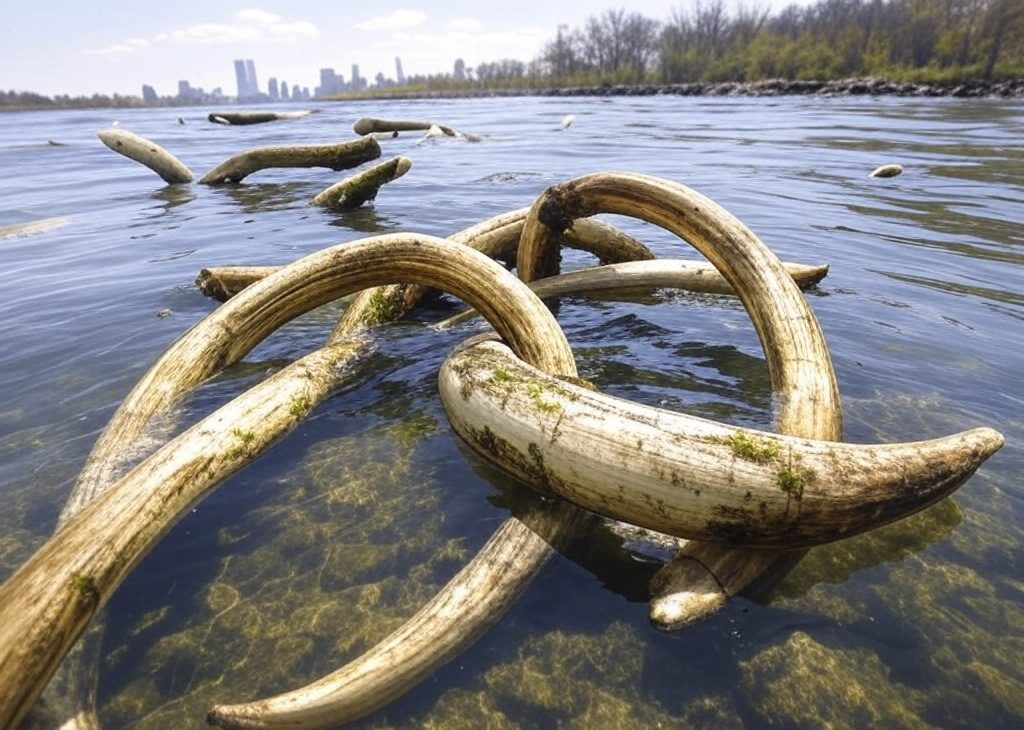
The Boneyard Alaska, a sprawling five-acre plot near Fairbanks, has emerged as a remarkable source of Ice Age fossils. John Reeves, a gold miner turned fossil enthusiast, says his family has uncovered woolly mammoth tusks, steppe bison remains, and other prehistoric specimens—all preserved in Alaska’s frozen ground. Yet, beneath this discovery lies a much stranger tale: a claim that bones from this very region were dumped into New York’s East River in the 1940s by the American Museum of Natural History. Decades later, Reeves’ account would send treasure hunters into the river in search of mammoth remains.
The museum denies having any record of such a disposal. The draft report Reeves cited does exist, but the story behind it is less straightforward than it first appears. So how did an Alaskan fossil discovery become the center of a New York treasure hunt—and could mammoth bones really be resting beneath the waters of the East River?
The Boneyard: A Glimpse into a Lost World—or a Hidden Agenda?
Reeves’ land in Alaska isn’t just a graveyard of Ice Age megafauna; it may offer a valuable window into a world that disappeared thousands of years ago. The site’s official account says the five-acre property was discovered in 2007 and that the Reeves family has recovered an estimated 250,000 or more fossil fragments and complete remains. That is the family’s estimate, rather than a figure established by an independent scientific inventory.
The sheer volume of material raises fascinating questions. What brought so many prehistoric animals to this particular stretch of Alaska? How did their remains become preserved in the frozen ground? And what might a closer scientific study reveal about the animals that once lived there?
One possible area of interest is the broader debate over the end of the Ice Age. The Younger Dryas impact hypothesis, for example, proposes that an extraterrestrial impact around 12,800 years ago contributed to abrupt environmental changes. The hypothesis remains contested, however, and there is no established evidence connecting the Boneyard’s fossil deposits to such an impact. The site’s discoveries are intriguing in their own right; they do not, by themselves, settle the debate over what caused the changes at the end of the Ice Age.
Reeves has documented the discoveries through social media and the documentary Boneyard Alaska. According to the family’s account, paleontologists visited the property during its early years, although the collection has not yet received the kind of comprehensive study that could answer many of the questions surrounding it. The family says it hopes to preserve the specimens until they can be properly studied.
There is also a financial dimension to the story. Mammoth ivory can be valuable, and Reeves has described substantial offers for individual tusks and pairs of tusks during a podcast appearance. Those figures are his reported accounts of offers and asking prices, not independent appraisals of the Boneyard collection. Still, when a property contains such a remarkable concentration of prehistoric remains, it is easy to see why the discoveries attract attention well beyond the world of paleontology.
The permafrost has preserved a remarkable collection, but the deeper story may still be waiting to emerge. The more Reeves and his family uncover, the more questions arise about the animals, the landscape, and the history locked beneath the Alaskan muck.
The East River Claim: A Tale Too Wild to Believe—or Too Uncomfortable to Acknowledge?
Then there’s the East River story, a claim Reeves brought to a much wider audience during a December 2022 appearance on The Joe Rogan Experience. He described a draft report connected to Fairbanks Exploration, a mining company whose assets he said he had acquired. According to the account in the report, a large quantity of Ice Age remains from Alaska may have been sent to the American Museum of Natural History before some surplus material was allegedly discarded in the East River during the 1940s.
The reported quantity was extraordinary: as much as 50 tons of bones. Reeves pointed to an area near what is now FDR Drive and East 65th Street, setting off a modern-day search for the supposed deposit.
But there is an important wrinkle. The document Reeves cited was a draft written in the 1990s, not a confirmed museum disposal record. One of its authors, archaeologist Robert Sattler, confirmed that the draft was authentic. However, he said the story about the dumping likely came from secondhand recollections shared by anthropologist Richard Osborne, who had since died. In other words, the document exists, but the central allegation within it has not been independently established.
The museum’s response was categorical: it said it had no record of disposing of the fossils in the East River and could find no record of the report in its archives or other scientific sources. That does not explain every detail of the story, but it is a significant obstacle to treating the alleged dumping as established history.
The location itself raises further questions. The East River shoreline was undergoing major changes during the period in question, as construction of the East River Drive—later renamed the FDR Drive—transformed parts of the waterfront. The highway opened in 1942, making the logistics of dumping a huge quantity of material in that area worth examining. Could the account describe a forgotten episode in the handling of Alaskan fossils, or did a secondhand recollection become something much larger over time?
For now, the evidence leaves room for questions, but not for a firm conclusion. The alleged disposal remains unverified, and the museum disputes that it happened.
The Treasure Hunt: A Quest for Truth or a Distraction?
Reeves’ account did not remain a curious podcast story for long. In early 2023, treasure hunters began searching the East River, using boats, diving equipment, sonar, and remote cameras in the hope of finding mammoth remains. The conditions were far from inviting. Divers faced cold water, strong currents, and visibility that could be reduced to little more than a foot.
Despite the excitement, the searches have not produced confirmed mammoth bones from the alleged dump site. Commercial diver Donald Gann and other searchers spent time investigating the area, but no verified discovery has emerged to establish Reeves’ account. Gann eventually shifted his attention to a possible dumping location off southern Brooklyn, which he considered a more plausible place for discarded material.
That leaves a tantalizing question: if the reported bones were never dumped at the Manhattan location, what became of the material described in the draft? And if the account was based on a genuine episode, could the remains have ended up somewhere else entirely?
The East River is not a natural resting place for a large concentration of Ice Age fossils, which is precisely why the claim captured so much attention. But the absence of confirmed finds matters. A search inspired by a historical allegation is not proof that the allegation is true. Until physical evidence or reliable records emerge, the supposed underwater treasure remains just that—a possibility.
What Lies Beneath the Surface?
The Boneyard Alaska and East River stories point to a broader tension between discovery and the preservation of scientific history. Reeves’ finds offer a striking glimpse into Alaska’s Ice Age past, while the East River allegation raises questions about how prehistoric specimens were handled and documented decades ago.
There is still much to learn about the Boneyard. A more comprehensive scientific study could help establish what the collection contains, what it reveals about the region’s ancient environment, and how the remains came to be concentrated at the site. Until then, it is important to distinguish the family’s reported discoveries and interpretations from conclusions that have been independently established.
The East River story is a different kind of mystery. The draft report is real, Alaskan mammoth remains did make their way to the American Museum of Natural History, and the museum has confirmed that it cannot find records supporting the alleged disposal. But the crucial claim—that tens of tons of bones were dumped into the river—still rests on secondhand recollections rather than confirmed documentation.
Perhaps the story reflects a forgotten chapter in the history of fossil collecting. Perhaps details became distorted as the account was passed along. Or perhaps further evidence will eventually emerge. For now, there is no verified answer.
Conclusion: Digging Deeper Than the Surface Allows
The Boneyard Alaska and the East River mystery remind us that history is not always neatly preserved in books, archives, or museum displays. Sometimes it begins with a discovery in the frozen ground. Sometimes it begins with an old document and a story that refuses to disappear.
John Reeves’ discoveries have brought renewed attention to Alaska’s Ice Age past, while his East River claim sent divers searching beneath one of New York’s busiest waterways. The two stories are connected by a remarkable possibility: that fossils unearthed in one part of the world may have ended up somewhere few people would ever think to look.
Whether the alleged dumping happened remains unresolved. No confirmed mammoth remains have been recovered from the East River search, and the museum says its records do not support the story. But the draft, the recollections behind it, and the unanswered questions have kept the mystery alive.
The truth may be buried in the permafrost, lost in an archive, or resting somewhere beneath the river. Until more evidence comes to light, the search continues.
SOURCES: Associated Press, The Boneyard Alaska, The Joe Rogan Experience, Alaska Public Media, Scienceline.