North America once supported mammoths, mastodons, giant ground sloths and enormous predators. Their disappearance near the end of the Ice Age remains one of prehistoric Earth’s most intriguing scientific questions.
Imagine travelling across North America near the end of the last Ice Age. The landscape might look familiar in some ways, but the animals roaming across it would make it almost unrecognizable.
Mammoths and mastodons moved through ancient forests and grasslands. Giant ground sloths, some weighing several tonnes, wandered across the continent. Enormous short-faced bears and American lions occupied the same prehistoric world, while ancient horses, camels and massive bison grazed across different regions.
Then, over thousands of years, much of this extraordinary wildlife disappeared.
The end of the Pleistocene brought the extinction of dozens of mammalian genera in North America, including many of its largest animals. The disappearance was so extensive that the continent’s ecosystems were fundamentally transformed.
But what happened?
For decades, scientists have debated whether humans hunted these animals into extinction, whether changing climates disrupted the environments they depended on, or whether several pressures combined to push vulnerable populations beyond recovery.
Research published over the years has produced competing explanations. More recent archaeological work has also raised questions about how confidently scientists can distinguish evidence of hunting from scavenging.
The evidence suggests that there is no single explanation that neatly accounts for every animal. Understanding what happened requires looking at the animals themselves, the changing environment and the people who entered their world.
A Continent Filled With Prehistoric Giants
During the Pleistocene, commonly known as the Ice Age, North America supported a remarkable diversity of large mammals.
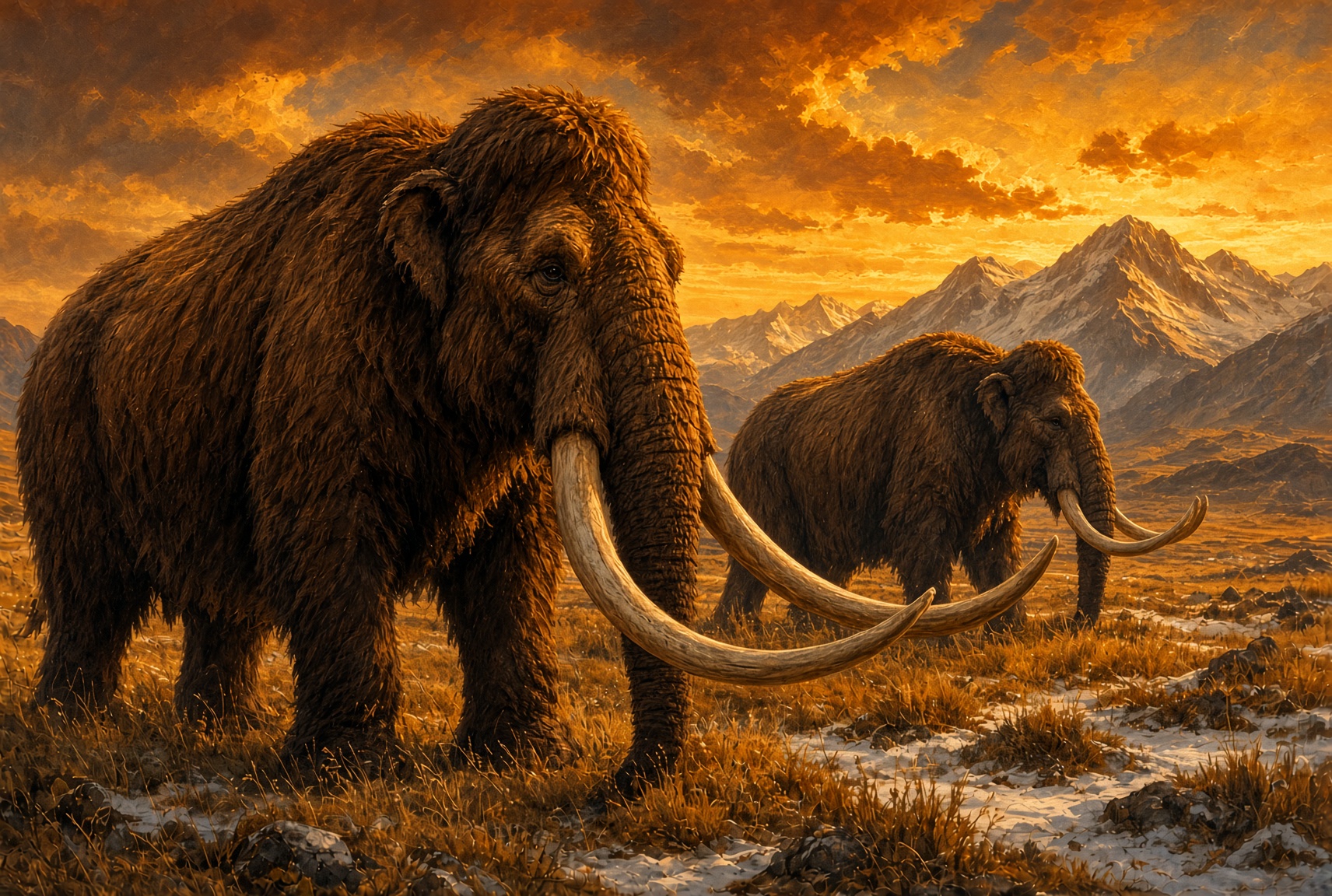
The woolly mammoth is perhaps the most recognizable. These relatives of modern elephants were adapted to cold environments, with thick coats, small ears and long, curved tusks. Their tusks helped them move snow and reach vegetation during difficult winter conditions.
Mastodons were another impressive group, although they were quite different from mammoths.
While mammoths were more closely associated with open grassland environments, mastodons were generally browsers that fed on leaves, twigs and other woody vegetation. Their different feeding habits allowed them to occupy different ecological settings.
But the continent’s ancient giants extended far beyond elephant relatives.
Giant ground sloths were among the most unusual mammals of the Pleistocene. Unlike the relatively small sloths living in trees today, some extinct ground sloths were enormous terrestrial animals weighing several tonnes.
Short-faced bears were another remarkable species. These powerful animals had long limbs and large bodies, making them very different from the bears familiar today.
North America also supported American lions, ancient horses, camels and giant bison.
These animals were not simply isolated curiosities. They formed part of interconnected ecosystems in which large herbivores consumed vegetation, predators hunted other animals, and different species competed for food and habitat.
It was a very different version of the continent, and much of that biological diversity would disappear as the Pleistocene came to an end.
How Many Ice Age Mammals Disappeared?
The scale of the extinction was extraordinary.
In a 2020 paper published in the Proceedings of the National Academy of Sciences, archaeologist David J. Meltzer examined the disappearance of North America’s Ice Age megafauna.
He identified 38 mammalian genera that went extinct toward the end of the Pleistocene.
Most belonged to large-bodied mammals, although not every animal included in the figure was a giant.
This distinction matters because a genus is a broader biological classification than a species. Several related species can belong to the same genus, meaning the disappearance of 38 genera does not mean exactly 38 individual animal species went extinct.
Nevertheless, the number illustrates the scale of the transformation.
Mammoths, mastodons, giant ground sloths and several other remarkable mammals disappeared from North America.
The extinction was also part of a much wider event.
Large animals disappeared across several continents during the late Quaternary, although the timing and severity differed considerably between regions.
Australia, South America and Eurasia experienced their own major losses of large-bodied animals.
North America’s disappearance of megafauna was therefore part of a broader transformation of the planet’s terrestrial wildlife.
Did Humans Hunt the Giants Into Extinction?
One of the most widely discussed explanations is that humans played a major role in the disappearance of Ice Age megafauna.
As modern humans spread into different parts of the world, they encountered animals that had not evolved alongside the same history of human hunting pressure.
Even enormous animals could have been vulnerable.
Large mammals often reproduce relatively slowly. If hunters repeatedly killed adult animals, populations could struggle to replace those losses, particularly when their numbers were already declining.
In North America, the Clovis people have received particular attention in this debate.
Clovis is an archaeological culture associated with distinctive stone tools, including carefully shaped projectile points. These tools have been found at several sites alongside the remains of extinct proboscideans, including mammoths.
Such discoveries have contributed to the overkill hypothesis.
According to this explanation, relatively small human populations could have caused widespread extinctions through sustained hunting, particularly if the animals had little experience with human predators.
However, there is an important complication: direct archaeological evidence of humans killing extinct megafauna is surprisingly limited.
In his 2020 PNAS paper, Meltzer emphasized that although 38 mammalian genera disappeared, the archaeological evidence connecting humans with extinct animals involves only a small subset of them.
This does not prove that hunting was unimportant. Archaeological evidence is incomplete, and the absence of documented kill sites does not establish that hunting never occurred.
But it does make the simplest version of the overkill explanation more difficult to demonstrate.
Scientists must distinguish between evidence that humans encountered an animal, evidence that they used its remains and evidence that they actually hunted it.
Those are not necessarily the same thing.
A New Question About Clovis Hunting
Research published in July 2026 has added another important dimension to the debate.
A paper in the Journal of Archaeological Science: Reports, titled Did Clovis foragers hunt megafauna, scavenge their carrion, or both – And can we tell the difference?, examined archaeological evidence connecting Clovis projectile points with the remains of large proboscideans.
The researchers examined 15 well-documented North American sites where Clovis points have been found associated with proboscidean remains.
Traditionally, these associations have often been interpreted as evidence of hunting.
But the researchers argued that the archaeological evidence does not necessarily allow scientists to distinguish reliably between hunting and scavenging.
A group of people finding the remains of an already dead mammoth could have used its meat and other resources without having killed the animal themselves.
The authors considered it likely that Clovis people practised both hunting and scavenging, while emphasizing that the available archaeological evidence cannot reliably establish how many of the associated sites represent actual hunting events.
This distinction is important.
It does not establish that Clovis people never hunted mammoths. Instead, it challenges how confidently certain archaeological discoveries can be interpreted as evidence of hunting.
It also demonstrates why the relationship between early humans and Ice Age megafauna remains a complicated subject.
The evidence of human interaction is real, but determining precisely how much hunting contributed to the extinction of entire animal populations is another question.
How Did Climate Change Affect Ice Age Animals?
Human activity is only one part of the extinction debate.
The end of the Pleistocene also involved enormous environmental changes as Earth transitioned away from the conditions of the last major glacial period.
Temperatures changed, glaciers retreated, vegetation shifted and ecosystems were reorganized.
Forests expanded in some regions, while grasslands and other habitats changed or contracted elsewhere.
These transformations could have affected animals in several ways.
Large herbivores depended on suitable vegetation and sufficient food supplies. Changes in plant communities could have altered the availability of the resources they needed to survive.
Animals adapted to particular environments might have found themselves facing increasingly unfamiliar conditions.
The transition was not simply a steady increase in temperature, either.
The period included significant climatic fluctuations, including the Younger Dryas, a period of renewed cooling in parts of the Northern Hemisphere after an earlier warming trend.
Such changes could have influenced vegetation, habitat availability and the distribution of animal populations.
However, an important question remains: if large mammals had survived earlier periods of substantial climate change, why did so many disappear during this particular transition?
That question is one reason scientists continue to examine the timing of extinctions alongside archaeological evidence and environmental records.
Climate change clearly transformed the environments in which these animals lived. Determining whether it was the primary cause of their disappearance, however, requires more than simply showing that temperatures changed.
What Does the Research Say About Both Explanations?
Rather than treating human hunting and climate change as mutually exclusive explanations, some researchers have examined how different pressures may have affected individual animal populations.
A 2018 study published in Nature Communications by Jack M. Broughton and Elic M. Weitzel investigated reconstructed population trends among humans and extinct megafauna.
The researchers used radiocarbon dating evidence to examine the relationship between changes in human populations and the decline of large mammals.
Their findings suggested that extinction patterns varied among animals and regions.
Three cases appeared linked to hunting, five were consistent with ecological effects associated with climate change, and one suggested that both factors may have contributed.
The researchers were not claiming to have established the cause of every extinction. Their analysis covered a limited selection of well-dated animal populations and archaeological records.
Nevertheless, it offered an important perspective: different animals may have disappeared for different reasons.
A separate global review published in Cambridge Prisms: Extinction in 2024 reached a stronger conclusion about the overall role of humans.
The researchers examined evidence from approximately the last 50,000 years and concluded that human pressures were the dominant driver of global late-Quaternary megafauna extinctions.
They found comparatively little support for climate change as a major overall explanation for the global pattern.
That conclusion is significant, but its geographical scope matters.
A global assessment does not automatically establish the precise cause of every extinction in North America. Nor does it mean environmental changes played no role in individual cases.
The research highlights an important distinction between identifying the dominant global pattern and explaining what happened to each particular species.
Why the Disappearance Changed North America’s Ecosystems
The extinction of Ice Age giants did more than remove impressive animals from the landscape.
Large mammals can have enormous effects on the ecosystems around them.
Herbivores consume vegetation, disperse seeds, move nutrients and influence the structure of plant communities. Large predators can influence the abundance and behaviour of other animals.
When these species disappear, the consequences can extend throughout an ecosystem.
A 2016 paper published in PNAS, titled Megafauna and Ecosystem Function from the Pleistocene to the Anthropocene, examined how large animals influence ecosystem structure, species composition, nutrient movement and other ecological processes.
The research helps explain why the loss of large mammals matters beyond the disappearance of individual species.
For example, losing enormous herbivores can change how vegetation is consumed and distributed. Losing large predators can also affect relationships among other animal populations.
These effects do not necessarily occur in the same way everywhere, and scientists cannot reconstruct every ecological consequence with certainty.
Nevertheless, the disappearance of North America’s megafauna represents a major change in the continent’s ecological history.
Bison, moose, bears and other large mammals survived, but the continent no longer supported the same diversity of enormous herbivores and predators that had existed during the Pleistocene.
The ecosystems that followed were not simply smaller versions of the Ice Age world. They were different ecological communities shaped by the animals that remained and the environmental conditions that developed afterward.
The Mystery of North America’s Lost Giants
The disappearance of North America’s Ice Age giants remains one of the most fascinating questions in prehistoric natural history.
Scientists have identified the animals that vanished and developed competing explanations for their disappearance. Yet the precise causes remain difficult to establish because extinction patterns differed between species, regions and periods.
Human hunting may have contributed significantly to the decline of some populations. Environmental changes affected habitats and food supplies. In certain cases, several pressures may have acted together.
New archaeological research also reminds us that even apparently straightforward evidence, such as tools found alongside animal remains, can have more than one interpretation.
What makes this story so remarkable is the scale of the transformation.
A continent once inhabited by mammoths, mastodons, giant ground sloths, enormous bears and other extraordinary mammals eventually became the North America we recognize today.
Their disappearance raises a much bigger question: how can relatively short periods of human and environmental change reshape the natural world?
The Ice Age giants are gone, but their fossils continue to reveal how different our planet once was—and how much remains to be understood about the forces that shaped the world we inherited.
SOURCES: David J. Meltzer, Proceedings of the National Academy of Sciences, Jack M. Broughton and Elic M. Weitzel, Nature Communications, Metin I. Eren et al., Journal of Archaeological Science: Reports, Jens-Christian Svenning et al., Cambridge Prisms: Extinction, Yadvinder Malhi et al., Proceedings of the National Academy of Sciences.