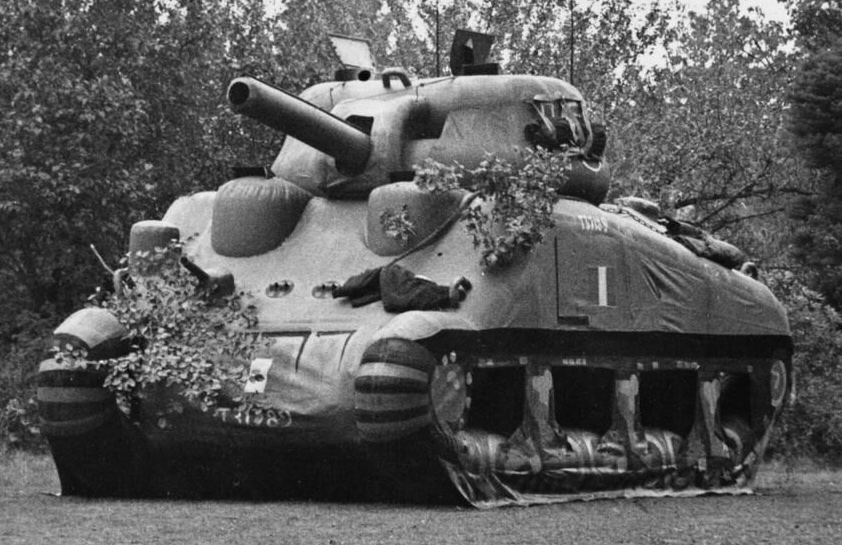
What if an army could make its enemies prepare for an attack that would never happen? What if hundreds of fake soldiers could send German troops rushing into the darkness, while inflatable tanks convinced enemy intelligence that entire divisions were waiting nearby?
During World War II, the Allies turned these ideas into reality.
In one of the most extraordinary military deception campaigns in history, Allied forces used fake paratroopers, inflatable tanks, imaginary armies, misleading radio transmissions and even a dead man carrying false military documents to confuse Nazi Germany.
Some soldiers became actors. Artists helped create battlefield illusions. Radio operators pretended to command military units that didn’t exist. And intelligence officers built elaborate false identities designed to deceive some of the most powerful military minds in Europe.
These weren’t isolated tricks. They were carefully planned operations intended to manipulate German expectations, divert enemy forces and give real Allied troops a better chance of succeeding.
Here are some of the remarkable ways the Allies made an imaginary battlefield look frighteningly real.
The Army That Didn’t Exist
By 1944, the Allies were preparing to invade Nazi-occupied Western Europe. The operation, eventually known as D-Day, would require an enormous force of soldiers, ships and aircraft.
German commanders knew an invasion was coming. The question was where.
The Pas-de-Calais region of northern France appeared to be the most logical target. It was the shortest crossing from England, making it an obvious location for an Allied assault.
The Allies decided to exploit that expectation.
Their deception campaign was called Operation Fortitude, part of a larger strategic plan known as Operation Bodyguard. Its purpose was to convince German commanders that the main invasion would take place somewhere other than Normandy.
One of its most important elements was an imaginary military formation called the First United States Army Group, or FUSAG.
Supposedly commanded by the real American general George S. Patton, this enormous army appeared to be gathering in southeastern England, preparing to cross the Channel toward Calais.
There was just one problem: much of the army existed only on paper.
To make the illusion convincing, the Allies positioned dummy tanks, aircraft and vehicles around southeastern England. They even constructed fake landing craft using materials such as wood, canvas and scaffolding.
From the air, these installations could resemble preparations for a massive invasion.
But the deception didn’t stop with fake equipment.
Radio operators transmitted artificial military communications, creating the impression that large numbers of soldiers and commanders were coordinating their movements. Meanwhile, British intelligence used double agents to pass carefully controlled false information to German intelligence.
One of the most important was Juan Pujol García, known by his code name Garbo. He was a British-controlled double agent who had convinced the Germans that he was providing them with valuable intelligence.
The information he supplied helped reinforce the false picture of Allied military preparations.
Then came June 6, 1944.
The real invasion began in Normandy, not Calais.
Yet German commanders continued to fear that Normandy might be a diversion and that the main attack was still coming. This helped keep important German forces concentrated around the Pas-de-Calais rather than immediately sending them to reinforce Normandy.
The imaginary army had helped create a very real military advantage.
Hundreds of Fake Paratroopers Fell From the Sky
One of the strangest deceptions of D-Day involved soldiers who weren’t soldiers at all.
During the night of June 5–6, 1944, Allied aircraft dropped hundreds of dummy paratroopers into occupied France as part of Operation Titanic.
Known as Ruperts, these crude figures were made from sackcloth and stuffed with materials such as straw and sand. They were shaped to resemble parachutists descending from aircraft.
They weren’t particularly sophisticated. Many were considerably smaller than real people.
But in the darkness, with parachutes opening overhead and German troops already on high alert, they could create convincing confusion.
According to the RAF Museum, approximately 450 Ruperts were dropped during the night of the invasion.
Some carried devices designed to produce gunfire sounds or release flares after landing. These effects helped make the supposed airborne operations appear more convincing.
The wider deception also involved special forces teams and sound effects intended to suggest that Allied troops were landing in locations away from the actual invasion areas.
German defenders were forced to contend with reports of airborne activity across different parts of the region.
Meanwhile, thousands of real British and American paratroopers were conducting dangerous airborne operations in support of the Normandy invasion.
The dummy soldiers were never intended to replace real troops. Their purpose was to make it harder for German forces to understand where the actual attacks were taking place.
Imagine being a German soldier in the middle of the night, hearing reports of parachutists landing nearby, only to discover that some of the supposed invaders were little more than sacks of straw.
It was an unusual weapon, but one designed to exploit the confusion of war.
The Ghost Army: Soldiers Who Made an Entire Army Appear
Some of the most extraordinary deception work of World War II came from an American unit known as the Ghost Army.
Its official name was the 23rd Headquarters Special Troops. It consisted of approximately 1,100 personnel and was created to deceive German forces about the size and location of American military formations.
Its members included artists, engineers, radio operators, sound specialists and soldiers.
Their equipment was unlike anything most people would associate with a military unit.
Instead of relying entirely on conventional weapons, they worked with inflatable tanks, dummy artillery, fake vehicles, sound recordings and carefully constructed radio messages.
Their mission was to make the enemy believe that entire military formations were nearby, even when the real soldiers were somewhere else.
The inflatable equipment was designed to resemble genuine American vehicles from a distance. Tanks could be positioned in fields, while dummy trucks and artillery helped create the appearance of a busy military encampment.
But the Ghost Army had another trick that was even more unusual.
Its sound specialists used powerful speakers mounted on military vehicles to broadcast recordings of tanks, trucks and troops moving through the countryside.
The recordings could make it sound as though an entire armored division was approaching.
At night, when visibility was limited, the effect could be especially convincing.
Radio operators added another layer to the illusion by transmitting fake communications. They even studied the distinctive habits of real military radio operators so their transmissions would sound authentic.
Some soldiers went further and impersonated members of actual military units. They wore the correct insignia, displayed appropriate vehicle markings and sometimes visited local establishments while pretending to belong to formations that were not actually there.
In other words, the Ghost Army wasn’t just creating fake equipment. It was creating fake military identities.
The unit conducted more than 20 deception operations across France, Belgium, Luxembourg and Germany, sometimes working dangerously close to the front lines.
The Operation That Made 500 Men Look Like 8,000
One particularly remarkable example took place near Bettembourg, Luxembourg, in September 1944.
American forces were holding a dangerously thin section of the front line while General George Patton’s Third Army was engaged in operations around the fortress city of Metz.
The Ghost Army was brought in to make the area appear much more heavily defended than it actually was.
Approximately 500 deception specialists helped create the impression of an armored force of around 8,000 soldiers.
Inflatable tanks were positioned in the area. Sound trucks played recordings of military vehicles moving into position, while soldiers impersonated members of an armored division.
The objective was to prevent German forces from recognizing how thinly the American line was held and to discourage attacks against that vulnerable section.
The deception continued for more than a week until real reinforcements could take over the position.
When the Ghost Army finally withdrew, its sound trucks played recordings of tanks moving away, maintaining the illusion that a real armored formation was leaving.
It was an extraordinary example of how a relatively small group of specialists could create the appearance of a much larger military force.
The unit’s activities remained classified for decades, and its remarkable story did not become widely known until long after the war.
Operation Mincemeat: The Dead Man Who Carried a False Invasion Plan
Not every Allied deception involved inflatable tanks or fake soldiers.
One of the strangest operations of the entire war involved a dead man, a fabricated identity and a briefcase full of false military documents.
It was called Operation Mincemeat, and it took place in 1943, a year before D-Day.
The Allies were preparing to invade Sicily, an important island that could open the way for further operations against Axis forces in Italy.
German commanders understood that Sicily was a likely target. British intelligence wanted to make them believe that the main Allied attack would happen somewhere else.
The plan was as unusual as it was elaborate.
British intelligence obtained the body of a deceased Welshman named Glyndwr Michael, who had died after ingesting rat poison. Officers gave him a fabricated identity: Major William Martin, a Royal Marines officer.
They dressed the body in military clothing and attached personal belongings designed to make the fictional officer appear to have a genuine life.
These included identification documents, personal letters and other everyday items.
But the most important object was a briefcase chained to his wrist.
Inside were confidential-looking documents suggesting that the Allies were planning major operations against Greece and Sardinia rather than Sicily.
The body was placed in a container and transported aboard the British submarine HMS Seraph. On April 30, 1943, it was released into the sea off the coast of Spain near Huelva.
The British knew that Spanish authorities would likely recover the body and that German intelligence might gain access to the documents.
Their gamble paid off.
The documents eventually reached German intelligence, where they were treated as genuine. German leaders responded by strengthening their defenses in Greece and other parts of the Mediterranean.
On July 10, 1943, Allied forces launched Operation Husky, the invasion of Sicily.
The island was not undefended, and the operation still involved fierce fighting. However, the deception helped divert German attention and resources away from the Allies’ actual target.
Operation Mincemeat remains one of the most unusual intelligence operations in military history.
A fabricated officer who never existed had helped deliver information that changed real military decisions.
Why Did These Deceptions Work?
At first glance, many of these operations might sound almost too ridiculous to succeed.
How could inflatable tanks fool experienced military officers? Why would German troops mistake sacks of straw for airborne soldiers? And how could a dead man carrying false documents influence the decisions of an entire military command?
The answer lies in how military intelligence works.
German commanders couldn’t personally verify every report coming from the battlefield. They depended on reconnaissance aircraft, intercepted radio communications, intelligence agents and reports from soldiers on the ground.
The Allies understood this and created false information that appeared to come from several independent sources.
A field full of dummy tanks became more convincing when supported by fake radio traffic. A supposed armored division became more believable when sound recordings suggested that vehicles were moving nearby. Reports from double agents reinforced the same misleading picture.
The deception worked because the different elements supported one another.
The Allies also understood the importance of German expectations.
The Pas-de-Calais was an obvious invasion target. By encouraging German commanders to focus on that possibility, the Allies made the false picture easier to believe.
None of these operations could guarantee success, and deception alone could not win a war. But they could create uncertainty, delay decisions and give real Allied forces valuable opportunities.
In a conflict where information could be as important as firepower, misleading the enemy could make a significant difference.
The Strange War Behind the War
World War II is remembered for its enormous battles, powerful weapons and millions of soldiers who fought across multiple continents.
But behind many of those battles was another conflict, one fought through intelligence, imagination and deception.
The Allies created entire armies that existed only in the minds of their enemies. They sent fake paratroopers into the night, filled fields with inflatable tanks and used recordings to make empty roads sound like they were packed with military vehicles.
They even turned a dead man into a fictional officer whose documents helped mislead German intelligence.
These operations were very different from the conventional battles taking place across Europe, but they reveal an important part of how the war was fought.
Sometimes, the most effective way to confuse an enemy wasn’t to attack them directly.
It was to make them believe an attack was coming from somewhere else.
And in World War II, some of the most convincing armies were the ones that never existed.
SOURCES: English Heritage, RAF Museum, Airborne Assault Museum, International Spy Museum, The Ghost Army Legacy Project, U.S. Army, National WWII Museum, Royal Navy Museums, Imperial War Museums.