Imagine standing on a Boston street when the ground begins to shake. A deep rumble grows louder. Before you can understand what is happening, a wall of dark, sticky liquid comes rushing toward you, carrying broken buildings, shattered wood and everything else in its path.
It sounds like something from a bizarre disaster movie. But on January 15, 1919, it happened in the North End of Boston.
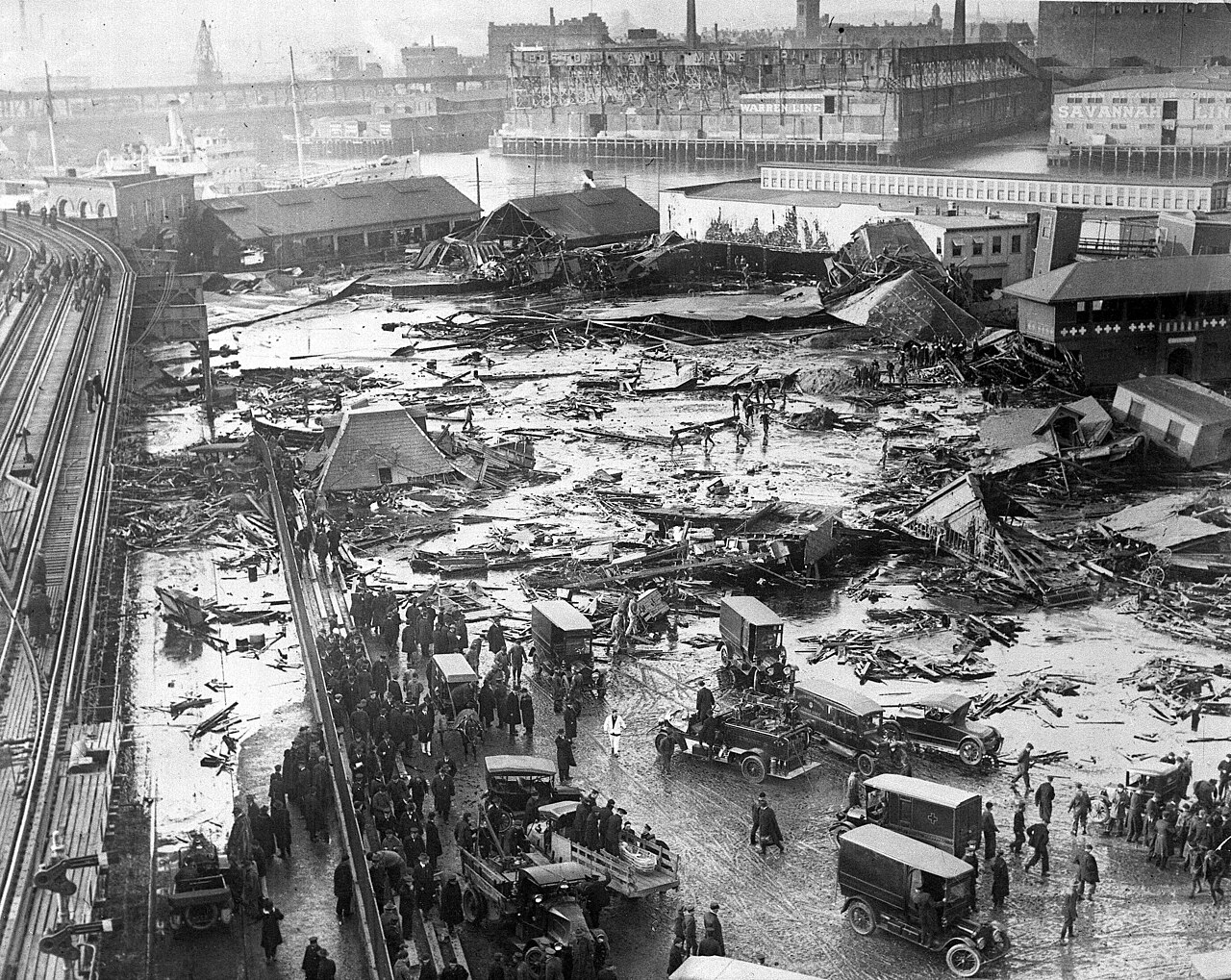
A massive industrial storage tank had ruptured, releasing approximately 2.3 million gallons of molasses into the neighbourhood. The flood swept through streets, damaged buildings, knocked an elevated train off its tracks and trapped people beneath the wreckage.
By the time the disaster was over, 21 people were dead and around 150 were injured.
The event became known as the Great Molasses Flood. Its name may sound almost comical, but the tragedy was anything but. It was a deadly industrial accident involving a substance most people associate with baking, and it raised serious questions about how a dangerous structure could have been allowed to operate.
A giant tank holding millions of gallons
The disaster began with a steel storage tank on Commercial Street in Boston’s North End.
Built in 1915 for the Purity Distilling Company, the tank stood approximately 50 feet tall and measured about 90 feet across. It was designed to hold as much as 2.5 million gallons of liquid.
Its contents were not intended for kitchens. The molasses was an industrial raw material used to produce alcohol through fermentation and distillation. Industrial alcohol had important uses in manufacturing, including the production of materials used in explosives during the First World War.
Ships delivered molasses to a nearby wharf, where it was pumped into the tank. From there, it could be transported by rail to distilleries in Cambridge, Massachusetts.
The tank was built quickly during a period of rising demand. But there were troubling signs from the beginning.
It leaked. Residents could see molasses escaping through its seams, and children reportedly brought containers to collect the sweet liquid dripping from the structure. Workers also reported problems, including unusual noises when the tank was filled.
These were not harmless quirks. They suggested that the enormous structure was under stress.
According to later engineering investigations, the tank’s steel walls were too thin for the loads they were expected to carry. Problems with the rivets also created areas where cracks could develop. The steel itself was vulnerable to becoming brittle in colder temperatures.
Yet the tank remained in operation.
January 15, 1919: The tank gives way
The afternoon of January 15 was unusually mild for a Boston winter. Workers and residents were outside enjoying the relatively warm weather.
Shortly before 1 p.m., people nearby heard a deep rumbling sound. Some initially thought it was an approaching elevated train.
Then the tank ruptured.
Its steel walls tore apart, releasing millions of gallons of molasses in a matter of moments. The sudden release created a powerful surge that raced through the surrounding streets.
The initial wave has been estimated to have reached speeds of up to 35 miles per hour. That figure comes from later scientific analysis, rather than a direct measurement taken during the disaster.
The force was extraordinary.
The flood swept through Commercial Street and nearby areas, carrying debris and smashing into buildings. A section of the elevated railway was knocked out of position, sending a train off its tracks. Vehicles were damaged, structures were torn apart, and the nearby Engine 31 firehouse was pushed from its foundations.
People caught in the flood were thrown into the wreckage or buried beneath collapsed structures. Some were pinned under debris, while others struggled to escape the thick liquid.
The disaster unfolded so quickly that many people had almost no chance to get out of its path.
How could molasses move that fast?
This is perhaps the strangest part of the story.
Molasses is thick, sticky and notoriously slow to pour. It seems difficult to imagine it moving at the speed of a fast-moving vehicle.
But the disaster involved an enormous quantity of liquid released all at once.
The tank held roughly 2.3 million gallons. When its walls failed, gravity drove that immense volume outward. The molasses did not simply ooze across the pavement. It moved as a powerful flow, behaving in some ways like a mudslide or an avalanche.
A liquid’s movement depends on more than whether it feels thick when poured from a container. The amount of material, the slope of the ground, the force driving it and the way it flows all matter.
Molasses is also a non-Newtonian fluid, meaning its resistance to movement does not behave in exactly the same way as that of water. Its flow properties can change depending on the conditions.
Later research into the disaster used fluid dynamics to examine how quickly the molasses could have travelled. One analysis concluded that the initial surge could have reached approximately 35 miles per hour.
At that speed, a person standing in its path would have faced a powerful moving mass, not a slow-moving puddle.
The sheer weight of the molasses made the situation even more dangerous. Its density is greater than water’s, so the enormous volume carried tremendous force as it surged through the neighbourhood.
The danger did not end when the wave stopped
After the initial flood, rescuers faced another problem: the molasses became increasingly difficult to move through as temperatures fell.
The relatively mild afternoon gave way to colder conditions after sunset. As the molasses cooled, it became more viscous and harder to move through. People already trapped beneath buildings and debris faced an even more difficult struggle.
The disaster had left victims buried in a mixture of molasses, broken wood, metal and other wreckage. Some people were pinned beneath collapsed structures, while others were trapped in the thick liquid itself.
The rescue effort was enormous.
Police officers, firefighters, Red Cross workers, volunteers and more than a hundred cadets from the nearby USS Nantucket rushed to the scene. The training ship was docked in Boston Harbor, and its cadets helped search for survivors and recover victims.
Rescuers worked through dangerous conditions, trying to locate people beneath the wreckage. The sticky molasses coated equipment and made it difficult to move debris. Even reaching someone who could be heard calling for help was not always straightforward.
The final toll was devastating: 21 people died and approximately 150 were injured. Many of the victims were workers and drivers in the area, but two children, both just 10 years old, were also among those killed.
Cleaning up millions of gallons of molasses
Even after the rescue operation began, the neighbourhood remained buried in a massive cleanup effort.
Molasses covered streets, buildings, vehicles and debris. It coated the wreckage so thoroughly that workers struggled to move pieces of damaged structures. The material clung to surfaces and made ordinary cleanup methods ineffective.
Crews eventually discovered that saltwater helped break down the molasses. Water was pumped from Boston Harbor and sprayed over the affected area to wash away the sticky material.
The cleanup took weeks. Workers had to remove damaged structures, clear debris and search through the remains of the tank. Welders cut apart sections of the steel structure as the search for victims continued.
The flood also spread molasses beyond the immediate disaster site. Cleanup workers, vehicles and equipment carried it through surrounding streets, adding to the scale of the mess.
For residents, the disaster was not over when the wave stopped. The work of restoring the neighbourhood continued long after the initial emergency.
The company blamed a possible bombing
The destruction raised an obvious question: how could a relatively new steel tank fail so catastrophically?
The company that owned the tank initially suggested that an anarchist attack might have caused the rupture. At the time, fears of political violence and sabotage were widespread in the United States, and the bombing theory became part of the early investigation.
But the evidence increasingly pointed toward the tank itself.
Investigators examined its construction, the steel, the rivets and the history of leaks. The structure had been poorly designed for the enormous loads it carried. Its walls were too thin, and weaknesses around the rivet holes created places where cracks could begin.
Later engineering analysis also identified a problem with the steel’s chemical composition. It contained too little manganese, making it more likely to become brittle at temperatures experienced that winter.
The tank had been filled many times, but the disaster occurred after a large shipment brought it close to capacity. The combination of its flawed construction, the weight of the molasses and the conditions that day led to catastrophic failure.
The legal case that followed lasted for years and involved extensive testimony from engineers and other experts. In 1925, a court-appointed auditor concluded that negligence by the tank’s owners was responsible for the collapse and the resulting deaths and property damage.
The company’s attempt to blame an anarchist plot did not explain the structural failures uncovered during the investigation.
The disaster became a major example of corporate responsibility and the importance of proper engineering oversight.
A lasting lesson in engineering failure
The Great Molasses Flood helped draw attention to the need for stronger oversight of industrial construction. It became part of a broader movement toward more rigorous engineering standards, building inspections and accountability for unsafe structures.
It would be an exaggeration to say that one accident created modern engineering regulation. But the disaster demonstrated why structures holding enormous quantities of material must be properly designed, tested and inspected.
The most disturbing part is that the warning signs had been there.
The tank leaked. Its structure showed signs of stress. Workers had raised concerns. Yet it continued to hold millions of gallons of heavy liquid beside a busy neighbourhood.
The disaster was not simply the result of an unpredictable natural event. It was an industrial failure involving problems that could have been identified and addressed before lives were lost.
The strange legacy of Boston’s molasses flood
Today, the site of the disaster is part of Langone Park in Boston’s North End. The neighbourhood has long since recovered, and it is difficult to imagine that the area was once overwhelmed by a flood of molasses powerful enough to knock a train off its tracks and destroy buildings.
The Great Molasses Flood remains one of the most unusual industrial disasters in American history. Its name can make it sound like an odd historical curiosity, but behind it are 21 people who lost their lives, families who suffered devastating losses and a community left to rebuild.
It also offers a lesson that reaches far beyond Boston.
Industrial disasters do not always begin with something that looks dangerous. Sometimes, the material involved is ordinary. The danger comes from the scale, the engineering and the decisions made by the people responsible for keeping it safe.
On that January afternoon in 1919, millions of gallons of molasses turned a busy neighbourhood into a disaster zone. And the warning signs had been there all along.
SOURCES: City of Boston, Boston Public Library, HISTORY, Boston.com, U.S. Geological Survey.