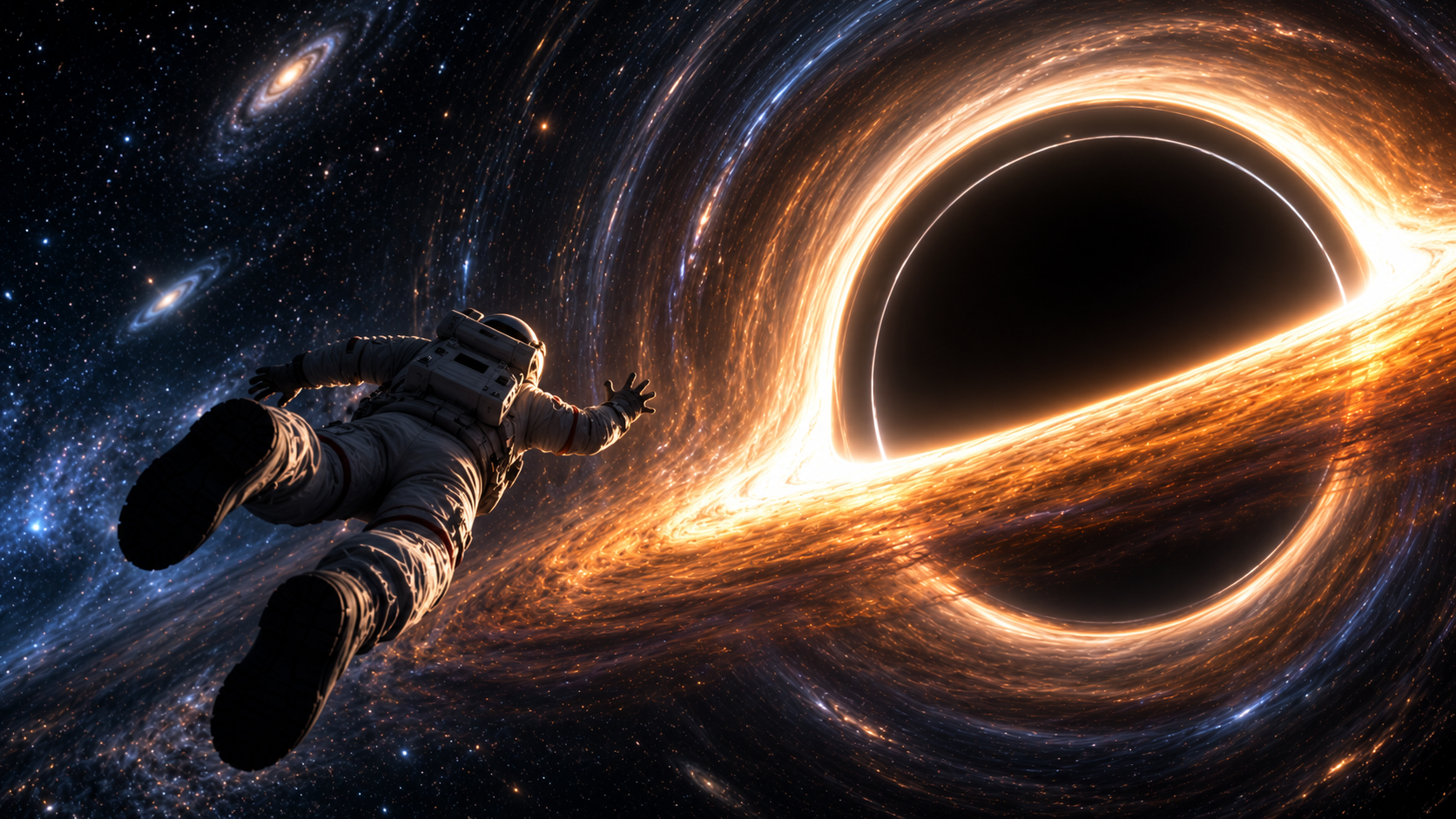
Imagine floating through space when, in the distance, you spot something strange: a dark sphere surrounded by a brilliant, swirling ring of light.
It looks almost unreal. The stars behind it appear distorted, the light bends into unusual shapes, and the closer you get, the stranger the view becomes.
You’re approaching a black hole.
But what would actually happen if you fell into one? Would you be stretched into a long strand of spaghetti? Would time stop? Could you survive crossing its mysterious boundary?
The answers are even more fascinating than science fiction suggests.
The Point of No Return
A black hole is a region of space where gravity is so powerful that nothing can escape once it passes a boundary called the event horizon. That includes light, which is why black holes cannot be seen directly.
The event horizon isn’t a solid surface. You wouldn’t crash into it like a wall or feel yourself hitting an invisible barrier. It’s the point beyond which escape is no longer possible.
Before reaching it, you might see light from distant stars bending dramatically around the black hole. Depending on your position, the sky could appear warped, with images of objects distorted or repeated in unexpected places.
Crossing the event horizon would mark a one-way journey. No spacecraft, engine, or rescue mission could bring you back out.
And surprisingly, if the black hole were sufficiently massive, you might not notice the exact moment you crossed it.
You Could Be Stretched Into Spaghetti
One of the most famous effects associated with black holes is called spaghettification.
The name sounds amusing, but the experience would be anything but.
Gravity becomes stronger the closer you get to a black hole. That means the part of your body nearest the black hole would experience a stronger gravitational pull than the part farther away.
Your feet, for example, could be pulled much more strongly than your head.
This difference in gravitational force is known as a tidal force. As it increases, your body would be stretched lengthwise and compressed from the sides.
Eventually, the forces would become strong enough to tear you apart.
The timing depends on the black hole’s mass. A smaller black hole can produce devastating tidal forces before you reach its event horizon. A supermassive black hole, however, can have much weaker tidal forces at its horizon, potentially allowing you to cross that boundary before being torn apart.
That doesn’t mean you would survive the journey. It simply means the worst effects might happen farther inside.
Time Would Behave Very Differently
Here’s where things get especially strange.
According to Einstein’s theory of general relativity, gravity affects the passage of time. The stronger the gravitational field, the more slowly time passes relative to an observer farther away.
As you approached a black hole, someone watching from a safe distance would see your movements appear increasingly slow. The light reaching them from you would become more stretched toward longer, redder wavelengths and increasingly faint.
Eventually, you would become too dim to see.
But here’s the important distinction: you wouldn’t experience time stopping.
From your own perspective, your clock would continue ticking normally. You would reach and cross the event horizon in a finite amount of time.
So while someone watching from far away would see your image slow and fade, you would continue falling.
Time hasn’t stopped. The difference comes from how gravity affects time and how light travels from you to the distant observer.
The View Would Be Almost Impossible to Imagine
A black hole doesn’t simply swallow light. Its gravity also bends light traveling nearby, producing some of the most extraordinary visual effects in the universe.
If you approached one, the stars and galaxies behind it could appear distorted. Light from the far side of the black hole’s surroundings could bend around it, making parts of the scene appear above, below, or around the dark central region.
You might also see a bright ring or disk of material surrounding the black hole.
This is called an accretion disk. It consists of gas, dust, and other matter orbiting the black hole. As this material moves at tremendous speeds and heats up, it can release enormous amounts of energy, including X-rays.
The disk can be so hot and energetic that approaching it could be deadly long before you reached the event horizon.
In other words, the black hole itself might not be the first thing to kill you. Its surroundings could be just as dangerous.
NASA has created remarkable computer simulations showing what a journey toward a black hole might look like. These visualizations demonstrate how gravity bends light and distorts the view as an object approaches the event horizon.
What Happens After You Cross the Event Horizon?
This is where our understanding becomes much less certain.
Once you cross the event horizon, escaping is no longer possible. Even traveling at the speed of light would not allow you to return.
In the simplest classical models of a black hole, everything that crosses the event horizon eventually moves toward the center, where general relativity predicts a region called a singularity.
A singularity is associated with extreme spacetime curvature, where the equations of classical general relativity stop providing a complete physical description.
But does a real black hole actually contain an infinitely dense point?
Scientists don’t know.
Our current theories of gravity and quantum physics do not yet provide a complete explanation of what happens under those extreme conditions. A successful theory of quantum gravity may eventually reveal what lies beyond the limits of our present understanding.
For now, the deepest interior of a black hole remains one of the biggest mysteries in physics.
Could You Actually Survive Falling Into One?
The honest answer is no, not for the entire journey.
Your chances would depend partly on the black hole’s mass and environment.
Near a relatively small black hole, tidal forces could destroy you before you reached the event horizon.
Near a sufficiently massive black hole, you might cross the event horizon without immediately noticing anything unusual. But you would still be trapped inside, unable to escape, and eventually encounter conditions that would destroy you.
And if the black hole had a powerful accretion disk surrounding it, the intense heat and radiation could kill you before you ever reached the boundary.
So while crossing the event horizon of a large, relatively quiet black hole might not feel dramatic at first, surviving the complete journey is not an option according to our current understanding of physics.
Why Scientists Are So Fascinated by Black Holes
Despite their terrifying nature, black holes are among the most important objects scientists study.
They help researchers test Einstein’s theory of general relativity under extreme conditions, understand how galaxies evolve, and investigate the relationship between gravity, space, and time.
Scientists have even captured images of black hole shadows using the Event Horizon Telescope, an international network of radio telescopes working together.
Astronomers have also detected gravitational waves produced when black holes collide and merge. These discoveries allow researchers to study events that would otherwise be impossible to observe directly.
And every new discovery raises more questions.
How does matter behave inside a black hole? What happens to information that falls in? What would a complete theory of quantum gravity tell us about their interiors?
We don’t have all the answers yet.
One thing is certain: black holes are not simply cosmic vacuum cleaners. They are extraordinary laboratories for understanding the universe itself.
And perhaps the strangest part of all is that the closer we get to understanding them, the more mysteries they seem to reveal.
If you could safely travel close enough to see a black hole up close, would you take the opportunity — or would you stay far away?
Sources: NASA, European Southern Observatory (ESO), Event Horizon Telescope (EHT), LIGO Scientific Collaboration, NASA Goddard Space Flight Center.