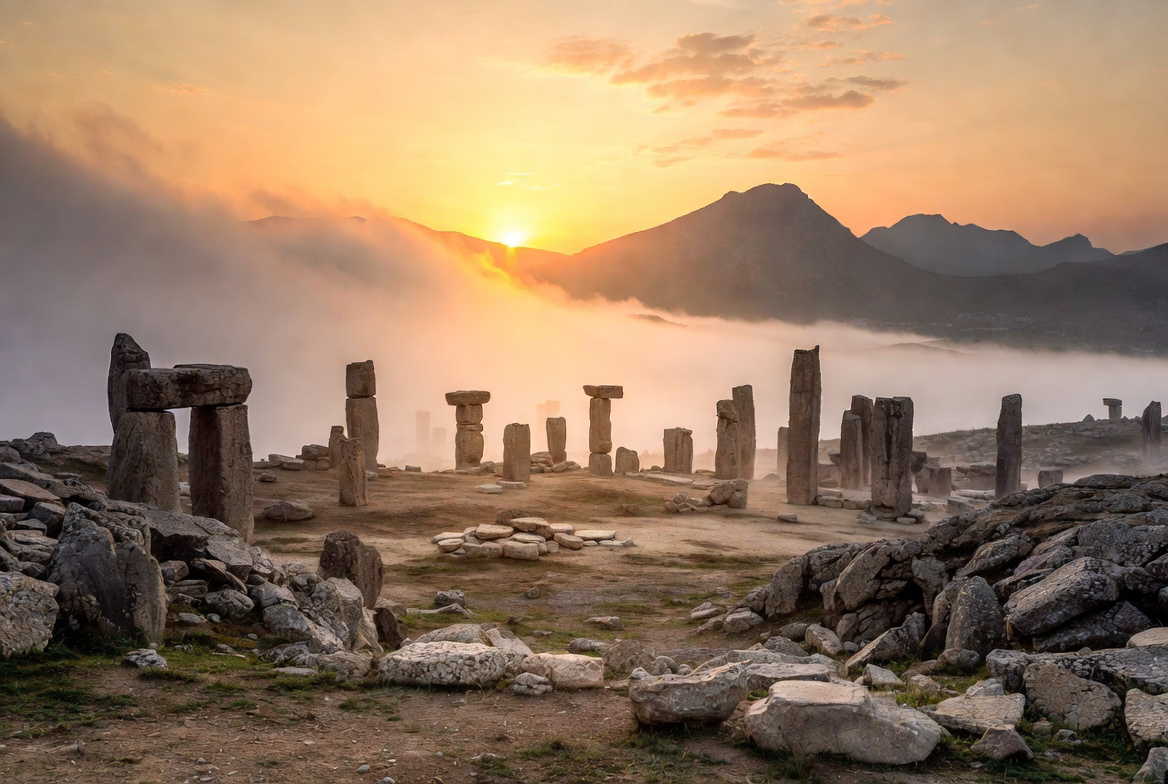
In southeastern Turkey, atop a limestone ridge in the Germuş Mountains, lies Göbekli Tepe—a site that challenges everything we thought we knew about human history. Dating back to around 9600 BCE, this sprawling complex of stone structures predates Stonehenge by over 6,000 years and stands as one of the oldest known examples of monumental architecture. But what makes Göbekli Tepe truly remarkable isn’t just its age or its intricately carved T-shaped pillars—it’s the fact that its monumental enclosures became deeply filled with soil, rubble, artifacts, and other debris, much of it apparently deposited intentionally, leaving much of its story still hidden beneath the earth. As archaeologists continue to unearth its secrets, the site raises a profound question: how much of our past do we still not understand?
The Mystery of the Burial
One of the most perplexing aspects of Göbekli Tepe is how it ended up buried. By the later phases of the site’s use, the circular enclosures—some up to 65 feet across—had become filled with soil, limestone rubble, artifacts, animal bones, and other debris. Evidence indicates that at least some of this material was deliberately deposited, although collapse, erosion, and other natural processes may also have contributed to the fills. Archaeologist Klaus Schmidt, who led excavations from 1995 until his death in 2014, noted that the fill included flint tools, animal bones, and even fragments of human skulls, suggesting a purposeful act rather than abandonment to the elements. In his book Göbekli Tepe: A Stone Age Sanctuary in South-Eastern Anatolia, Schmidt interpreted this as a form of ‘ritual burial,’ proposing that the site’s creators intentionally covered the structures, perhaps to sanctify or decommission it.
But why? Some scholars suggest it was a protective measure, a way to preserve the site’s sanctity from outsiders or future misuse. Others, like Andrew Curry in a 2008 Smithsonian Magazine article, speculate it could mark the end of an era—possibly as the hunter-gatherers who built it transitioned to farming and no longer needed their ancient gathering place. Yet the sheer effort involved—moving tons of earth to cover massive stone structures—hints at a deeper motive we may never fully grasp. The fills helped preserve Göbekli Tepe remarkably well, shielding much of the site from erosion and later settlement, but they also locked away clues about its purpose, leaving us with more questions than answers.
The T-Shaped Pillars: Silent Witnesses
At the heart of Göbekli Tepe are its T-shaped limestone pillars, some towering up to 18 feet and weighing as much as 10 tons. These megaliths, carved from nearby quarries, are the site’s defining feature. Excavations have uncovered over 40 of them so far, arranged in circles with two larger pillars at the center of each enclosure, surrounded by smaller ones. Many are adorned with vivid reliefs—snakes, foxes, vultures, and other animals—while some bear human-like features, such as arms or belts, suggesting they might represent stylized figures or deities.
Schmidt argued these pillars were anthropomorphic, with the horizontal tops symbolizing heads and the vertical shafts as bodies, an interpretation echoed in a 2016 World History Encyclopedia entry by Brian Haughton. The carvings don’t depict everyday life—no hunting scenes or domestic animals—but instead focus on fierce, otherworldly creatures, hinting at a symbolic or spiritual role. A 2020 article in Cambridge Archaeological Journal by Gil Haklay and Avi Gopher further notes the precision of their placement, suggesting the enclosures followed a geometric plan, a level of sophistication unexpected for a society without writing or metal tools.
Yet only a fraction of these pillars have been excavated. Geophysical surveys suggest that more than 200 T-shaped pillars may exist across the site in total, with many still buried underground, along with numerous additional enclosures. This means that what we’ve seen—stunning as it is—may be just the tip of the iceberg. Each unexcavated pillar could hold new carvings, new insights, or even challenge existing theories about who built Göbekli Tepe and why.
What Lies Beneath: A Past We Don’t Fully Understand
The fact that so much of Göbekli Tepe remains underground underscores a broader truth: our grasp of prehistory is incomplete. For decades, archaeologists assumed complex societies emerged only after agriculture, around 10,000 BCE. Göbekli Tepe flips that narrative. Built by hunter-gatherers before widespread farming, it suggests that monumental architecture and organized labor preceded settled life. As Ian Hodder told Smithsonian Magazine in 2008, “This shows sociocultural changes come first, agriculture comes later.”
But with only about 10% of the site excavated—according to UNESCO—the full picture eludes us. Recent finds, like domestic structures and rainwater systems noted in a 2024 Popular Archaeology article, challenge Schmidt’s view of Göbekli Tepe as purely a ritual site, hinting it might have been a lived-in settlement too. Every new discovery reshapes the story, yet the bulk of the site stays out of reach, buried beneath millennia of soil. It’s a reminder that our understanding of the past is built on fragments, and what’s still hidden could rewrite history again.
A Link to Our Uncertain Origins
Göbekli Tepe’s buried pillars and unexplored depths connect us to a time we can barely imagine—a world of hunter-gatherers capable of feats we once thought impossible for their era. The evidence of deliberate backfilling, the intricate pillars, and the vast unexcavated expanse all point to a sophistication and intent that defy simple explanations. Were they hiding something sacred? Marking a cultural shift? Or simply moving on? We don’t know, and that uncertainty is the site’s most powerful lesson.
As we stand on the edge of this ancient mystery, Göbekli Tepe whispers that our past is deeper, stranger, and more complex than we’ve dared to assume. Until we uncover what lies beneath, it remains a monument to both human ingenuity and our enduring ignorance.
SOURCES: UNESCO World Heritage Centre, German Archaeological Institute, Cambridge Archaeological Journal, Science Advances, Smithsonian Magazine.