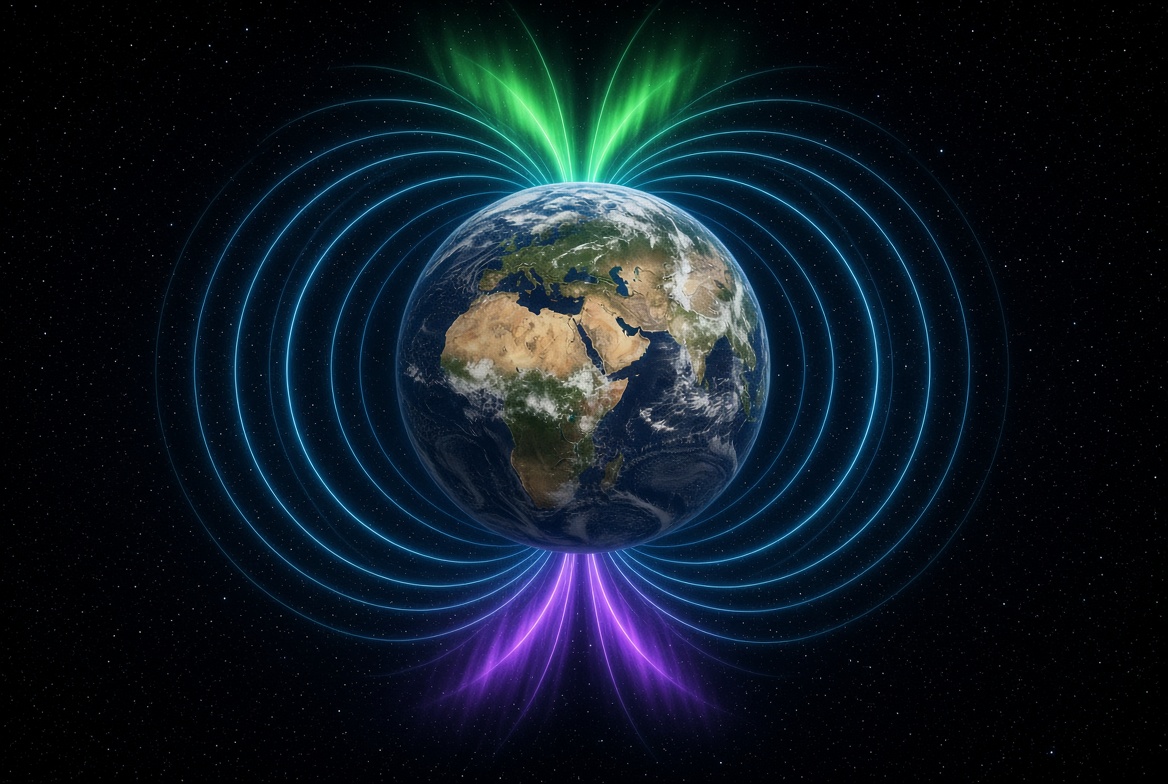
What would happen if Earth’s magnetic field suddenly flipped?
A hiking compass would eventually point the opposite way. But Earth would not suddenly lose its atmosphere, oceans would not boil away, and humanity would not automatically go extinct.
A magnetic reversal is a natural change in Earth’s magnetic field. It has happened many times throughout Earth’s history, and the geological record shows that life survived previous reversals.
The bigger question is what a reversal would mean for modern civilization.
A weaker and more complicated magnetic field could mean more radiation in near-Earth space, greater challenges for satellites and astronauts, changes to auroras, and potentially more stress on technology during major solar storms.
But there is an important distinction between what scientists know from geological evidence and what computer models suggest could happen during a future reversal.
Here is what the evidence actually tells us.
What is a magnetic field reversal?
Earth’s magnetic field is generated by the movement of electrically conducting iron in the planet’s liquid outer core.
The field extends far beyond Earth’s surface and forms the magnetosphere, which helps shield the planet from charged particles carried by the solar wind and from some high-energy radiation from space.
Sometimes, the magnetic field changes dramatically. During a magnetic reversal, the magnetic north and south poles eventually switch places.
This does not mean Earth itself flips over.
It means the orientation of the planet’s magnetic field changes.
Earth has experienced many reversals throughout its geological history. NASA reports that the poles have reversed about 183 times over the past 83 million years, with at least several hundred reversals occurring over the past 160 million years. The average interval between reversals is roughly 300,000 years, although the timing is highly irregular. The most recent full reversal occurred about 780,000 years ago.
Would Earth’s magnetic field flip overnight?
Almost certainly not.
A magnetic reversal is not like flipping a light switch.
The magnetic field changes gradually, becoming weaker and more complicated before eventually settling into the opposite polarity. During the transition, the field can become highly disorganized, and temporary magnetic poles can appear in unexpected locations.
The U.S. Geological Survey says magnetic reversals generally take hundreds to thousands of years rather than happening instantaneously.
Most well-studied reversals appear to unfold over roughly hundreds to thousands of years, but a 2026 study identified two much older Eocene polarity transitions with estimated durations of approximately 18,000 and 70,000 years. The researchers say this suggests reversal duration may be much more variable than the traditional picture of a roughly 10,000-year transition.
Those unusually long examples should not be treated as the expected duration of a future reversal. The researchers themselves note that uncertainties remain and that they cannot yet establish a typical timescale for reversals.
Would Earth’s atmosphere be blown away?
No evidence suggests that a magnetic reversal would suddenly strip Earth’s atmosphere away.
Earth’s magnetic field helps protect the upper atmosphere from charged particles from the Sun, but the magnetic field is not what holds the atmosphere to Earth. Gravity does that.
A weaker magnetic field could change how energetic particles interact with the upper atmosphere. That could increase certain forms of radiation exposure and alter atmospheric chemistry.
But there is no evidence that a normal magnetic reversal would cause Earth’s atmosphere to suddenly escape into space.
Would radiation increase?
Potentially, yes.
One of the most important consequences of a substantially weaker magnetic field would be reduced shielding from charged particles and some cosmic radiation.
Evidence for this comes from geological records. Scientists can use isotopes such as carbon-14 and beryllium-10 as indicators of changes in cosmic-ray activity. During periods when Earth’s magnetic field was unusually weak, production of these cosmogenic isotopes increased.
During the Laschamps geomagnetic excursion roughly 41,000–42,000 years ago, for example, studies of cosmogenic isotopes indicate that cosmic-ray exposure in the atmosphere increased substantially as Earth’s magnetic field weakened.
That does not mean people on the ground were exposed to lethal radiation levels.
Earth’s atmosphere provides another major layer of protection, and radiation exposure depends on altitude, latitude, solar activity, and the strength and structure of the magnetic field.
The biggest concern would likely be for spacecraft, satellites, astronauts and high-altitude aviation rather than ordinary people living at Earth’s surface.
Could auroras appear much farther south?
Very possibly.
Auroras occur when energetic charged particles interact with gases in Earth’s upper atmosphere.
Today, the strongest auroras are generally concentrated around the polar regions because Earth’s magnetic field guides charged particles toward the poles.
If the magnetic field became substantially weaker or more complicated during a reversal, the regions where energetic particles enter the atmosphere could change.
That could allow auroras to become visible much farther from the traditional polar regions.
In other words, during a major geomagnetic disturbance, people in places that rarely see auroras today could potentially see them.
What would happen to satellites?
Satellites could face greater challenges.
Earth’s magnetic field helps protect spacecraft from energetic charged particles. When that shielding is reduced, satellites can experience a harsher radiation environment.
High-energy particles can interfere with electronics, cause data errors and contribute to damage over time.
Earth already has an example of this problem: the South Atlantic Anomaly, a region where the magnetic field is unusually weak.
NASA monitors the anomaly because satellites passing through the region can encounter increased exposure to energetic particles.
A global magnetic reversal would be far more complicated than the South Atlantic Anomaly, but the anomaly provides a real-world example of why weaker magnetic shielding matters for spacecraft.
That does not mean satellites would all suddenly stop working.
Modern spacecraft can be designed with radiation protection, redundancy and operational procedures to reduce these risks.
Could a magnetic reversal cause a global blackout?
Not by itself.
There is no established evidence that past magnetic reversals automatically caused global electrical blackouts.
However, there is a potentially important interaction between a weak magnetic field and space weather.
Power grids can be affected by powerful solar storms because changing magnetic fields can induce electrical currents in long conductors such as transmission lines.
If an unusually powerful solar storm occurred while Earth’s magnetic field was substantially weaker, the combination could create a more challenging environment for electrical infrastructure. But this is a scenario based on known space-weather physics, not an established consequence observed during past magnetic reversals.
So a magnetic reversal should not be presented as an automatic worldwide blackout.
The bigger concern would be how vulnerable modern infrastructure is to severe space-weather events occurring during a period of reduced magnetic shielding.
What would happen to GPS?
GPS would not simply stop working because Earth’s magnetic poles changed.
GPS satellites use radio signals and atomic clocks rather than magnetic compasses to determine position.
However, a changing magnetic field could complicate magnetic navigation, while associated space-weather conditions could also create challenges for satellites and degrade GPS accuracy.
Navigation systems that rely on magnetic direction, such as magnetic compasses and magnetic models used by aircraft and ships, would need to account for the changing field as the magnetic poles moved and the field evolved.
Modern navigation systems could also increasingly rely on satellite navigation, inertial systems and other technologies rather than magnetic direction alone.
What about birds, turtles and other animals?
This is one of the more interesting uncertainties.
Many animals appear to have some form of magnetoreception, meaning they can sense or use Earth’s magnetic field for navigation.
Migratory birds, sea turtles and some other animals are known to use Earth’s magnetic field as one of several navigational cues.
A changing magnetic field could therefore affect how some animals navigate.
But that does not mean a reversal would automatically cause mass animal deaths or widespread ecological collapse.
Animals use multiple environmental signals, and scientists do not know exactly how every species would respond to a long-term change in magnetic direction and strength.
The most reasonable conclusion is that some species could experience navigational changes or behavioral disruption, while others might adapt.
Could a magnetic reversal destroy the ozone layer?
There is a potential connection between a weak magnetic field and atmospheric chemistry, but the idea should not be exaggerated.
A weaker magnetic field can allow more energetic particles to penetrate deeper into the atmosphere. Those particles can trigger chemical reactions involving nitrogen- and hydrogen-containing compounds, which can affect ozone chemistry.
That means a period of unusually weak magnetic shielding could potentially alter ozone levels, but there is no evidence that a normal magnetic reversal would automatically cause a catastrophic collapse of the ozone layer.
The exact effects would depend on the strength and duration of the magnetic weakening, solar activity and the state of Earth’s atmosphere.
The Laschamps excursion: a warning or a coincidence?
The Laschamps event, which occurred roughly 41,000–42,000 years ago, is an important example of a major disruption in Earth’s magnetic field.
Importantly, it is generally described as a geomagnetic excursion, not a completed full reversal.
During the event, Earth’s magnetic field weakened dramatically and the magnetic poles moved substantially before the field eventually returned to its previous polarity.
Scientists have used geological and cosmogenic-isotope evidence to reconstruct the event.
A 2021 Science paper proposed that the Laschamps event, combined with unusually low solar activity, contributed to major changes in atmospheric chemistry, ozone, climate and environmental conditions. The researchers called this a global environmental crisis.
However, those broader environmental and extinction interpretations remain debated.
Some researchers have challenged specific claims linking the Laschamps event to megafaunal extinctions and major changes in human culture, so these effects should be treated as hypotheses rather than established consequences of geomagnetic weakening.
The Laschamps event therefore provides valuable evidence about what happens when Earth’s magnetic field becomes unusually weak, but it does not prove that a future magnetic reversal would cause the same environmental effects.
Would a magnetic reversal cause a mass extinction?
There is no established evidence that magnetic reversals cause mass extinctions.
Earth has experienced many magnetic reversals throughout its history, yet life continued through them.
The U.S. Geological Survey says there is no evidence of a correlation between magnetic reversals and mass extinctions.
That does not mean magnetic changes have zero biological effects.
A substantially weaker magnetic field could increase radiation exposure and alter atmospheric chemistry. Those effects could potentially place additional stress on some organisms.
But the geological record does not support the idea that a magnetic reversal automatically wipes out life.
Would Earth become uninhabitable?
No evidence suggests that a magnetic reversal would make Earth uninhabitable.
The planet has experienced numerous reversals, and life survived them.
Even during a reversal, Earth would retain its atmosphere, gravity, oceans and other systems that make the planet habitable.
The more realistic concern is not that Earth itself would become unlivable, but that a long period of changing magnetic conditions could create additional challenges for modern technology and space-based infrastructure.
Is Earth’s magnetic field flipping right now?
Earth’s magnetic field is changing all the time, but that does not mean a reversal is currently underway.
NASA reports that the global magnetic field has weakened by roughly 9% over the past 200 years.
That sounds dramatic, but magnetic-field strength naturally changes over time.
The U.S. Geological Survey says the present weakening is not evidence that a reversal is imminent. Scientists cannot reliably predict when the next reversal will occur.
The South Atlantic Anomaly is another example of ongoing changes in the field, but it is not proof that a global reversal has begun.
How often does Earth’s magnetic field reverse?
There is no fixed schedule.
NASA estimates that the average interval between reversals is around 300,000 years, but the actual intervals have varied enormously. Some reversals have occurred relatively close together, while Earth has also gone tens of millions of years without a reversal.
The fact that the last reversal happened about 780,000 years ago does not mean Earth is “due” for another one.
Magnetic reversals do not operate like a predictable clock.
What would a magnetic reversal mean for humans?
For most people on the ground, probably far less than movies suggest.
There would be no reason to expect Earth to suddenly stop rotating, oceans to disappear or the atmosphere to vanish.
Instead, the biggest challenges would likely involve technology.
Satellites could face increased radiation exposure. Spacecraft and astronauts could face greater risks. Magnetic navigation would become more complicated. And if severe solar storms occurred during a period of unusually weak magnetic shielding, electrical infrastructure could face additional risks.
Humanity also has a major advantage that organisms in the geological past did not have: technology.
Modern satellites, spacecraft, aircraft, electrical grids and communication systems can be monitored and redesigned around known risks.
What if the field became extremely weak?
This is where the situation becomes more uncertain.
Scientists know that Earth’s magnetic field can weaken dramatically during a reversal. Paleomagnetic evidence indicates that field intensity at Earth’s surface can fall substantially during some transitions.
A very weak field would provide less magnetic shielding from charged particles.
That could mean:
- More radiation exposure for astronauts
- Greater radiation-related risks for satellites
- More frequent spacecraft electronics problems
- Changes in auroral activity
- Greater complexity for magnetic navigation
- Potentially stronger interactions between solar particles and the upper atmosphere
But the severity of these effects would depend on how weak the field became, how long it stayed weak and what the Sun was doing at the same time.
A magnetic reversal is therefore not one single scenario with one guaranteed outcome.
The surprising lesson from Earth’s history
The biggest lesson is that magnetic reversals are natural geological events, not planetary disasters.
Earth has gone through many of them.
The field can weaken. Its structure can become complicated. Magnetic poles can wander. Radiation levels in the atmosphere can change. Auroras can occur at unusual latitudes.
But Earth does not suddenly become a dead planet.
The geological record is especially important because it gives scientists a way to separate realistic possibilities from science fiction.
There is no evidence that previous reversals automatically caused global extinction, destroyed Earth’s atmosphere or made the planet permanently uninhabitable.
The biggest difference today is that modern civilization depends heavily on technologies that operate in space and rely on electrical infrastructure.
That means the consequences of a future reversal would likely be felt more strongly by our technology than by the planet itself.
Frequently Asked Questions
What happens if Earth’s magnetic field flips?
The magnetic north and south poles eventually switch places. During the transition, the field would weaken and become more complicated, potentially affecting radiation levels, satellites, auroras, navigation and some atmospheric processes.
Would Earth lose its atmosphere?
No evidence suggests that a magnetic reversal would suddenly remove Earth’s atmosphere. Gravity keeps the atmosphere bound to Earth, while the magnetic field provides additional protection from charged particles.
Would humans go extinct?
There is no evidence that magnetic reversals cause human extinction or mass extinctions. The main concerns for modern humans would likely involve radiation exposure, space technology and infrastructure.
Would there be more radiation?
Potentially. A weaker magnetic field provides less shielding from charged particles and some cosmic radiation. Earth’s atmosphere would still provide substantial protection.
Would satellites be affected?
They could be. A weaker magnetic field could expose satellites to a harsher radiation environment, increasing risks to electronics and spacecraft systems.
Would GPS stop working?
A magnetic reversal would not automatically shut down GPS. GPS relies on radio signals and precise timing rather than Earth’s magnetic poles. However, magnetic navigation and some space-based systems could face additional challenges.
Would animals get lost?
Some animals use Earth’s magnetic field for navigation, so a major change could affect certain species. However, scientists cannot say that a reversal would cause widespread animal collapse.
Would there be more auroras?
Possibly. Changes in Earth’s magnetic field could allow auroral activity to occur at lower latitudes than usual, particularly during periods of strong solar activity.
Is Earth’s magnetic field reversing now?
Earth’s magnetic field is changing and has weakened in recent centuries, but that does not mean a reversal is currently underway. Scientists do not have evidence that a reversal is imminent.
How long would a reversal take?
Most well-studied reversals appear to unfold over thousands of years or less, but a 2026 study identified two ancient Eocene transitions lasting approximately 18,000 and 70,000 years. Those unusual examples show that reversal durations may be more variable than previously thought, but they do not establish a typical future timescale.
The Bottom Line
What if Earth’s magnetic field flipped?
It would be a major geological event, but not the instant apocalypse often imagined in science fiction.
Earth would not suddenly lose its atmosphere. The oceans would not boil away. Humanity would not automatically go extinct.
Instead, Earth’s magnetic field would gradually weaken and become more complicated before settling into the opposite polarity.
During that transition, radiation levels in near-Earth space could increase, auroras could appear at unusual latitudes, magnetic navigation could become more difficult, and satellites and astronauts could face a harsher radiation environment.
If an extreme solar storm occurred during a period of substantial magnetic weakening, electrical infrastructure could also face additional risks—but that remains a scenario based on known space-weather physics rather than a proven consequence of past reversals.
The most important point is that Earth has experienced magnetic reversals many times before.
The planet has survived every one of them.
The real question is not whether Earth could survive another reversal.
It is how well modern civilization would adapt to a changing magnetic environment.
SOURCES: NASA Science, U.S. Geological Survey, Communications Earth & Environment, Science.