On December 5, 1952, London woke to what seemed like another ordinary winter morning. The city was cold, coal fires were burning in homes across the capital, and a familiar blanket of fog hung over the streets.
But this was no ordinary fog.
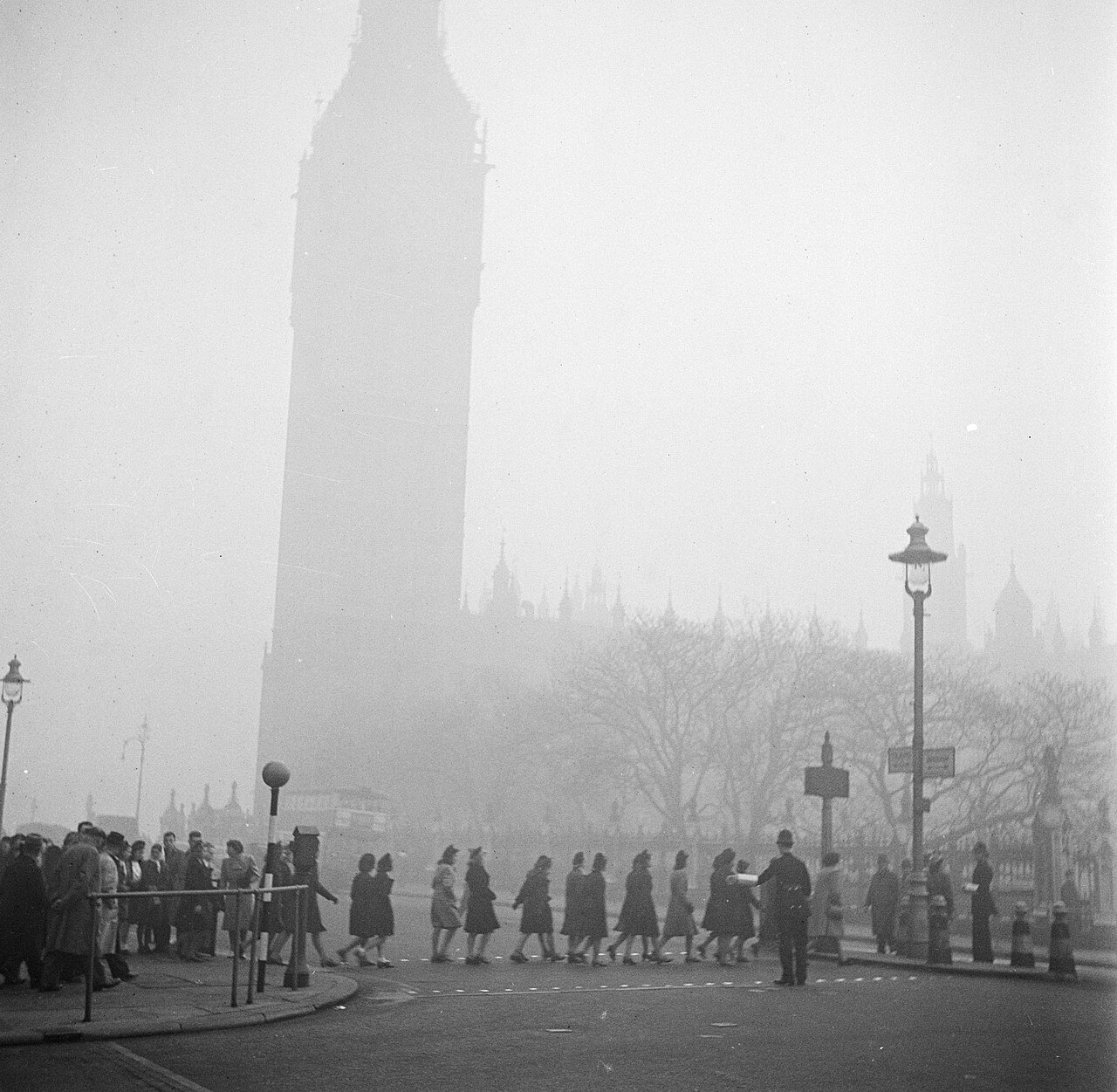
Over the next five days, a thick, poisonous mixture of smoke and fog swallowed London. Visibility fell so dramatically that people struggled to see their own feet. Buses stopped running, cars were abandoned, and the polluted air began making people seriously ill.
The danger was almost impossible to see clearly. There was no explosion, no warning siren and no sudden disaster that people could escape. Instead, a deadly combination of industrial pollution, household coal smoke and unusual weather conditions had turned the air itself into a threat.
By the time the skies finally cleared, thousands of people were dead.
The event would become known as the Great Smog of 1952, one of the deadliest air pollution disasters in modern history.
When London Vanished
London was already accustomed to thick, dirty fog.
For generations, coal had been burned in homes, factories and power stations across the city. The resulting smoke mixed with moisture in the atmosphere, creating the familiar yellowish or brownish haze that became known as a pea-souper.
But the conditions in December 1952 were particularly dangerous.
The preceding weeks had been unusually cold. Londoners were burning large quantities of coal to heat their homes, sending enormous amounts of smoke into the atmosphere. Factories and power stations were adding even more pollution.
The situation deteriorated on December 5.
A weather system known as an anticyclone had settled over the region, bringing calm conditions and preventing polluted air from dispersing. A temperature inversion also developed, trapping cooler air near the ground beneath a layer of warmer air.
Normally, warm air rises and helps carry pollution away. Under these unusual conditions, however, the polluted air remained trapped close to the surface.
An easterly wind also carried additional pollution towards London from industrial areas across continental Europe.
The result was a dense mixture of ordinary fog and industrial smoke that became increasingly difficult to escape.
As the days passed, visibility deteriorated. In some areas, people could barely see a few metres ahead. The smog was so thick that pedestrians struggled to navigate familiar streets, while motorists found it increasingly dangerous to continue driving.
The pollution did not remain outside, either. It seeped into buildings through gaps around doors and windows, exposing people indoors as well as those attempting to travel through the streets.
London had effectively become trapped beneath its own pollution.
The Air Itself Had Become Dangerous
What made the Great Smog particularly deadly was not simply how difficult it was to see through. The air contained a dangerous concentration of pollutants.
Burning coal released smoke particles and sulphur dioxide, a gas that can irritate and damage the respiratory system.
When sulphur dioxide interacts with moisture in the atmosphere, it can contribute to the formation of sulphuric acid.
The Met Office estimates that during the smog, approximately 370 tonnes of sulphur dioxide were released each day. It also estimates that around 800 tonnes of sulphuric acid were produced daily through atmospheric chemical processes.
Smoke particles and acidic pollutants accumulated close to the ground, creating an extremely hazardous environment.
People began experiencing coughing, breathing difficulties and other respiratory problems. Those already suffering from heart and lung conditions were particularly vulnerable.
Hospitals and medical services faced increasing pressure as the number of seriously ill patients rose.
The danger extended beyond people. Contemporary reports even described cattle at Smithfield Market being overcome by the polluted air.
The disaster was no longer simply disrupting daily life. It was becoming a major public health emergency.
A City Brought to a Standstill
As the smog intensified, everyday life across London became increasingly difficult.
Public transport was heavily disrupted. Many buses were cancelled, while motorists struggled to navigate streets where visibility had almost disappeared.
Cars were abandoned, and pedestrians found themselves moving through familiar neighbourhoods without being able to see clearly where they were going.
The pollution also affected entertainment and public gatherings. Cinemas and theatres experienced disruptions because audiences could not properly see what was happening on stage or screen.
Perhaps most disturbing was the fact that people could not simply escape the problem by going indoors. The polluted air entered homes and buildings, leaving many residents exposed even when they were away from the streets.
For five days, London remained beneath the thick smog.
The fog finally began clearing on December 9, as weather conditions changed and the trapped pollution dispersed.
But the damage had already been done.
How Many People Did the Great Smog Kill?
The full human cost of the disaster became clearer only after the immediate crisis had passed.
Initial estimates suggested that approximately 4,000 people had died as a result of the smog and its immediate effects.
However, researchers later discovered that the consequences continued long after the skies cleared.
A 2001 study published in Environmental Health Perspectives examined mortality records, hospital admissions, respiratory illnesses and other public health data from the winter of 1952–1953.
The researchers estimated that approximately 12,000 excess deaths occurred between December 1952 and February 1953 because of the acute and lingering effects of the pollution.
This distinction is important. The 12,000 figure does not represent people who all died during the five days of smog. It includes additional deaths over the following months.
The disaster had consequences that extended far beyond the period when London was visibly covered in pollution.
The Disaster That Changed Britain’s Clean Air Laws
Before 1952, London’s polluted air was often treated as an unfortunate consequence of industrialisation and everyday life.
The Great Smog made that attitude much harder to defend.
Public concern grew as the scale of the disaster became apparent. The government faced increasing pressure to investigate air pollution and introduce stronger protections.
A series of measures followed, including the Clean Air Act of 1956.
The legislation introduced controls on smoke emissions and established smoke control areas where residents were required to use cleaner fuels or approved heating methods. Further legislation followed in 1968.
These changes helped transform the way Britain approached air pollution.
The process was gradual, and London continued to experience serious pollution problems for years afterwards. Nevertheless, the Great Smog had become a turning point in the country’s environmental history.
It demonstrated that pollution was not merely an inconvenience or an unavoidable feature of industrial progress. Under the wrong conditions, it could become deadly on a massive scale.
A Warning That Still Matters
Today, the streets of London look very different from the city that disappeared beneath the Great Smog in December 1952.
Coal smoke no longer dominates the capital’s atmosphere in the way it once did. Cleaner fuels, industrial regulations and modern pollution controls have dramatically changed urban air quality.
But the underlying problem has not disappeared.
Air pollution remains a major public health threat around the world. Traffic emissions, industrial activity, power generation and other sources continue to expose millions of people to harmful pollutants.
The Great Smog remains a powerful reminder of what can happen when pollution accumulates faster than the environment can disperse it and when its dangers are underestimated.
For five days in 1952, London struggled to see through its own air. By the time the fog lifted, thousands of lives had been lost, and the country had been forced to confront a problem it could no longer ignore.
SOURCES: Met Office, London Museum, UK National Archives, Environmental Health Perspectives, Greater London Authority.