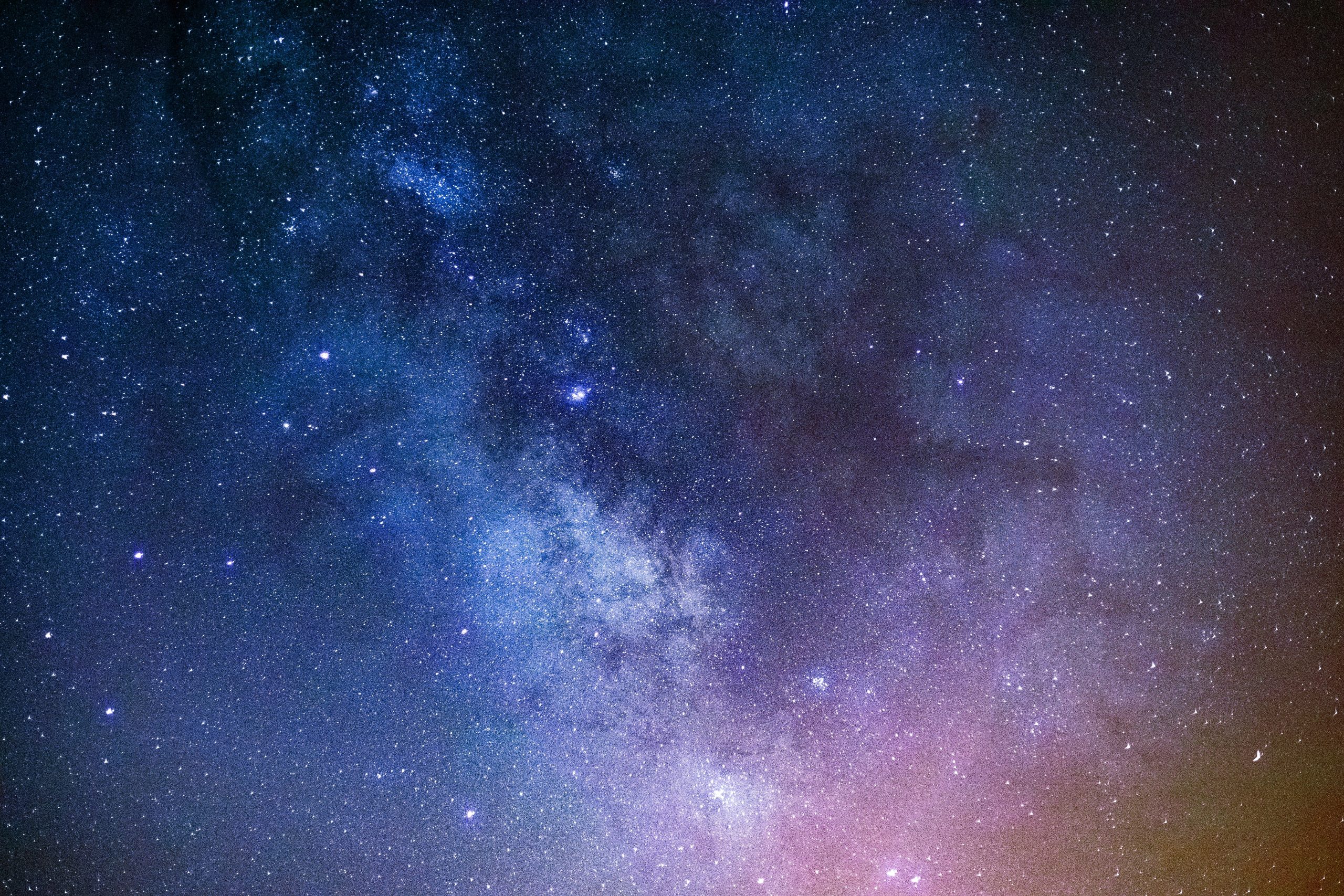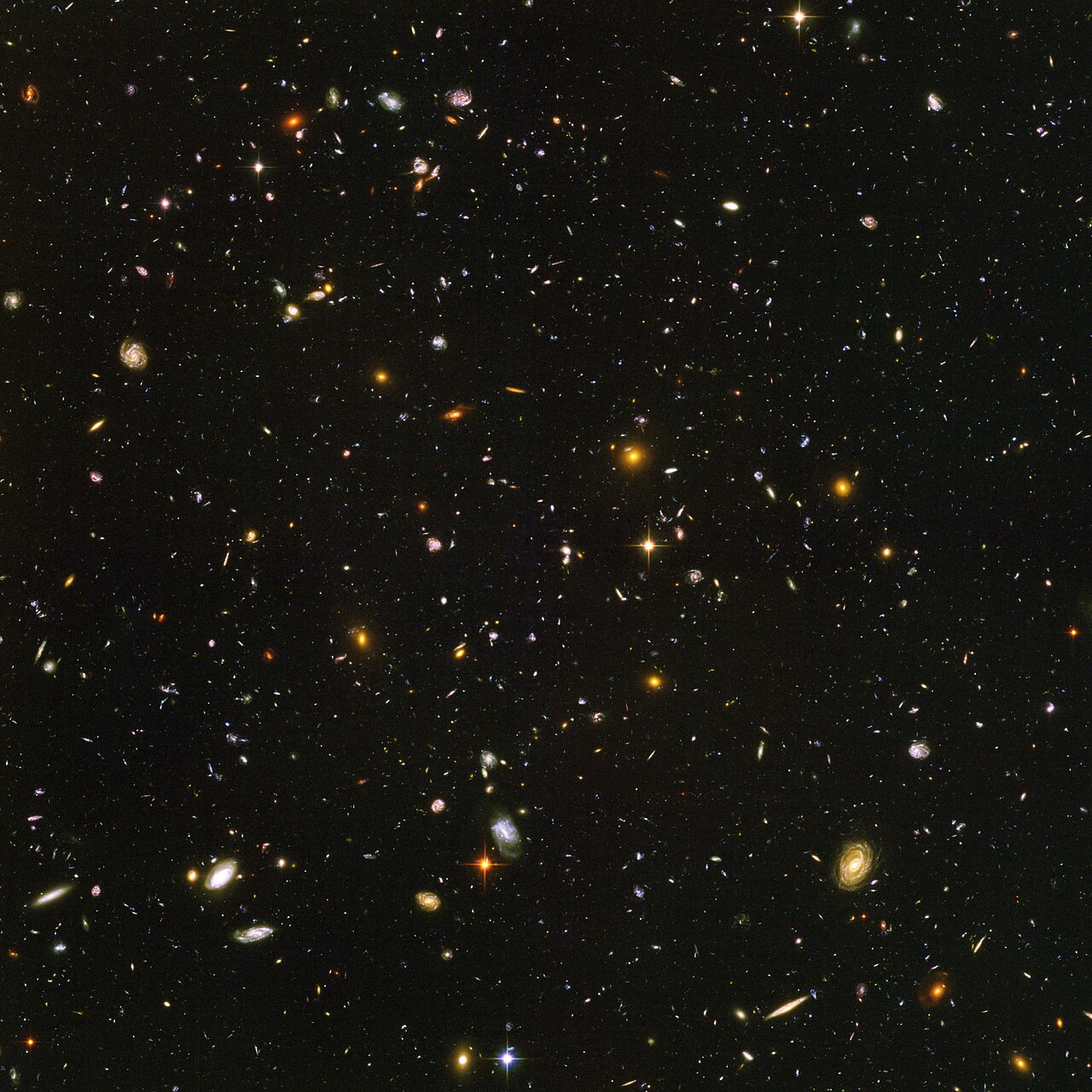
Picture standing on a ship in the middle of the ocean. The horizon is real, but it isn’t a wall. The water continues beyond it. The universe may work in a similar way.
We can only see so far into space because light takes time to travel. The universe is about 13.8 billion years old, which means light from the most distant regions we can observe has been travelling toward us for nearly the entire history of the cosmos.
But there is a surprising detail: because space has expanded while that light was travelling, the objects that released it are now much farther away than 13.8 billion light-years. The boundary of the observable universe is roughly 46 billion light-years away in every direction, making the observable universe about 93 billion light-years across.
That boundary is called the cosmic horizon. It marks the limit of what we can observe, not necessarily the end of everything that exists.
There is no known wall, drop-off or physical barrier where galaxies suddenly stop. Beyond our observable horizon, there may be regions of space filled with galaxies and matter just like the ones we can see. Their light simply has not had enough time to reach us.
So, if the universe has no visible edge, does that mean it goes on forever?
What does it mean for the universe to be infinite?
To understand the question, it helps to look at the shape of space.
Scientists study the geometry of the universe by examining how light travels and how matter is distributed across enormous distances. One important measurement is the universe’s overall curvature.
In simple terms, space could be positively curved, negatively curved or flat.
A positively curved universe is sometimes compared to the surface of a sphere. Imagine travelling in a straight line across Earth. You could keep moving without ever reaching an edge, eventually returning to where you started. The surface has a limited area, but no boundary.
The universe is not literally the surface of a sphere, of course. The comparison simply illustrates how something can be finite without having an edge.
A negatively curved universe has a different geometry, somewhat like a saddle. In the simplest models, this type of space extends infinitely.
A flat universe is the most familiar possibility. On large scales, parallel lines remain parallel, and the angles inside a triangle add up to 180 degrees.
If space is perfectly flat and has a simple, unbounded topology, it would extend infinitely in every direction. However, flat geometry alone does not prove that the universe is infinite. More complicated arrangements could allow space to be finite while still having no edge.
What have scientists discovered about the universe’s shape?
Measurements of the cosmic microwave background, the faint radiation left over from the early universe, provide some of the strongest evidence about the geometry of space.
The Planck satellite, operated by the European Space Agency, mapped tiny temperature variations in this ancient radiation. These variations preserve information about the universe when it was only about 380,000 years old.
When scientists compare those observations with other measurements, the results indicate that the universe is remarkably close to flat on the scales we can observe.
That is an important clue, but it does not settle the question.
If the universe has some curvature, it may be so slight that the observable region is not large enough to reveal it clearly. The entire universe could be vastly larger than the part we can see.
In other words, even if space eventually curves back on itself, the distance required to detect that curvature could be far beyond our cosmic horizon.
Could the universe wrap around itself?
There is another possibility that makes the question even more interesting.
A universe could be flat and still have a finite volume if space had a more complicated topology.
Imagine a classic video game in which a character walks off the right side of the screen and reappears on the left. The game world has no boundary, even though its total area is limited.
Some mathematical models describe a universe with a similar arrangement. In principle, travelling far enough in one direction could bring you back to a region you had already passed.
If the universe worked this way, we might expect to find repeating patterns in the distribution of distant galaxies or in the cosmic microwave background.
So far, scientists have not found convincing evidence that space wraps around in this way. That does not rule out every possible finite arrangement, but it places limits on the kinds of models that remain plausible.
Did the universe’s early expansion make it infinite?
One idea that helps explain why the universe looks so uniform is cosmic inflation.
According to the inflationary model, space underwent an extremely rapid expansion during its earliest moments. This expansion would have stretched tiny regions of space to enormous sizes, helping explain why the universe looks so similar in different directions.
Inflation is consistent with a universe much larger than the region we can observe. Some models even describe a universe that is effectively infinite.
But inflation does not prove that the universe is infinite. It does not tell us exactly how large all of space is, or whether space eventually loops around or curves beyond our observable horizon.
The theory helps explain the universe’s early development, but the question of its total size remains open.
So, does the universe have an edge?
The honest answer is that we don’t know whether the entire universe is infinite.
What scientists do know is that the observable universe has a limit. We can see only the regions from which light has had enough time to reach us since the beginning of the cosmos.
Beyond that horizon, space may continue indefinitely. It may also be finite but have no edge, with a shape or topology that we cannot yet measure.
The distinction is important: the edge of what we can see is not necessarily the edge of what exists.
And perhaps the strangest possibility is that the universe could be so much larger than our observable region that we may never be able to determine its true size.
SOURCES: European Space Agency (Planck Mission), NASA, Planck Collaboration, BBC Science Focus, Universe Today.