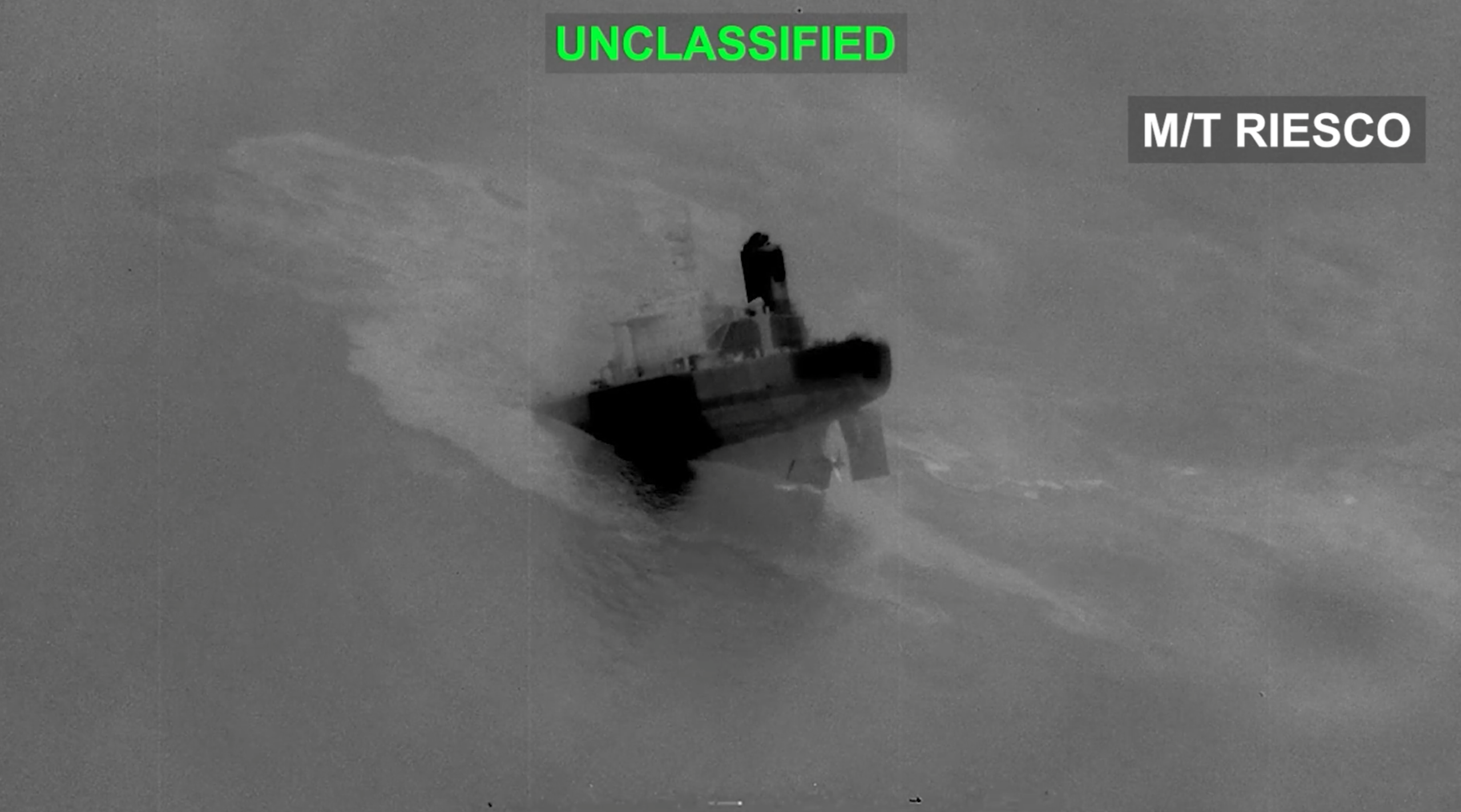
The U.S. military said Tuesday it destroyed five Iranian crude tankers after what it described as two ballistic-missile attempts against a Navy warship.
U.S. Central Command said the ship evaded both attempts, remained on patrol, and that no American personnel were harmed. It identified the tankers as the M/T Kaviz, M/T Charminar, M/T Horizon 1 and M/T Riesco, struck in the Gulf of Oman, and the M/T Derya, struck near Kharg Island. CENTCOM said the vessels were linked to the Guard, that crews were told to abandon ship before the attacks, and that the ships were “rendered inoperable.” It later released a video showing the Riesco sinking.
The Guard said it responded by firing ballistic missiles at a base near Al Azraq in Jordan used by U.S. forces and by attacking ships near the Strait of Hormuz. Iranian state media also reported U.S. strikes near Kharg Island and the port of Jask.
Jordan’s military said it engaged 20 missiles launched from Iran, intercepted 18, and that two fell in unpopulated areas. It reported no casualties. It did not confirm the Guard’s claim of damage at the base. No public U.S. or Jordanian statement reviewed for this article confirmed additional ship hits. Casualties among the tanker crews have not been established in those statements.
Tuesday’s action followed a similar CENTCOM announcement on Sept. 5. That day the command said it had hit three other carriers — the Downy off Kharg, the Stark 1 near Jask, and the Kylo, also known as the Noxen, in the Gulf of Oman — after what it described as failed attacks on an aircraft carrier and a destroyer. Secretary of State Marco Rubio, asked about the latest strikes while in Colombia, said that if Iran tried to hit U.S. ships, “they’re going to lose tankers.”
Kharg Island, in the northern Gulf, is Iran’s main crude-loading terminal. Reuters and other energy desks have long reported that, in normal conditions, about 90 percent of Iran’s crude exports left through Kharg. A strike near Kharg, in the U.S. account, is a strike on that export system. It is not the same as closing the Strait of Hormuz, the narrow exit from the Gulf to the open ocean.
The U.S. Energy Information Administration has put typical flows through Hormuz near 20 million barrels a day, or about a fifth of world petroleum-liquids use and about a quarter of oil moved by sea. The International Energy Agency uses a similar scale. Most of that oil is bound for Asia. Saudi Arabia and the UAE can move some crude around the strait by pipeline; several other exporters cannot. War has already reduced traffic. UBS analysts, cited by Barron’s, have estimated recent Hormuz oil and product flows at about 7 million barrels a day, down from more than 20 million before the war. That figure is an estimate. It is not a tally of cargo on the five ships named Tuesday.
Brent crude traded above $100 a barrel on Wednesday for the first time since July 24, Reuters and the Associated Press reported. Both tied the move to a wider day of fighting in the region, not to a measured loss from those five tankers.
SOURCES: U.S. Central Command, Jordanian Armed Forces, Reuters, Associated Press, Barron’s, U.S. Energy Information Administration, International Energy Agency.