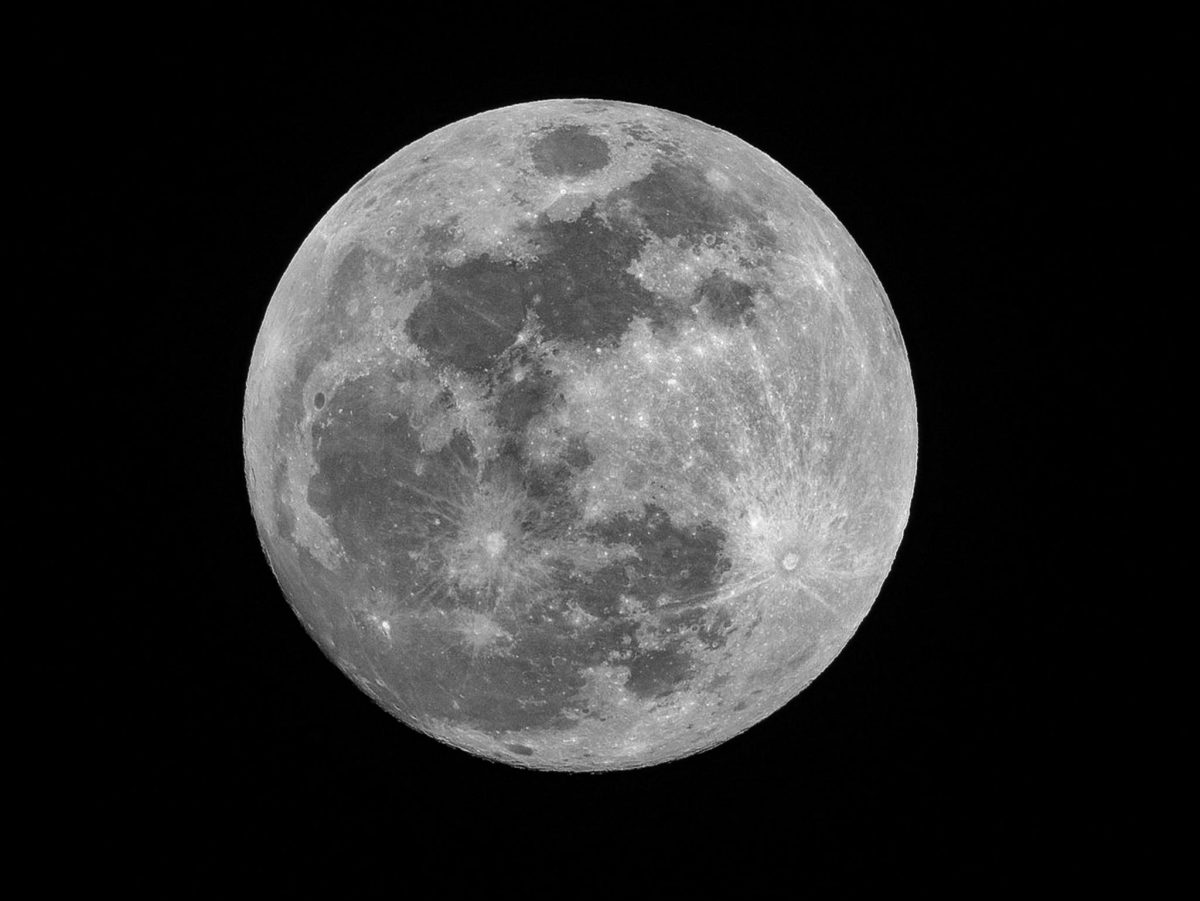
The Moon has been Earth’s constant companion for about 4.5 billion years. It lights the night, pulls on the oceans, slows the planet’s rotation, and helps keep Earth’s axis from swinging wildly. Most people experience it as a familiar presence in the sky. Fewer realize how deeply it shapes the conditions that make the modern Earth stable and habitable.
This article explores a clear hypothetical: What if the Moon suddenly left Earth’s orbit and vanished? The scenario is not based on any real risk. The Moon is slowly drifting outward at a few centimeters per year, but it is not about to escape. The discussion uses established physics of gravity, tides, and planetary motion to examine what would change if it disappeared overnight.
The Sky and the Immediate Sensory Change
The first thing anyone would notice is darkness. Full moonlight can be bright enough to read by and to cast clear shadows. Without it, nights would be far blacker, broken only by stars, planets, and human lights. Ancient calendars, religious observances, and navigation methods that relied on lunar phases would lose their reference. Total solar eclipses would end, because they require the Moon to pass directly between Earth and the Sun.
For many nocturnal animals, the sudden loss of moonlight would disrupt feeding, mating, and predator-avoidance behaviors that have evolved under lunar cycles.
Tides Would Shrink Dramatically
The Moon is the main driver of Earth’s ocean tides. The Sun also creates tides, but its effect is less than half as strong. If the Moon vanished, the difference between high and low tide would drop sharply—roughly to the scale of today’s weaker neap tides or smaller.
Coastal ecosystems depend on the regular movement of water. Intertidal zones, salt marshes, estuaries, and the species that live in them rely on the twice-daily flooding and exposure that strong tides provide. Weaker tides would reduce the mixing of nutrients from the seafloor, alter salinity patterns in estuaries, and shrink the productive areas that many fish, birds, and invertebrates use. Over years and decades, coastlines themselves would begin to change as tidal currents and sediment transport weakened.
The same tidal interaction that raises the oceans also creates friction. That friction has been slowing Earth’s rotation for billions of years, lengthening the day by about 2 milliseconds per century. Without the Moon, this braking effect would be greatly reduced, although solar tides and other processes would still affect Earth’s rotation. The length of the day would remain close to its present value rather than continuing to lengthen at the current lunar-driven rate.
Earth’s Axis Would Lose Its Stabilizer
Perhaps the most significant long-term consequence involves Earth’s axial tilt. The planet currently spins at an angle of about 23.4 degrees relative to its orbit around the Sun. That tilt creates the seasons. Over tens of thousands of years the angle varies only modestly, between roughly 22.1° and 24.5°. The Moon’s gravity is the main reason the swings stay small.
Without the Moon, gravitational pulls from other planets—especially Jupiter and Venus—would cause the tilt to vary far more. Models indicate that without the Moon, Earth’s axial tilt could vary much more substantially over long timescales, with some models allowing very large excursions depending on the planet’s initial conditions. At times Earth might have almost no tilt, producing weak or nearly absent seasons. At other times the planet could tilt dramatically, creating extreme seasonal contrasts: prolonged polar daylight and darkness, and unusual temperature patterns even at mid-latitudes.
Mars, which lacks a large stabilizing moon, has experienced much larger axial-tilt variations than Earth. It provides a useful example of how planetary obliquity can vary substantially without a large moon, although Earth’s moonless evolution would not necessarily follow the same pattern.
Climate Chaos on Geological Timescales
Seasons as we know them would no longer be reliable over long periods. Shifting axial tilt would redistribute sunlight across the globe in changing patterns. Ice sheets could advance or retreat in unfamiliar ways. Climate zones would migrate. Regions that are temperate today could experience repeated episodes of severe seasonal stress or, conversely, long stretches with little seasonal variation.
Complex life on land evolved under relatively stable seasonal rhythms. Large, chaotic swings in tilt would introduce a new source of climate pressure. Whether ecosystems and agricultural systems could adapt is unknown, but the background stability that has characterized much of Earth’s recent geological history would be gone.
Biological Rhythms and Coastal Life
Many species time critical behaviors to the Moon. Some corals spawn en masse after specific lunar phases. Certain crabs, fish, and insects coordinate reproduction or migration with moonlight or tidal cycles linked to the Moon. The sudden absence of these cues would disrupt those patterns.
Weaker tides would further stress coastal food webs. Species adapted to broad intertidal ranges could lose habitat. The overall productivity of some shallow marine environments might decline, with effects that could ripple outward through food chains.
Human Society in the Short and Long Term
In the first years, people would mainly notice darker nights and milder tides. Ports, fishing fleets, and coastal engineering projects designed around current tidal ranges would need adjustment. Cultural and religious practices tied to the lunar calendar would lose their astronomical basis.
Over much longer timescales the unstable axial tilt would pose deeper challenges. Agriculture depends on predictable seasons. Infrastructure and settlement patterns assume relatively stable climate zones. A planet whose tilt wandered significantly would force repeated adaptations in food production, water management, and coastal planning across thousands of generations.
Most modern technology—satellites, communications, power systems—would continue to function, since it does not rely on the Moon’s presence. The larger difficulties would be environmental and climatic rather than technological.
Why the Moon Matters
The Earth-Moon system is tightly coupled. The Moon did not merely arrive and stay; its gravitational influence has helped shape the length of the day, the strength of the tides, and the stability of the seasons. Removing it would leave a planet with darker nights, weaker coastal rhythms, and a far more unpredictable long-term climate.
The scenario remains entirely hypothetical. The Moon is not at risk of suddenly leaving orbit. Exploring the question simply reveals how much of Earth’s present character depends on a satellite we often take for granted.
Closing Perspective
If the Moon vanished overnight, the sky would go dark, the oceans would quiet, and the dominant lunar braking of Earth’s spin would largely disappear. The most profound changes would appear only over geological time: an axis that wandered, seasons that became unreliable, and a climate system subjected to repeated large shifts in the distribution of sunlight.
The Moon is more than a night light or a driver of tides. It is a gravitational anchor that has helped keep Earth’s orientation relatively steady for billions of years. Its sudden absence would produce a very different planet—one still habitable in the short term, but far less stable over the long spans on which complex life and human civilization have developed.
SOURCES: NASA Science, NOAA, Nature, Icarus.