A mini-split that suddenly blows cooler air, goes quiet outside, or sends up a cloud of “smoke” in January is usually doing its job.
In heating mode the outdoor coil is the cold part of the system. It pulls heat from outdoor air. When that coil is colder than freezing and the air is damp, frost forms on the fins. Left alone, the frost blocks airflow and the unit cannot keep extracting heat. So the system runs a short defrost cycle: it sends heat back to the outdoor coil, melts the frost, then returns to heating.
That is why some home owners google whether the outdoor unit is on fire, what “dF” on the display means, and why the heat suddenly stopped.
What you will see
A normal defrost cycle often includes some or all of these:
- Steam or a white cloud off the outdoor unit (melted frost turning to vapor in cold air)
- Water dripping from the outdoor cabinet
- The outdoor fan stopping
- The indoor unit pausing, or blowing room-temperature air for a few minutes
- A click or hiss as the reversing valve changes direction
- “dF,” “DF,” or a defrost icon on the indoor display
None of those, by themselves, mean the compressor has failed. “dF” on most units is a status message, not an error code.
Typical length for a defrost cycle is about 5 to 15 minutes. In cold, wet weather the cycle may repeat every 30 to 90 minutes. Dry cold often means fewer cycles. The exact timing depends on coil temperature, outdoor humidity, and how the manufacturer wrote the control logic.
How the cycle works
A mini-split is a heat pump. Refrigerant moves heat. It does not burn fuel.
In heating, the outdoor coil acts as the evaporator: refrigerant there is cold enough to absorb heat from outdoor air, even when that air feels freezing to you. The compressor then raises the refrigerant’s pressure and temperature. The indoor coil releases that heat into the room.
Frost forms when the outdoor coil is cold and the air is damp. Sensors on the coil watch for that. When frost is likely, the control board starts a defrost cycle.
- The reversing valve flips the refrigerant path.
- Hot refrigerant is sent to the outdoor coil. That coil becomes the warm side for a few minutes.
- Ice melts. Steam rises. Water drains.
- The outdoor fan often stays off so it does not blow the heat away.
- Sensors see the coil warm up, or a timer ends. The valve flips back. Heating resumes.
During the cycle, the indoor fan is often slowed or stopped so the unit does not push a burst of cooler air across the room while heat is being used outside.
Defrost can start even when the outdoor air is a little above freezing. The coil itself can still be below 0°C (32°F) while it is pulling heat from that air.
What is normal vs not
Usually normal:
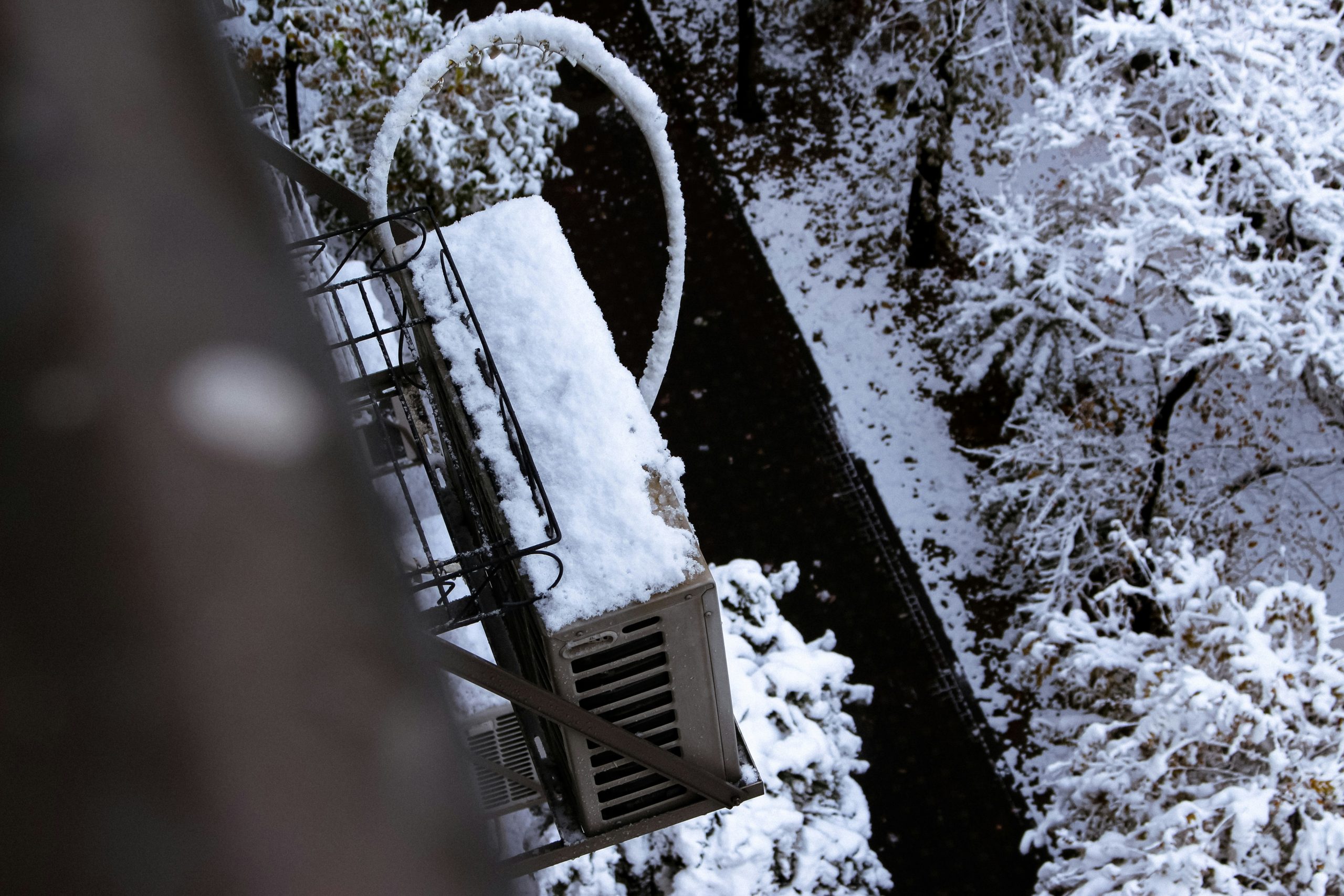
- Thin white frost on the outdoor fins in heating mode
- Steam during or just after defrost
- Heat that pauses, then returns in under about 15 minutes
- Cycles every half hour to an hour and a half on a damp, near-freezing night
Not normal:
- The outdoor unit is a solid block of ice that does not melt after a cycle
- Defrost cycle every 10–15 minutes, all day
- Indoor air stays cold long after the display leaves “dF”
- Ice on the indoor coil
- Burning-plastic smell (steam has no odor)
- Error codes other than a defrost status, or a unit that will not restart
A thick ice shell that never clears can mean a failed defrost sensor, a stuck reversing valve, a blocked drain, a dirty outdoor coil, poor airflow around the cabinet, or a refrigerant problem. Those are repair issues. Do not chip ice off the fins with a tool. You can bend the coil or cut a line.
What you can check without tools
- Outdoor unit has space to breathe. Snow, leaves, or a deck skirt wrapped around it will make frost worse.
- Indoor filters are clean. A clogged filter can ice the indoor coil.
- The display really says dF / DF, not a different fault code in the manual.
- After 15 minutes, heating actually returns.
If the unit is heating again and the outdoor coil is wet rather than armored in ice, leave it alone.
Why this matters in a cold climate
Standard mini-splits lose capacity as outdoor temperature falls. Cold-climate models are built to keep moving heat at lower temperatures, but they still frost. More frost means more defrost time, and defrost time is time the system is not heating the house. That is expected physics, not proof the product is a scam.
A unit that defrosts often on a wet 0°C / 32°F night can still be correctly sized. A unit that cannot keep the house warm after the cycle ends, or that ices into a block, is a different problem.
SOURCES: U.S. Department of Energy, Ductless Mini-Split Heat Pumps; U.S. Department of Energy, Heat Pump Systems; ENERGY STAR, Cold Climate Heat Pumps; Natural Resources Canada, Air-Source Heat Pumps; ASHRAE, vapor-compression and defrost-cycle fundamentals; Mitsubishi Electric, Daikin, Fujitsu, and LG residential owner manuals (defrost / “dF” or “DF” status display).