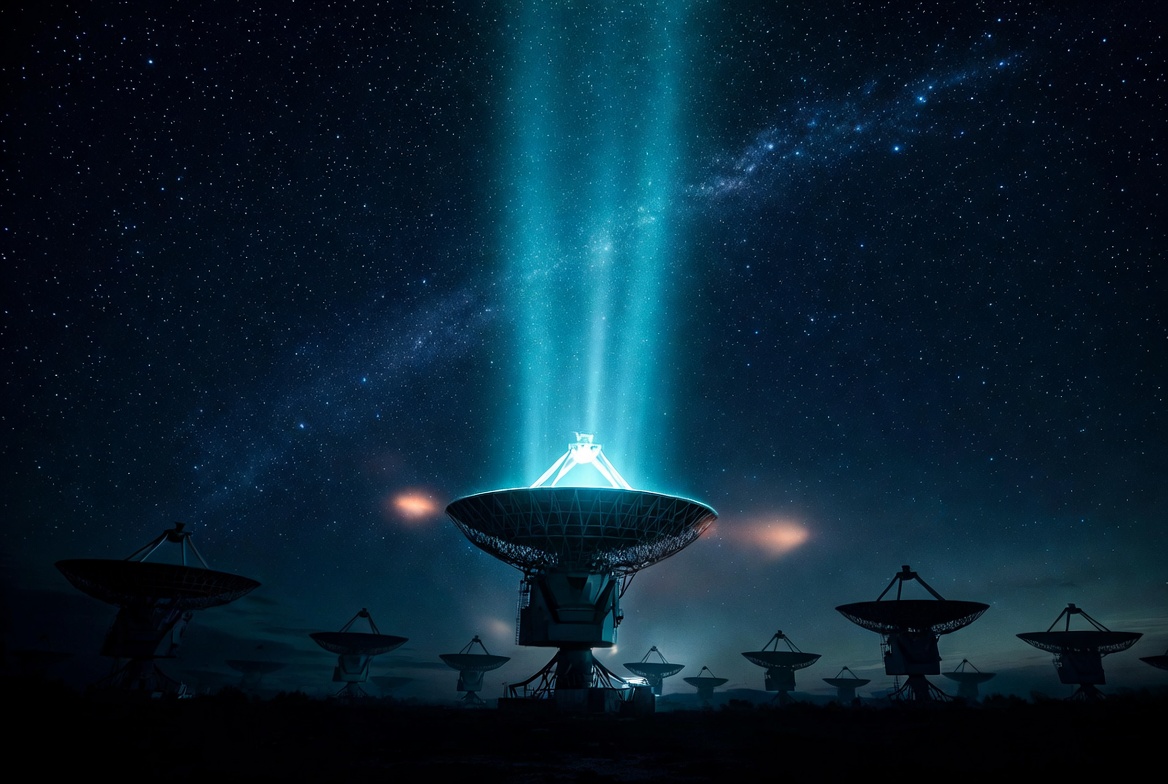
The search for intelligent life beyond Earth is a real scientific program. Radio surveys and related work at places such as the Green Bank Telescope, the Allen Telescope Array, Parkes, and Breakthrough Listen look for signals that do not look natural: narrow radio tones, pulsed beacons, and other technosignatures.
This article asks one question. What if a candidate signal survived the checks that have rejected every previous “signal of interest”?
This is not a prediction. There is still no confirmed evidence of extraterrestrial intelligence. The aim is to separate a verified detection from the movie version of first contact.
What discovery would actually look like
The first detection would probably not be a landing, a translated message, or a ship in orbit.
It would be a persistent unnatural signal. The usual picture is a narrow radio tone that stays fixed on one patch of sky, drifts in a way that fits a rotating planet or spacecraft, and vanishes when the telescope looks away.
That last test is the basic filter. If the same tone is still there when the dish points elsewhere, it is almost certainly interference from Earth: a satellite, a phone, a radar, or a glitch.
Breakthrough Listen’s BLC1 candidate looked interesting until further checks tied it to local interference. The 1977 Wow! signal was strong and brief and has never been seen again. That is why it remains a curiosity, not a confirmed detection.
A realistic “tomorrow” case would start as a candidate, not as proof. Other telescopes, of different designs and in different countries, would have to recover the same source. Until then, responsible teams do not announce first contact.
How a candidate lives or dies
The pipeline is built to kill false alarms.
First, the instrument itself is checked. A bad receiver, a software spike, or a calibration tone can look exotic for a few minutes.
Second comes the on/off test. The telescope stares at the target, then at empty nearby sky. A real sky source should appear only on target. Earth-made radio usually appears in both.
Third, the drift is compared with known junk. Satellites, aircraft, and ground transmitters produce tones that wander in characteristic ways. A signal that matches those patterns is discarded.
Fourth, other dishes look. A second observatory, preferably with different hardware and a different local interference environment, has to recover the same frequency and the same sky position. No candidate in modern SETI has cleanly reached the last green box of that process.
Fifth, archives are searched. If the same tone was sitting in older data from the same site, or if lookalike tones appear at other frequencies in the same session, the odds shift back toward human machinery.
That is the mechanism. Discovery, in this field, is not a feeling. It is a signal that survives a list designed to make it fail.
Distance decides what the discovery even is
Light is slow on these scales. Where the signal comes from changes the story.
If the source were inside the Solar System, the travel time would be minutes to hours. A reply could be sent the same day. That would also be the hardest claim to prove, because Earth’s sky is already full of our own satellites and radios.
If the source were a nearby star, the wait would be longer but still human. Proxima Centauri is about 4.2 light-years away. A message sent today would arrive in a little over four years. Their answer, if they heard us and chose to reply, would take another four years. That is a conversation. It is measured in years, not minutes.
Most detections, if one ever comes, would likely be farther away than the nearest stars. At 50 light-years, a question and answer would take 100 years. At 200 light-years, they would take 400 years.
By then the senders may already be gone. They may never have aimed at Earth. They may not even be able to hear a reply.
That would still count as a discovery. It would not be contact in any ordinary sense.
The word is the same. The event is not. A tone from next door is not the same story as a tone from 200 light-years away.
A tone is not a message
Not every unnatural signal carries information.
A carrier wave is just a clean tone. Finding one that truly came from another civilization would still be historic. It would tell us that something technological emitted radio. It would not give us words, pictures, or instructions.
A structured signal has pattern on top of the tone: pulses, switching, encoding. That would raise a second question. Is the pattern a clock, a call sign, or an attempt to send content? Extracting meaning is not automatic. We do not share a language, a biology, or a culture.
A beacon aimed at Earth is the rarest and loudest case. It would imply they know we are here, or at least that this region of sky is worth lighting up. That still does not tell us what they want.
Physical craft—probes, ships, visits—are a different claim with different evidence. A radio detection does not make them imminent.
Rules that already exist
SETI researchers are not starting from scratch. The International Academy of Astronautics has kept a Declaration of Principles since 1989. It was revised in 2010 and updated again in 2026 for social media, deepfakes, and a 24-hour news cycle.
The main points are simple:
- Verify first, with more than one facility and more than one method. There is no duty to go public while checks are still running.
- If the evidence looks credible, publish it. Tell the scientific community, the public, and the United Nations Secretary-General.
- Do not send a reply on your own. A response, if any, is treated as a decision for a broad international body.
- These rules are guidance among researchers. They are not law. A government, a private operator, or a leak can ignore them.
Article XI of the Outer Space Treaty already tells states to inform the UN Secretary-General of activities in space that bear on other countries. A radio detection is an awkward fit for a treaty written around spacecraft, which is one reason the scientific guidelines keep pointing at the UN anyway.
The first hours and days
Suppose the candidate clears the first filters. It is not in the off-source data. It is not in known interference catalogues. It is not an instrument artifact. It is not a one-off spike.
What follows is slow and official, not cinematic.
Other observatories are asked to look at the same coordinates and frequency. Funding agencies are informed. If the claim still holds, the discoverers are supposed to release the data and the tests they ran.
In 2026 that process would collide with leaked screenshots, fake audio, and unverified posts. The latest protocol update exists largely because a rumor can move faster than a confirmation.
Markets and politics would react to the rumor as much as to the paper. That reaction is not evidence about the signal.
What we would still not know
Even after a clean confirmation, the list of unknowns would be long.
We would not know the senders’ bodies, minds, or lifespan.
We would not know whether they meant to be found.
We would not know whether they can hear us.
We would not know whether the civilization that produced the signal still exists.
We would not know how to talk, or whether talking is wise.
We would not gain new physics, energy systems, or medicine from a tone.
A confirmed detection would answer one question: we are not the only technological process the galaxy has produced, at least at the time the signal left. Almost every other question would remain open.
What would not change overnight
A distant confirmed signal would not rewrite daily life the next morning. Power grids would still run. Harvests would still depend on weather. Governments would still argue about the same budgets.
It would raise money for astronomy and SETI. It would scramble school courses. It would start a long fight over whether silence or a reply is safer.
Those are large cultural effects. They are not an invasion timeline.
What this scenario is not
This is not a claim that a detection is due this year, in ten years, or ever. Surveys of tens of thousands of nearby stars have produced no confirmed technosignature.
That does not prove we are alone. It does mean loud, continuous beacons at the frequencies and powers we can currently see are not common nearby.
The hypothetical only asks what the next steps would be if a candidate finally cleared the bar that BLC1 and Wow! did not. The honest answer is verification, distance, and politics—not a conversation by the weekend.
Closing
If intelligent alien life were “discovered tomorrow,” the discovery would almost certainly be a confirmed unnatural signal at interstellar distance. More than one telescope would have to see it. The announcement would come after checks that most candidates fail.
Existing SETI principles say: publish the evidence, tell the UN, and do not reply until there is an international decision.
That would be a historic scientific result. It would not be first contact in the ordinary sense. Contact needs a channel both sides can use on a human timescale. A delay of decades or centuries is not that channel.
The Earth we woke up on the next day would look the same. The sky would hold a new fact. The argument would be about what, if anything, to send back — and how to keep that fact tied to the data while everyone else treats it as a plot.