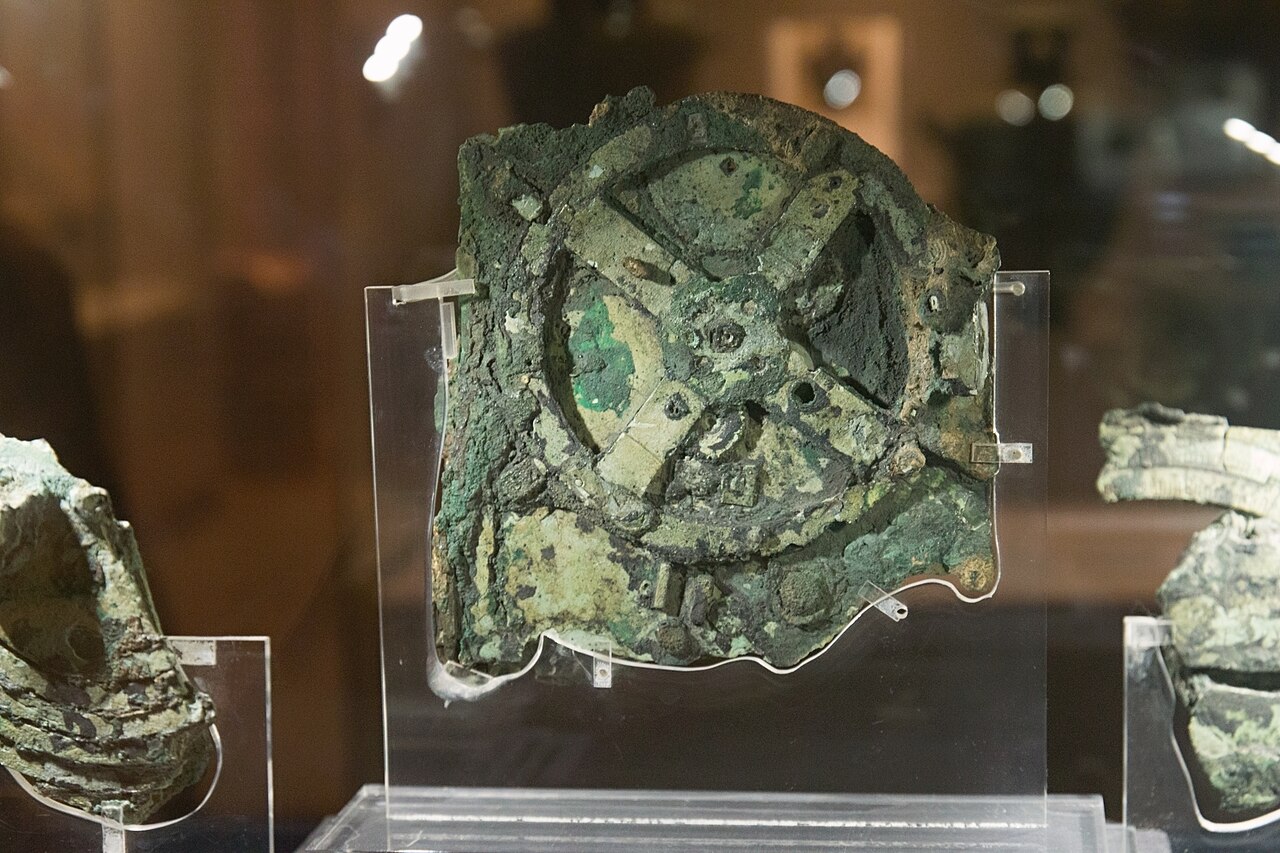
More than 2,000 years ago, someone built a machine capable of predicting eclipses, tracking the movements of celestial bodies, and calculating astronomical cycles using an intricate system of bronze gears. It was so advanced that nothing quite like it would appear again for more than a thousand years.
Then it disappeared beneath the sea.
For nearly two millennia, this extraordinary invention lay hidden in a shipwreck off the coast of Greece. When divers finally recovered it, they had no idea that a corroded lump of bronze would eventually challenge everything historians thought they knew about ancient technology.
Today, it is known as the Antikythera Mechanism, widely regarded as the world’s oldest known analog computer.
A Discovery Beneath the Sea
The story began in 1900, when a group of sponge divers from the Greek island of Symi took shelter from a storm near the small island of Antikythera, between Crete and the Peloponnese.
When the weather cleared, they returned to the water and discovered an ancient shipwreck filled with remarkable cargo. Beneath the seabed were bronze statues, marble sculptures, pottery, amphorae, and other objects from a vessel that had sunk more than 2,000 years earlier.
Among the recovered artifacts was an unremarkable-looking lump of heavily corroded bronze.
It was transported to the National Archaeological Museum in Athens, where it sat largely overlooked until May 1902. That was when archaeologist Spyridon Stais noticed something unusual embedded in the corrosion: a small gear wheel.
What initially appeared to be little more than a damaged piece of metal turned out to be something extraordinary.
Hidden inside the corroded fragments was an intricate mechanical device unlike anything researchers expected to find from the ancient world.
An Ancient Machine That Could Predict the Future
Dating to roughly the second or first century BCE, the Antikythera Mechanism was a hand-operated astronomical calculator. Approximately the size of a shoebox, it was originally enclosed in a wooden case and operated using a hand crank.
Turning the crank moved a complicated arrangement of interlocking bronze gears. Each gear represented a different astronomical cycle, translating mathematical relationships into mechanical movement.
The result was essentially an ancient mechanical computer.
Rather than simply displaying the time, it could calculate and predict events in the sky.
Researchers have identified several functions, including:
The Sun and Moon: Tracking their positions through the zodiac.
Lunar phases: Displaying the changing appearance of the Moon.
Planetary movements: Evidence and modern reconstructions suggest the mechanism included displays for the five planets known to ancient Greek astronomy: Mercury, Venus, Mars, Jupiter, and Saturn.
The Metonic cycle: A 19-year cycle that helps reconcile lunar months with the solar year.
Solar and lunar eclipses: Predicting eclipses using the Babylonian 223-month Saros cycle.
Ancient sporting festivals: Tracking a four-year cycle associated with major Panhellenic games, including the Olympic Games.
The device essentially allowed its operator to turn a crank and see how the heavens would move through time.
For people living more than 2,000 years ago, that was an extraordinary achievement.
The Engineering Was Centuries Ahead of Its Time
What makes the Antikythera Mechanism so remarkable isn’t just what it could calculate. It’s how it accomplished those calculations.
Researchers have identified at least 30 gears among the surviving fragments, although the original machine contained additional components that have since been lost.
These weren’t simple gears thrown together to make something turn. They were carefully designed to represent complex astronomical relationships.
One particularly ingenious feature was a pin-and-slot mechanism used to model the Moon’s irregular motion across the sky. The Moon doesn’t travel around Earth at a perfectly uniform apparent speed, and the ancient designers found a mechanical way to reproduce that variation.
The precision required to manufacture these components was remarkable.
The device also contained inscriptions explaining aspects of its operation, essentially providing instructions for the person using it.
Its front displayed astronomical information, including the zodiac and the movements of celestial bodies. The back featured spiral dials representing longer astronomical cycles, including those used to predict eclipses.
This was sophisticated mechanical engineering combined with an impressive understanding of astronomy and mathematics.
And it was built long before the mechanical clocks and precision instruments that would eventually emerge in medieval and Renaissance Europe.
How Scientists Uncovered Its Secrets
For decades after its discovery, the Antikythera Mechanism remained difficult to understand. Its bronze components were badly corroded, broken into fragments, and partially fused together.
Researchers couldn’t simply take it apart and examine its internal workings.
A major breakthrough came in the 1950s and 1970s, when physicist Derek de Solla Price began investigating the device using X-ray imaging. His work, published in 1974, helped establish that the fragments contained a sophisticated system of interconnected gears.
The investigation advanced considerably in the 2000s.
The Antikythera Mechanism Research Project used high-resolution X-ray computed tomography and advanced imaging techniques to examine the surviving pieces in extraordinary detail.
For the first time, researchers could see hidden gear structures and read inscriptions that had remained concealed inside the corrosion.
Studies published in scientific journals, including Nature, revealed increasingly sophisticated details about the machine’s astronomical calculations, eclipse predictions, and mechanical design.
Modern reconstructions have since demonstrated how its complex gearing could reproduce astronomical cycles.
The more scientists discovered, the more extraordinary the device became.
The Mystery of a Lost Technology
Perhaps the most fascinating question isn’t how the Antikythera Mechanism worked.
It’s why nothing comparable appears to have survived from the ancient world.
The shipwreck itself is generally dated to around 70–60 BCE, based on archaeological evidence, including coins and pottery. The mechanism was likely already decades old when the vessel sank.
It may have been manufactured in a major center of Hellenistic scientific activity, possibly Rhodes, and could have been created for a wealthy patron or someone interested in astronomy.
Ancient writers such as Cicero described elaborate mechanical astronomical devices associated with figures such as Archimedes. These accounts suggest that the Antikythera Mechanism may not have been an entirely isolated invention, even though no other surviving ancient device matches its complexity.
The knowledge required to build such a machine would have demanded skilled metalworkers, mathematical expertise, astronomical observations, and specialized workshops.
Yet the technology appears to have disappeared from the historical record.
The exact reasons remain uncertain. The loss of specialized workshops, the disruption of knowledge networks, and the disappearance of practical technical traditions may all have contributed.
Whatever happened, the result was remarkable: a level of mechanical sophistication that would not become visible again in surviving European technology for many centuries.
It is a reminder that technological progress isn’t always a straight line. Civilizations can develop extraordinary capabilities and then lose the knowledge needed to reproduce them.
Why the Antikythera Mechanism Still Matters
The Antikythera Mechanism changed our understanding of what ancient engineers were capable of achieving.
Before its discovery, historians had little physical evidence of mechanical engineering on this level in the ancient Mediterranean world. The device provided something far more convincing than written descriptions: an actual working concept preserved in bronze.
It demonstrated that ancient Greek scientists and engineers could combine astronomy, mathematics, and precision mechanical construction to create a remarkably sophisticated calculating machine.
Its significance also extends beyond archaeology.
Modern technology depends on accumulated knowledge. Every generation builds upon discoveries, techniques, and ideas passed down by those who came before it. But that knowledge isn’t guaranteed to survive.
The Antikythera Mechanism is a striking example of what can happen when an advanced technology outlives the tradition that created it.
For nearly 2,000 years, it rested on the seabed, its purpose completely forgotten.
When it finally resurfaced, it revealed that the ancient world had achieved something that modern historians could scarcely have imagined.
And it raises an intriguing possibility: if one of history’s most sophisticated inventions was lost beneath the sea for centuries, what other remarkable achievements might still be waiting to be discovered?
SOURCES: Nature, The Antikythera Mechanism Research Project, History.com, World History Encyclopedia, Popular Mechanics.